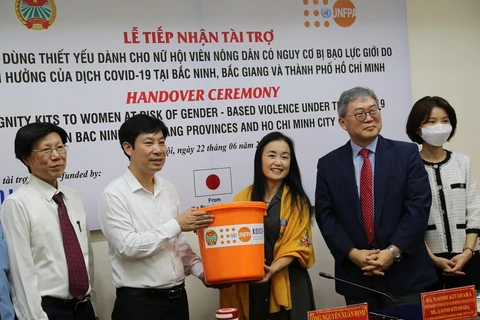
UNFPA Representative in Vietnam Naomi Kitahara (Source: UNFPA Vietnam)
 Hanoi (VNA) - This year, the United Nations Population Fund (UNFPA) marks World Population Day (July 11) with the theme “Rights and Choices are the answer: Whether baby boom or bust, the solution lies in prioritising the reproductive health and rights of all people.”
On the occasion, UNFPA Representative in Vietnam Naomi Kitahara emphasised the impact of the COVID-19 pandemic on the quality of the population in general and that of Vietnam in particular in the following op-ed:
The ongoing COVID-19 pandemic has exposed health care systems globally, highlighting serious gaps and challenges in the provision of sexual and reproductive health information and services. The allocation of resources away from these services is taking a toll on the health of women and girls. At this critical juncture, UNFPA marks World Population Day on July 11 with the theme “Rights and Choices are the answer: Whether baby boom or bust, the solution lies in prioritising the reproductive health and rights of all people.”
While the impact of COVID-19 on mortality and morbidity have been relatively well documented, the impact of the pandemic on human fertility trends, patterns and choices remains less studied.
As of July 9, 2021, there were 26,010 cumulative cases and 110 deaths recorded in Vietnam. While Vietnam has been generally successful in curbing the spread of the virus, even this exemplary country has not been an exception in facing the negative socio-economic consequences of the pandemic just like any other country in the world. And when it comes to the issue of fertility, we will only begin to see the pandemic’s impact in the coming months. As the lead UN agency for the analysis of population dynamics, UNFPA highlights five key dimensions of the pandemic which can impact fertility: high mortality, restricted access to family planning services, increased household burden on women, economic recession and uncertainty, and fewer births attended by skilled medical professionals.
First, with regard to high mortality, we need to recall that in the period 1918-1919, when the so-called Spanish Flu pandemic hit the hardest, we saw a birth deficit after the mortality peaked in many countries. Part of the reason is the compromised sexual and reproductive health status of women including the availability of healthy women giving birth.
Second, family planning supplies and services are often interrupted during the pandemic, particularly in low and middle income countries. In settings where supply and demand-side restrictions impede access to family planning services, there is a real potential for a rise in unintended pregnancies. At global level, UNFPA projected that 47 million women in 114 low and middle income countries may be unable to use modern contraceptives if the average lockdown persists for six months with high levels of COVID-19 related disruptions to health services, causing an additional seven million unintended pregnancies. In Vietnam, it is estimated that in the first quarter of 2020, COVID-19 reduced the utilisation of clinical family planning methods by 20 percent and non-clinical methods by 10 percent in the most disadvantaged areas.
Third, with lockdowns and school closures, students are at home, and parents have to face increasing workloads in housework and childcare. This domestic burden is exacerbated by the decline in the availability of formal and informal childcare services. When COVID-19 further increases the domestic burden on women, in contexts where access to family planning has not been disrupted, individuals and couples may postpone having children at least in the short term.
Fourth, the relationship between the country’s economy and fertility is a well-studied area. Economic recession and uncertainty may encourage couples and individuals to postpone childbearing at least in the short term, and can also work as an obstacle to fertility choices, making it more difficult for couples to realize their ideal family size.
And lastly, the COVID-19 pandemic can prevent pregnant women from delivering babies assisted by qualified medical personnel. Also fear of the pandemic can drive pregnant women not to avail of optimally scheduled antenatal care services, thus making it difficult to identify pregnancy-related risks and morbidity early enough. Child delivery without skilled birth attendance exposes women to heightened risks, thus affecting the outcome of the pregnancy.
In 1994, 179 countries in the world including Vietnam committed to sexual and reproductive health as a key pillar of sustainable development at the International Conference on Population and Development (ICPD) in Cairo. The ICPD principles stipulate that “all couples and individuals have the basic right to decide freely and responsibly the number, timing and spacing of their children and to have the information, education and means to do so (ICPD Programme of Action, para 7.3)”. As a guardian of the ICPD, UNFPA stands firm in reiterating the ICPD principles, and advises all countries, including Vietnam, to safeguard against rolling back on the progress made in expanding and strengthening sexual and reproductive health and rights for all.
The answer in mitigating the negative impacts of COVID-19 is to prioritise sexual and reproductive health and rights by ensuring the continuous provision of crucial information and services for all people even in a crisis or under lockdown, uninterrupted care to pregnant mothers, and the investment of financial and human resources to achieve all of this.
As Vietnam seeks to build back better from the impacts of what the UN Secretary-General has called the biggest global crisis since World War Two, we cannot leave the country’s greatest assets - its women and girls - behind. Getting back on track and achieving the Sustainable Development Goals in this Decade of Action towards the 2030 finish line includes achieving ICPD and its vision of rights and choices for all, with women and girls at the centre./.