Rising middle class pushes wealth management potential in Vietnam

The personal financial assets market in Vietnam is forecast to reach hundreds of billions of US dollars in the next few years, providing significant opportunities for wealth management services.

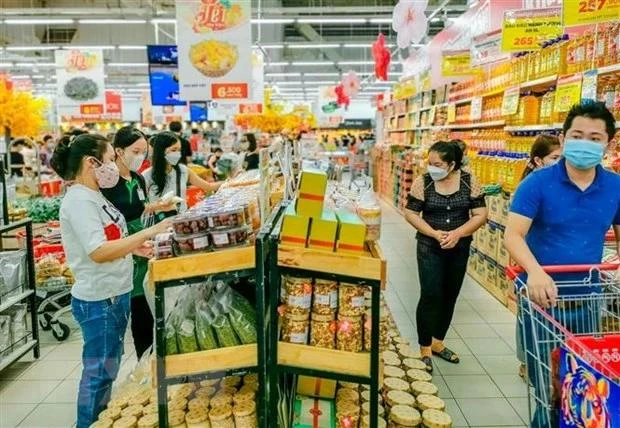
People shop at a supermarket in Hanoi. (Photo: VNA)

Hanoi (VNS/VNA) - The personal financial assets market in Vietnam is forecast to reach hundreds of billions of US dollars in the next few years, providing significant opportunities for wealth management services.

According to insight by McKinsey, the personal financial assets (PFA) market of Vietnam is projected to reach 600 billion USD by 2027, growing at a rate of 11% per year from a baseline of 360 billion USD as of the end of 2022.
Director of AFA Capital Nguyen Minh Tuan estimated that the PFA market could reach thousands of billions of US dollars, if gold and real estate assets were included.

Knight Frank’s Wealth Report from this year predicted that the number of ultra-high-net-worth individuals (UHNWIs) in Vietnam with net assets of 30 billion USD or more will grow to 978 in 2028, meaning an increase of around 30% in the next five years – the fifth fastest growth rate in the Asia-Pacific region, after India (50.1%), China (47%), Turkey (42.9%) and Malaysia (34.6%).

The middle class in Vietnam is expected to account for 26% of the country’s population by 2026, up from 13% in 2023, according to the report by the Ministry of Labour, Invalids and Social Affairs.

The rapid increase of the affluent and middle class generates tremendous opportunities for wealth management services.

In Vietnam, wealth management services providers include commercial banks, securities companies, insurance companies and fintechs, of which banks dominate because of their established and extensive network and diverse products.

However, wealth management services are still in their nascent stages. A large number of individuals are still investing following a crowd psychology, such as buying gold, property or securities, rather than working with wealth management services providers.

According to financial and banking expert Le Xuan Nghia, wealth management should be used from an early stage, first by saving, followed by accumulating and then investing.

Although the rate of people using wealth management services is low, the market potential is huge because Vietnamese individual investors tend to like investing and have a high tolerance to risk taking.
With a population of 100 million people, the wealth management market of Vietnam can top in Southeast Asia in the next decade, Nghia believes.

Currently, most individual investors lack knowledge about personal financial planning – a reason why many lose money and get scammed when investing on their own.

A survey by Vietnam Financial Consultants Association in Hanoi found that 80% of citizens in the capital city can not accurately identify what individual finance is.

Nghia estimated that Vietnamese individuals participating in financial investments currently account for around 7-8% of the country’s population, compared to the rates of 40-80% in many other countries.

Despite its huge potential, the wealth management market in Vietnam remains sluggish due to a lack of a synchronised legal measures, lack of trust and lack of a diversity of products, according to Nghia.

It is critical for wealth management services providers to be professional and offer tailored financial advisory solutions to capitalise on the huge wealth management opportunities in Vietnam. The sector also needs a framework in which to operate in order to grow, for example, policies to encourage individual investors to participate in open-ended funds.

According to Tuan, the number of individuals with assets of 1-5 trillion VND will grow exponentially in Vietnam.

Economist Can Van Luc said that individual finance education should be popularised, even at high school levels./.

VNA

See more

An Phát Complex Industrial Park in Hai Phong City is one of the eco-friendly industrial parks. (Photo: VNA)

Green industrial parks become new magnet for FDI

Statistics show that about 80% of FDI enterprises prioritise investing in industrial parks with green energy infrastructure, reflecting a growing shift in investment preferences amid tightening global environmental standards.

Wood panel production at the Thuan An Wood JSC in Ho Chi Minh City (Photo: VNA)

Vietnamese businesses ride wave of investment in green manufacturing

Recent developments in private investment show that as confidence in the private sector has grown and is a key driver of economic development, investors are strengthening support for enterprises not only through capital but also management expertise and market connectivity.

Officers and soldiers of Son Tra Border Guard Station, Da Nang City Border Guard Command tell local fishermen about IUU fishing. (Photo: VNA)

Fishing solidarity groups help Vietnam with IUU “yellow card” warning removal

Over the years, coastal authorities in Da Nang have intensified efforts to educate fishermen about regulations, particularly the need to avoid illegal fishing in foreign waters. Local administrations and competent forces have also strengthened vessel registration and inspection procedures, installed vessel monitoring systems and ensured transparent declarations of catches at ports.

Representatives of Central Retail Vietnam and Lotte Plaza Market sign a distribution cooperation agreement at the networking event in Ho Chi Minh City on March 13. (Photo: VNA)

Vietnamese firms step up cooperation with international distribution chains

Connecting Vietnamese businesses with international distribution networks has been a key component of government-led trade promotion programmes for many years, which are designed to help domestic companies place goods directly into global retail systems rather than exporting solely through intermediaries.

Direct Hanoi–Amsterdam flights by Vietnam Airlines to begin on June 16. (Photo: Vietnam Airlines)

Vietnam Airlines to launch direct Hanoi–Amsterdam service on June 16

Under the plan, the Hanoi–Amsterdam route will commence operations on June 16, 2026, with an expected frequency of three return flights per week using modern wide-body Airbus A350 aircraft. This will be the first direct air link between Vietnam and the Netherlands, helping to shorten travel time and enhance connectivity between Vietnam and one of Europe’s key economic, logistics and aviation transit hubs.

Farmers harvest the 2025 Winter–Spring rice crop in An Giang province. (Photo: VNA)

An Giang accelerates export shift to meet green consumption trends

To enhance competitiveness, authorities are assisting businesses in obtaining globally recognised certifications such as GlobalG.A.P., Organic and HACCP, enabling key exports including rice, seafood and clean agricultural products to strengthen their position in global markets, according to Quang Xuan Lua, Director of the An Giang Centre for Trade and Investment Promotion.

Motorcycle riders refill their vehicles at a petrol station in Hanoi (Photo: VNA)

E5 RON92 biofuel price falls in latest adjustment

Since the beginning of this year, domestic fuel prices have undergone 14 adjustments, including five decreases and nine increases for RON95 and six declines and eight hikes for E5 RON92. Meanwhile, diesel price has fallen three times and risen 11 times.

A French customer is tasting Vietnamese lychee. (Photo: VNA)

Vietnamese agricultural products boost global brand recognition

Vietnam aims to achieve about 74 billion USD in agro-forestry-fishery export turnover this year. Expanding value-added products, improving quality standards and strengthening brand building, especially through international supermarket systems, will be key to enhancing the competitiveness and global recognition of Vietnamese agricultural products.

An apartment building developed by BCONS in Binh Duong (Photo: VNA)

Resolution 68 boosts businesses entering market

By the end of 2025, Vietnam had more than one million active enterprises. In the first two months of 2026, about 64,500 enterprises entered or re-entered the market, up 29.4% year-on-year, averaging 32,200 newly established or returning businesses per month.

A Vinh Long official introduces signature local products to Korean guests. (Photo: VNA)

Vinh Long courts Korean investment in key sectors

Vice Chairman of the provincial People’s Committee Nguyen Truc Son vowed to accompany investors and provide them with optimal conditions, while building a transparent and stable business environment to secure long-term engagement from foreign enterprises, particularly those from Daejeon.

Delegates at the launching ceremony (Photo: VNA)

Digital platform on overseas market development launched

With Vietnam’s network of 64 trade offices overseas, Deputy PM Son noted that connecting them through a modern digital platform could help establish a unified national trade information system that operates efficiently, transparently and with strong forecasting capacity.