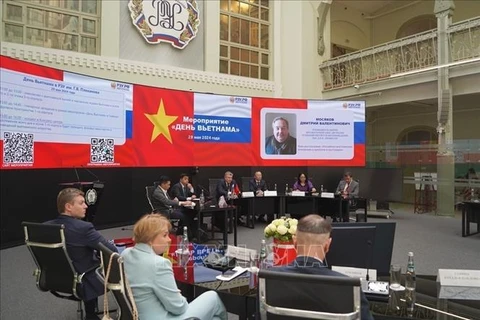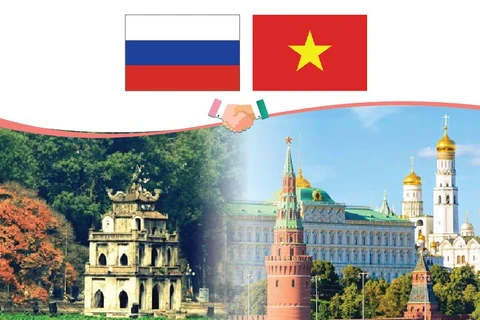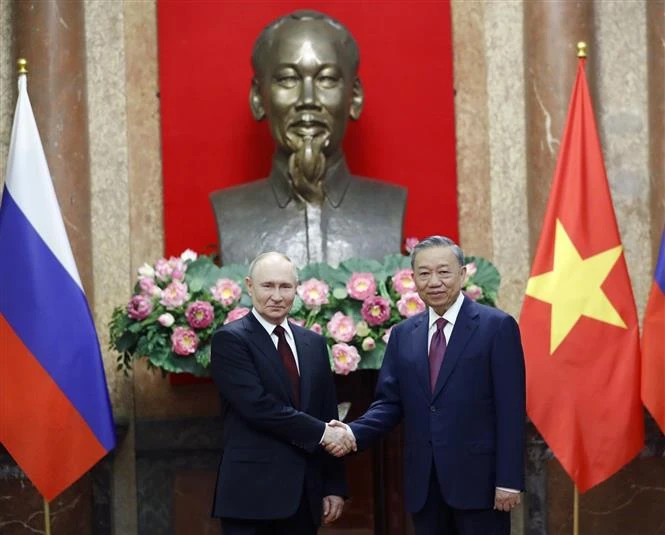
Hanoi (VNA) – On the occasion of his state visit to Vietnam from June 19-20, Russian President Vladimir Putin sent an article on the history, current status and future of the Russia-Vietnam partnership to Nhan dan (People) newspaper for publication.
In the article, the Russian leader highlighted the role of President Ho Chi Minh in initiating the relations between the two countries, noting that last year, a statue of the late Vietnamese leader was inaugurated in St. Petersburg to mark the 100th anniversary of President Ho Chi Minh’s visit to the “northern capital” of Russia.
Reviewing Russia’s support to Vietnam during the country’s struggle for independence and national construction, President Putin said that the time-tested comradeship and mutual support have served as a solid foundation for the two sides to continue strengthening the bilateral comprehensive strategic partnership.
Noting that Vietnam is a long-standing, brilliant and independent civilisation in the panorama of a multipolar world, which is pursuing an external policy of independence and strongly supports a fair world order based on international law, and principles of equality among states and not interfering into each other’s internal affairs, President Putin said he highly values the two countries’ similar approach to urgent and important issues on the international agenda. The two countries have coordinated closely at key multilateral forums, first of all the United Nations, stated the Russian leader. Russia and Vietnam have shared similar assessments on the Asia-Pacific situation, President Putin wrote, adding that the two countries have similar views on building a new Eurasian security structure that is equal, non-separated, inclusive and non-discriminatory.
President Putin cited Russia’s data showing that trade between Russia and Vietnam rose by 8% year-on-year in 2023 and by more than one third in the first quarter of this year. Russian food, mineral raw materials, machinery and equipment have been exported to Vietnam, while many Vietnamese goods, including clothes, fruits, vegetables and other agricultural products, have reached consumers in the Russian market. The free trade agreement that Vietnam and the Eurasian Economic Union (EAEU), signed in 2015, has created favourable conditions for the two sides to reinforce and promote these positive trends, he held.
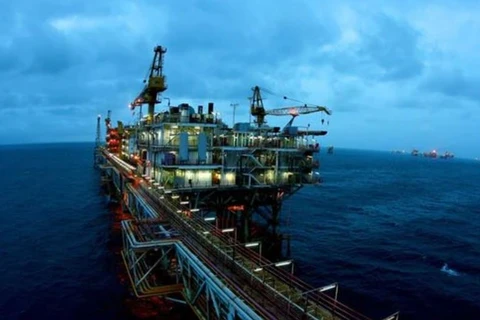
He affirmed that energy has been an area with strategic importance in bilateral cooperation. Vietsovpetro joint venture has been exploiting mines on the Vietnamese continental shelf for more than four decades and has shown high efficiency. The volume of oil produced by Vietsovpetro in recent years has exceeded 250 million tonnes. Another joint venture, Rusvietpetro, founded in 2008, is also successfully operating in the Nenets Autonomous Region of Russia. In the difficult conditions of the Arctic region, Rusvietpetro has drilled more than 35 million tonnes of oil from deep underground. Gazprom Group is exploiting gas in Vietnam, while another large Russian company, Novatek, plans to deploy liquefied natural gas (LNG) projects in the Vietnamese territory, he noted.
Currently, the two sides are working on the establishment of a nuclear science and technology centre in Vietnam with support from Russia's Rosatom State Atomic Energy Corporation. Rosatom is always ready to support Vietnamese partners in building the national atomic energy industry, including enhancing human resources training, he underscored.
Hydropower is also another traditional area of cooperation between Russia and Vietnam, he said, adding that Russian company RusHydro is interested in participating in the reconstruction and increasing the capacity of hydroelectric projects on Vietnamese rivers.
In Vietnam's central city of Da Nang, GAZ - Thanh Dat joint venture is implementing automobile assembly activities under the Russian brand GAZ, the Russian President noted.
Russia hopes that Vietnamese investors will also be more active in taking advantage of the great opportunities in the Russian market, he wrote.
The Russian leader also mentioned the sound bilateral collaboration in education, revealing that Russia will pay special attention to this cooperation area, including training Vietnamese citizens in Russian universities using the federal budget.
He also showed Russia’s interest in expanding partnership with Vietnam in the fields of humanity and tourism, including the increasing of direct flights between the two countries.
“Together with our Vietnamese friends, we will continue to build bilateral relations and develop cooperation for the benefit of the two peoples, for stability and prosperity in the region and around the world. And I believe that our two countries, on the basis of the fine traditional friendship, trust and mutual support, will achieve all the major set goals,” the Russian President concluded, wishing Vietnamese people peace, happiness and prosperity./.