Vietnam, Russia eye stronger partnership in training high-quality human resources

The ongoing state visit by Russian President Vladimir Putin to Vietnam and the expected signing of a new agreement on higher education cooperation between the two countries are expected to create a strong impetus to step up bilateral educational cooperation, said an official from the Ministry of Education and Training (MoET).

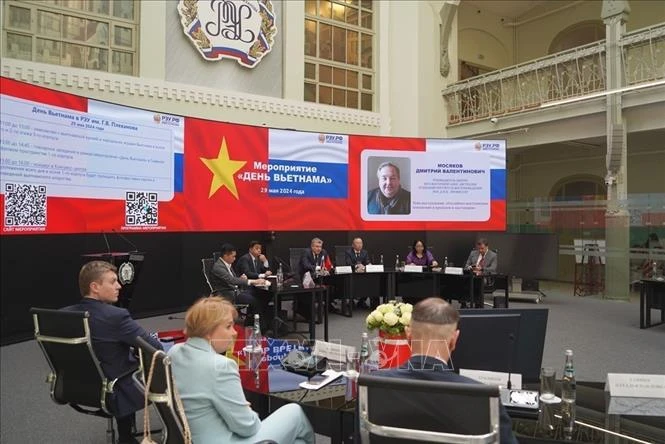
Conference "Vietnam Day" at Plekhanov Russian University of Economics of Russia on May 29, 2024 (Photo: VNA)

Hanoi (VNA) - The ongoing state visit by Russian President Vladimir Putin to Vietnam and the expected signing of a new agreement on higher education cooperation between the two countries are expected to create a strong impetus to step up bilateral educational cooperation, said an official from the Ministry of Education and Training (MoET).

Pham Quang Hung, Director of the ministry's International Cooperation Department, said that cooperation in training high-quality human resources between the two countries remains a top priority for Vietnam, adding that Russia remains a reliable destination for sending students for training, especially in basic sciences, engineering, new technologies, energy, digital technology, artificial intelligence, marine science, and arts.

Vietnam and Russia have implemented many cooperative ideas in the field of education and training, with priority given to training high-level human resources.

On the basis of a long-standing and close traditional relationship, the education and training cooperation between the two countries has always been seen as a bright spot in bilateral relations.

The former Soviet Union and Russia today have helped Vietnam train nearly 70,000 scientific and technical personnel, managers, and skilled technical workers over the last 75 years, with many of them having held important leadership positions in the Party, State, Government, National Assembly, State agencies, grassroots organisations, universities, and scientific research institutes.

The intellectual workforce trained in Russia has always been an important source of manpower with advanced working methods, significantly contributing to Vietnam’s national construction and serving as a solid and enduring bridge of friendship between the two peoples.

Since 2021, Russia has provided Vietnam with 1,000 scholarships, lifting the number of Vietnamese citizens trained in the country to dozens of thousands.

According to the MoET, over the past decade, along with human resources training efforts, cooperation between Vietnamese and Russian universities has been promoted with substantial developments, with hundreds of cooperation agreements signed between higher education institutions.

Vietnam and Russia currently maintain a mechanism to rotationally organise a forum of rectors of Russian and Vietnamese universities.

The 2nd forum of this kind took place in April this year in Moscow with the participation of representatives from 21 Vietnamese higher education institutions and 40 Russian universities, offering a chance to discuss ways to expand higher education cooperation, contributing to concretising and more effectively realising commitments to education and training cooperation signed between the two countries, and promoting academic exchange activities. At the event, about 30 cooperation documents between universities were signed.

In 2023, the two countries established networks of universities specialising in engineering, and information technology – telecommunications as an initiative to intensify bilateral cooperation between their top engineering universities, providing impetus for them to engage deeply in collaborative efforts in training high-level human resources and conducting joint research to serve the training and socio-economic development tasks of each nation.

Hung said the two sides will continue to explore and implement various cooperative activities in line with the Vietnam - Russia Comprehensive Strategic Partnership, focusing on upgrading the Pushkin Sub-Institute in Vietnam to a Pushkin Centre with investment from Russia, aiming to enhance Russian language teaching and popularise the Russian culture in Vietnam and regional countries.

Efforts will be made to encourage reputable Russian universities to partner with Vietnamese ones in joint training and science research cooperation programmes in Vietnam, he added./.

VNA

See more

Brocade weaving is a cultural lifeblood for the Khmer community in the Bay Nui (seven-mountain) area of An Giang. (Photo: VNA)

Khmer brocade weaving helps drive heritage-based economic development

Nestled at the foot of the majestic That Son mountain range, Van Giao - the brocade weaving village of Khmer people in An Cu commune, An Giang province - is not only a repository of centuries-old cultural heritage but is also emerging as a model for heritage-based economic development.

People and vehicles travel across the Lo river pontoon bridge on the morning of February 16. (Photo: VNA)

PM commends units for constructing pontoon bridge to serve Tet travel demand

Prime Minister Pham Minh Chinh on February 16 sent a letter commending the determination and strong sense of responsibility of agencies and units in urgently building a pontoon bridge across the Lo river in Phu Tho province to promptly serve people’s travel demand during the Lunar New Year (Tet) 2026.

Prime Minister Pham Minh Chinh visits and extends Lunar New Year greetings to a patient undergoing treatment at Bach Mai Hospital. (Photo: VNA)

PM extends best wishes to doctors, patients on Tet occasion

Prime Minister Pham Minh Chinh visited and extended Tet greetings to medical staff and patients at Bach Mai Hospital and Viet Duc University Hospital in Hanoi while inspecting healthcare services during the holiday at these two leading central hospitals on February 16, or the last day of the Year of the Snake.

The Van Mieu-Quoc Tu Giam heritage site in Hanoi remains a major attraction for large numbers of visitors during the early days of spring. (Photo: VNA)

Hanoi offers free parking, public transport during Lunar New Year

During Tet, Hanoi offers free parking at selected schools and locations surrounding central heritage sites. In addition, single-journey fares are waived on the Cat Linh–Ha Dong and Nhon–Hanoi Station metro lines, while subsidised public bus services across the city are operating free of charge during the holiday period.

President Luong Cuong, his spouse, delegates and artists at the special Spring Homeland Art Programme 2026. (Photo: VNA)

Five major shifts chart overseas Vietnamese affairs in 2026 and beyond

In a world marked by intensifying strategic competition, emerging conflicts and intertwined economic, security and social challenges, nearly 6.5 million Vietnamese living in over 130 countries and territories have continued to look to the homeland as a firm spiritual anchor. The homeland remains a source of confidence, connection and aspiration for Vietnamese abroad.

Vietnamese Ambassador to Cuba Le Quang Long (right) symbolically hands over 250 tonnes of rice to Cuban Deputy Minister of Agriculture Telce Abdel González (Photo: VNA)

Vietnam supports Cuba in ensuring food security

Cuban Deputy Minister of Agriculture Telce Abdel González affirmed that Cuba will create all favourable conditions for AgriVMA’s rice production project in Los Palacios district, Pinar del Río province, with a view to expanding the model to other localities across the country.

The Binh Phuoc provincial Intelligent Operations Center (IOC), operational since September 2020, has played an important role in supporting the development of digital government. (Photo: VNA)

Breakthroughs under Resolution 57 drive local development

Following the Politburo’s Resolution No. 57-NQ/TW on advancing science, technology, innovation and national digital transformation, many localities across Vietnam are translating strategic guidelines into concrete action, laying the foundation for a new development model based on knowledge, technology and modern governance.