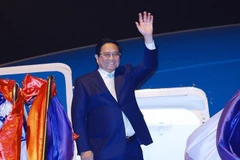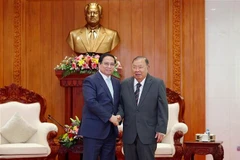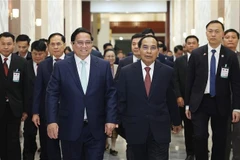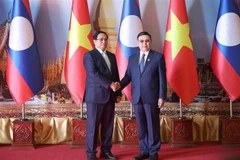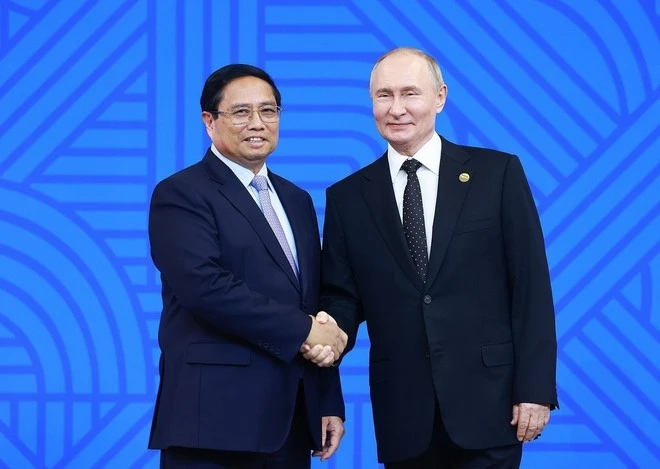
Hanoi (VNA) - Russian Prime Minister Mikhail Vladimirovich Mishustin's official visit to Vietnam from January 14-15 at the invitation of his Vietnamese counterpart Pham Minh Chinh is expected to continue strengthening the relationship between the two countries, making it more effective, towards a better future.
Deepening Vietnam-Russia Comprehensive Strategic Partnership
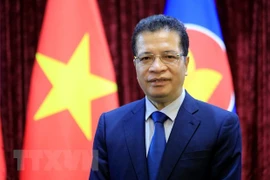
Vietnamese Ambassador to Russia Dang Minh Khoi said that the trip is of great significance, as it takes place in the context that the two countries just celebrated the 30th anniversary of the signing of the Treaty on Basic Principles of Friendly Relations (June 16, 1994 - 2024) and are looking forward to the 75th anniversary of the establishment of their diplomatic relations (January 30, 1950 - 2025).
This is the first visit of Prime Minister Mishustin to Vietnam, aimed at strengthening the Vietnam-Russia Comprehensive Strategic Partnership and preparing for important activities in the bilateral relationship this year.
It demonstrates that both countries value their traditional friendship and are committed to further consolidating and enhancing the Comprehensive Strategic Partnership, Khoi stated, adding that Russia has affirmed Vietnam as a reliable partner and an important priority in its “Look East” policy, while Vietnam consistently regards Russia as one of top priorities in its foreign policy.
The trip reaffirms the strong commitment of both sides to maintaining and advancing the comprehensive strategic partnership, making it more intensive, substantive, and effective. It will also provide an opportunity for Vietnamese and Russian leaders to discuss, and reach consensus on important issues, while outlining future strategic orientations, and clearly defining key areas of cooperation, spanning from economy, trade, energy, and science -technology, to education, culture, and defence-security, Khoi stressed.
The two sides will look into existing obstacles to bilateral cooperation and progress on key cooperative projects in energy, industry, and other fields. They will also map out solutions to expand cooperation in potential areas, creating momentum to further foster the bilateral relations.
Looking back on the bilateral relations over the past 75 years, the diplomat said that the exchange of high-level delegations has played a crucial role, offering opportunities for the two sides to discuss strategic directions and long-term goals of their relationship, and to resolve existing challenges to the bilateral cooperation through the strong political commitment and decisive directions of high-ranking leaders during their visits.
He pointed out the immense potential and ample room for the relations to grow stronger and more intensively in the time ahead, adding that bilateral cooperation mechanisms such as the Inter-Parliamentary Cooperation Committee, the inter-governmental committees on economic, trade, and scientific-technical cooperation, as well as military and technical collaboration, and the Vietnam-Russia Committee on Educational, Scientific and Technological Cooperation will play a significant role in driving this progress.
With the political will of leaders and the unwavering determination of the people of the two nations, 2025 will mark the beginning of a new phase in the comprehensive cooperation between Vietnam and Russia, he emphasised.
Over seven decades of traditional and strong relationship between Vietnamese and Russian peoples
The former Soviet Union, now Russia, was one of the first countries in the world to recognise and officially establish diplomatic relations with Vietnam on January 30, 1950, laying the foundation for the strong friendship and fine cooperation between the two countries in the years to come.
The bilateral relationship entered a new stage of development after the signing of the Treaty on Basic Principles of Friendly Relations in 1994. To this day, the leaders of both countries continue to affirm that it is a historic document of great significance, symbolising the beginning of a new phase in the multifaceted cooperation, and laying the groundwork for upgrading their relationship to a Comprehensive Strategic Partnership.
The framework of bilateral relations in the 21st century has been continuously elevated through key milestones: the establishment of a Strategic Partnership in 2001; the upgrade to a Comprehensive Strategic Partnership in 2012; the signing of the Joint Statement on the Vision for the Comprehensive Strategic Partnership by 2030 in 2021; and in June 2024, the signing of the Joint Statement on deepening their comprehensive strategic partnership, building on the achievements of the three-decade implementation of their Treaty on Principles of Friendly Relations.
These milestones hold significant importance, marking the development of the bilateral relationship and demonstrating the determination of their leaders and peoples to make bilateral cooperation increasingly effective and substantive across all areas, thus meeting the needs and interests of the two countries' people, and contributing to peace, cooperation, and development in the region and the world.
Based on the strong friendship between the leaders and people of the two countries, the political relationship is highly trustworthy, with frequent exchanges of delegations and contacts at all levels. This creates a strong momentum for bilateral comprehensive cooperation.
In addition to high-level visits and contacts, the two countries have maintained the mechanism of the Intergovernmental Committee on Economic-Trade and Scientific-Technological Cooperation; and cooperated closely at multilateral forums and international organisations such as the United Nations, the Asia-Pacific Economic Cooperation (APEC), the Asia-Europe Meeting (ASEM), the ASEAN Regional Forum (ARF), and the Conference on Interaction and Confidence-Building Measures in Asia (CICA), among others.
Bilateral trade has grown rapidly, particularly since the Free Trade Agreement between Vietnam and the Eurasian Economic Union officially came into effect in October 2016. Two-way trade increased from 3.63 billion USD in 2023 to 4.57 billion USD last year.
As of November 2024, Russia had 199 investment projects in Vietnam with a total registered capital of approximately 990 million USD, ranking 26th out of 147 countries and territories investing in Vietnam. On the other hand, Vietnam had 16 valid investment projects in Russia with a total registered capital of 1.6 billion USD, ranking 4th out of 81 countries and territories investing in Russia.
There are currently around 60,000 Vietnamese people living in Russia. They have made contributions to both the homeland and the host country as well as their traditional friendship./.