Shortage of textbooks, facilities affect teaching in new school year

The 2022-23 school year is the third year that the entire education and training sector has deployed the 2018 general education programme as part of the national education reform strategy.
Shortage of textbooks, facilities affect teaching in new school year ảnh 1A textbook section in a book shop in HCM City. (Photo: VNA)
Hanoi (VNS/VNA) - The 2022-23 school year is thethird year that the entire education and training sector has deployed the 2018general education programme as part of the national education reformstrategy. 

The school year has begun. But a shortage of textbooks, teachers and facilitiesremains in many localities, the national radio broadcaster Voice ofVietnam reports. 

This problem affects not only the progress but also the effectiveness of thenew education programme. 

In particular, a lack of 10th grade textbooks in the first year ofimplementation of the new curriculum at the high school level is causingmany difficulties for both teachers and students.

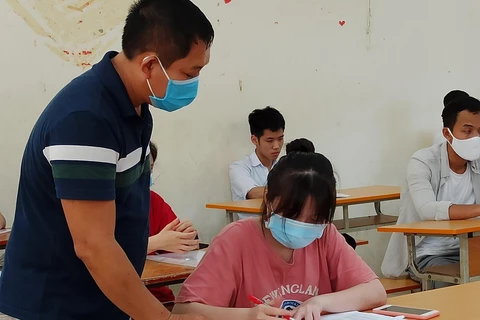
Students at Hoang Van Thu High School of Hanoi’s Hoang Mai district stilldon't have enough textbooks to study. 

Preparing for the new school year, students have registered to buy textbooks atthe school. But publishing houses and textbook suppliers have so far failed tosupply enough textbooks for students.

"The school has informed students and their families of the lack of atextbook for one subject in the new programme, adding that the school will giveit to students as soon as the textbook is available from the supplier. I alsodon't know when the students will have enough books to study," Nguyen KimOanh, mother of a 10th grader, told Vietnam News. "I have looked atmy child's 10th grade textbook set. It is quite interesting. The content of thetextbook has many innovations and is closer to reality."

The new curriculum and the shortage of textbooks have caused difficulties forstudents.

Nguyen Phuong Anh, a 10th grader, said, "students have a bit of aproblem studying because we have not received the textbooks for the newsubject, Economic and Legal Education. However, the teacher who teaches thissubject already has a textbook and also tries to make it easy for us tounderstand. Learning in class will be easier if we have the book. We can readand see illustration photos and can prepare lessons at home before going toclass."

In some schools, teachers are temporarily using e-books provided by theMinistry of Education and Training (MoET) to teach their students.

Students face difficulties learning while teachers facedifficulties teaching. 

Many teachers say that there are no textbooks so students cannotprepare lessons at home, and they will not be able to review and dohomework after studying, affecting the quality of teaching and learning andfailing to promote students' self-study and self-research skills according tothe goals of the new programme.

HCM City Department of Education and Training has reported that it is stilllacking 7,053 sets of textbooks under the 2018 National Education Programme. 

The department has worked with publishers to ensure enough textbooks forstudents. 

It was expected that students would have enough textbooks before September 16.

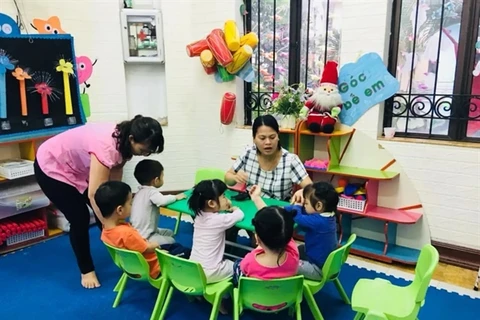
Along with difficulties in teaching and learning due to the shortage oftextbooks, a lack of teachers and degraded facilities and teachingequipment are also problems at many schools. 

Teachers and students face many difficulties in subjects that needexperimentation and practice.

Nguyen Van Ngoc, Principal of Thuan My Secondary School in Hanoi,said, "the school still does not have enough equipment for the newcurriculum and has asked the Department of Education to supply more."

In Hoa Binh province, some schools have built classrooms but do not haveequipment, while some schools have classrooms and practical equipment, but donot have teachers to teach those subjects. 

Ngan Thi Lam, Principal of Hang Kia A Primary and Secondary School,said, "the classroom for informatics has been built. However, thereare not enough computers for students."

Xa Van Che, head of Muong Chieng Primary School in Hoa Binh province said theschool had English teachers but didn't have informatics teachers.

At the secondary level, many teachers have to teach two or three subjectsat the same time. They have participated in refresher courses to add newsubject knowledge but the transition from single subject teaching to integratedones requires teachers to make more effort and self-study to be ableto teach according to the requirements of the new curriculum.

At this time, educational institutions across the country are forced toorganise teaching and learning according to their actual conditions.

Assoc. Dr. Nguyen Xuan Thanh, director of the Secondary EducationDepartment under MoET, said the ministry had known about the lack oftextbooks in a few localities. The Ministry would ask the Department ofEducation and Training and publishers to work closely to ensure enoughtextbooks for students, especially in localities such as HCM City./.
VNA
See more

Quang Ninh's seaport infrastructure, including the Ha Long International Cruise Port, is capable of serving large cruise ships. (Photo: VNA)

Quang Ninh 2030: Ambitious targets for a breakthrough

These objectives reflect the principle that economic development must not become detached from living standards; rather, the benefits of growth should create opportunities for all residents to share in its achievements.

A police officer guides a citizen on how to use VNeID app. (Photo: VNA)

Shift to data-driven administrative procedures needs acceleration

Under a draft decree replacing Decree 63, authorities will have to proactively pull information from databases and records for informational or technical procedures. Applicants would no longer be required to resubmit documents, and certification or information requests could not be turned into discretionary licensing through an “ask – give” mechanism.

Cuban journalist Luis Manuel Arce Isaac, author of the article published in Mexico’s Voces del Periodista magazine. (Photo: Screenshot/VNA)

Mexican journalist praises Vietnam’s profound transformation

According to the article, Vietnam’s progress over the past decades has turned President Ho Chi Minh’s aspiration for a country that would be more dignified and more beautiful into reality in ways that have far exceeded what was initially envisioned.

The Liaison Board of the Vietnamese Community in Singapore organises the annual Mid-Autumn Festival to strengthen community bonds and spread Vietnamese language and culture. (Photo: VNA)

Continued efforts made to nurture love for homeland through mother tongue

From language classrooms and community activities to digital platforms, Vietnamese is being preserved through increasingly diverse approaches. More than a means of communication, the mother tongue carries memories, culture and affection for the homeland. Ensuring that Vietnamese remains naturally present in the daily lives of overseas Vietnamese is therefore an important way to nurture their lasting bond with the Fatherland.

Deputy General Director of the Vietnam News Agency Doan Thi Tuyet Nhung (fifth, right) and representatives of regional news agencies and media organisations attend the launch of the Asia-Pacific Media Partnership Organising Committee at the Asia-Pacific Media Forum. (Photo: VNA)

VNA attends Asia-Pacific Media Forum in Shenzhen

Participants in the forum highlighted the need to increase coverage of the region's rapid opening-up and integration, provide comprehensive information on the progress and achievements of cooperation among economies across various fields, and help create a favourable environment for regional development.

Ngo Phuong Ly (right), the spouse of General Secretary of the Communist Party of Vietnam Central Committee and President To Lam, and Kyu Kyu Hla, the spouse of Myanmar President Min Aung Hlaing, visit Van Phuc silk village on September 5. (Photo: VNA)

First ladies of Vietnam, Myanmar visit Van Phuc silk village

Ngo Phuong Ly, the spouse of General Secretary of the Communist Party of Vietnam Central Committee and President To Lam, said the two countries share similarities in silk weaving and can enrich their cultural heritage through exchanges and experience sharing.

Prime Minister Le Minh Hung join students and teachers of the Muong Khuong Inter-level Primary and Secondary Boarding School, Lao Cai province, in the opening ceremony of the 2026–2027 academic year on September 5. (Photo: VNA)

PM urges substantive education reform in 2026–2027 school year

PM Le Minh Hung called on the education sector to continue making strong changes in management mindset and teaching methods, putting learners at the centre, and viewing schools as the foundation, teachers as the driving force, families as a source of support and society as a resource accompanying education development.

General Secretary of the Communist Party of Vietnam Central Committee and President To Lam (Photo: VNA)

Top leader extends message to education sector on new school year

Party General Secretary and President To Lam expressed confidence that with the nation’s traditional fondness for learning, the dedication of teachers and the aspirations of the younger generation, the 2026–2027 academic year will open a new chapter of progress for the country’s education sector.

Students attend the opening ceremony for the 2026–2027 academic year at the primary school campus of the Gia Quat Primary and Secondary School in Hanoi on September 5, 2026. (Photo: VNA)

Students across Vietnam begin 2026–2027 academic year

This milestone school year marks a pivotal transition from laying the groundwork for reform to delivering substantive changes as the country pushes ahead with implementing Politburo Resolution No. 71-NQ/TW on breakthroughs in education and training development.