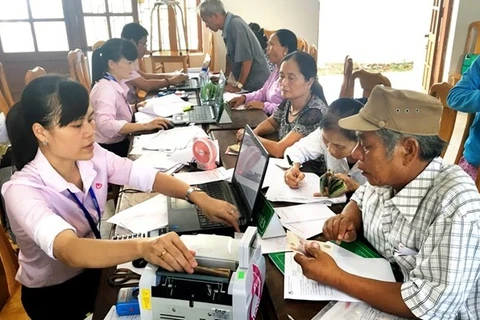
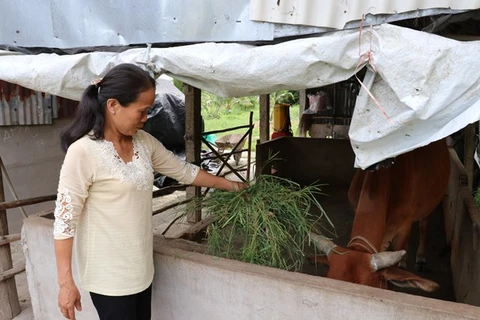
People attend the workshop on the role of social policy credit in ensuring the livelihood and development of people. (Photo: VNA)
 Hanoi (VNA) – The Ho Chi Minh National Academy of Politics (HCMA) and the Bank for Social Policies on August 16 co-organised a workshop on the role of social policy credit in ensuring the livelihood and development of people, especially the poor and other social policy beneficiaries.
Speaking at the workshop, HCMA President and Chairman of the Central Theory Council Prof. Dr. Nguyen Xuan Thang said that social policy credit is a unique and humane policy that has become one of the pillars in the system of policies on poverty reduction, social security and social welfare in Vietnam.
Social policy credit suits the reality and development conditions in Vietnam, meeting the aspirations of the people, especially low-income earners who are not eligible for loans from commercial banks, he said.
 HCMA President and Chairman of the Central Theory Council Prof. Dr. Nguyen Xuan Thang speaks at the event. (Photo: VNA)
 Thang affirmed that the provision of social policy credit has produced practical results, helping create more jobs and livelihoods for beneficiaries, improve people's lives, promote gender equality, and at the same time contributing to preventing loan sharking and black credit, especially in rural, remote, border and ethnic minority areas.
Social policy credit programmes have provided important resources for the implementation of national target programmes such as the building of new-style rural areas, sustainable poverty reduction, and socio-economic development in ethnic minorities areas and mountainous areas, he said.
The official held that social policy credit and commercial credit are two parallel and complementary financial channels with unique characteristics of a socialist-oriented market economy, emphasing that both contribute to promoting sustainable economic growth and social developments. Most notably, Vietnam's poverty rate reduced from nearly 60% in the 1990s to 4.3% in 2022.
According to the General Director of the Bank for Social Policies, Duong Quyet Thang, by the end of July 31, 2023, the bank's total capital surpassed 324.75 trillion VND (13.56 billion USD), its total outstanding loans under policy credit programmes topped 305.145 trillion VND, with more than 6.6 million poor households and policy beneficiaries getting loans.
The bank’s average annual growth rate is about 19%. Along with the growth of credit scale, the quality of social policy credit continues to be improved. Overdue and frozen debts account for just 0.62% of the total outstanding loans.
Over the past 20 years, nearly 44.3 million social policy loans have been provided to poor households and policy beneficiaries, helping more than 6.5 million households escape poverty and creating jobs for over 6.2 million labourers.
Thanks to the preferential credit, more than 6.5 million households escaped from poverty, and more than 6.2 million workers got jobs.
Participants to the workshop pointed out the difficulties and inadequacies in the implementation of social policy credit, resources for implementation and structure of capital sources. They also analyzed and evaluated the system of current legal regulations, mechanisms and policies on social policy credit as well as proposed measures to improve the effectiveness and efficiency of the Bank for Social Policies./.