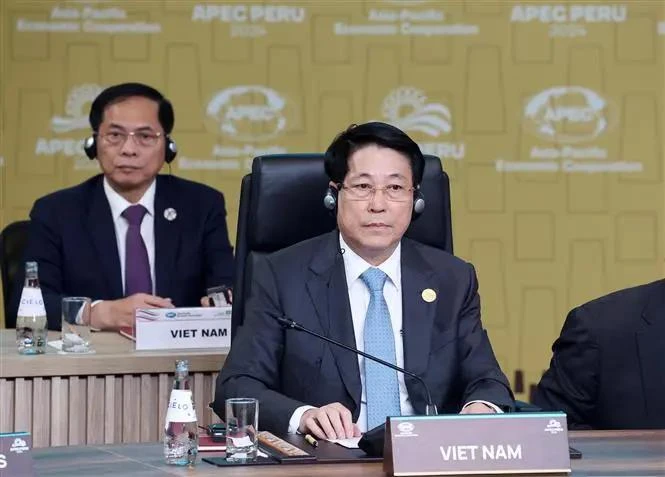
State leader addresses APEC Leaders’ Informal Dialogue with Guests

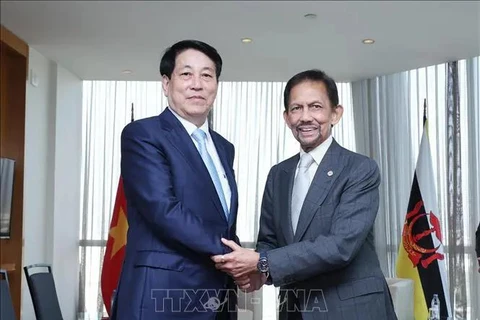
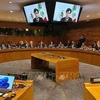
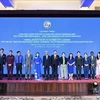
State President Luong Cuong delivered a speech at the Asia-Pacific Economic Cooperation (APEC) Leaders' Informal Dialogue with Guests in Lima on November 15 (local time).

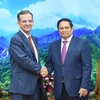
State President Luong Cuong attends the Asia-Pacific Economic Cooperation (APEC) Leaders' Informal Dialogue with Guests in Lima on November 15 (local time) (Photo: VNA)

Lima (VNA) - State President Luong Cuong delivered a speech at the Asia-Pacific Economic Cooperation (APEC) Leaders' Informal Dialogue with Guests in Lima on November 15 (local time).

This dialogue, held as part of the APEC Leaders’ Week, provided a platform for APEC leaders to exchange information, aimed at strengthening cooperation with partners both within and beyond the region.

It drew leaders and heads of delegations from 21 APEC member economies, alongside representatives from three guest partners - the United Arab Emirates (UAE), the United Nations Food and Agriculture Organisation (FAO), and the Development Bank of Latin American and the Caribbean (CAF).

Cuong expressed strong support for inter-regional cooperation and connectivity, emphasising that it is both an opportunity and an essential requirement for development.

He affirmed that as a leading region in terms of scale, growth rate, and international economic integration, the Asia-Pacific is confidently entering a new era marked with peace, stability, prosperity, sustainability, and inclusivity. However, in an increasingly volatile and challenging world, the region cannot "move forward alone" but must "advance together" with others, Cuong stressed.

To this end, he emphasised three key principles and four main solutions. The three principles include strengthening dialogue, fostering consensus, and maintaining a peaceful environment for development; respecting international law and promoting multilateralism; and ensuring balanced, inclusive, and equitable benefits, with people and businesses at the core.

Meanwhile, the four solutions are implementing selective and phased integration processes, maximising regional advantages and complementarities; improving institutional frameworks and enhancing the efficiency of existing mechanisms; unlocking resources and leveraging the effectiveness of North-South, South-South, and public-private partnerships; and prioritising the development of inter-regional and inter-community bridges, as well as networks for digital transformation, green transition, trade and investment linkages, financial and banking systems, infrastructure, and cultural and people-to-people exchanges.

Cuong affirmed that Vietnam is ready to cooperate with other APEC economies and partners to promote effective inter-regional connectivity that benefits all people and businesses. With its favourable geographical location in Southeast Asia and a modern logistics network, Vietnam is well-positioned to serve as a bridge for expanding trade and fostering inter-regional links, he stated.

By participating in major free trade agreements such as the Comprehensive and Progressive Agreement for Trans-Pacific Partnership (CPTPP), the Regional Comprehensive Economic Partnership (RCEP), and the EU-Vietnam Free Trade Agreement (EVFTA), Vietnam has established itself as a critical link in global value and supply chains. In the coming time, the country will collaborate with other ASEAN members to enhance cooperation between the ASEAN Economic Community and the dynamic, innovative Latin American region, he pledged.

APEC leaders and guests welcomed and highly valued President Cuong's insights and practical proposals.

They highlighted the crucial role of inter-regional economic integration and connectivity in driving economic development and addressing global challenges, and called for enhanced mutual understanding among people from different regions.

Given the current rapid changes in the global landscape, APEC was urged to strengthen collaboration with ASEAN, Africa, Europe, and the Middle East in areas such as digital transformation, green transition, inclusive growth, innovation, and building sustainable supply chains. They also emphasised the complementary benefits between the Free Trade Area of the Asia-Pacific (FTAAP) agenda and other regional free trade agreements.

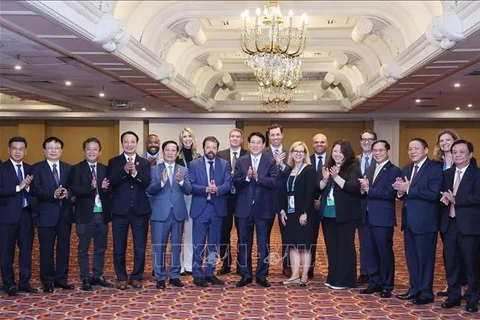
The same day, Deputy Prime Minister and Minister of Foreign Affairs Bui Thanh Sơn participated in the Dialogue between APEC Leaders and the APEC Business Advisory Council (ABAC).

Under the theme "People. Business. Prosperity", the dialogue focused on solutions to support small- and medium-sized enterprises (SMEs), particularly those led by women. Participants explored strategies and approaches to advancing the establishment of the FTAAP and enhancing cooperation between APEC, ASEAN, the WTO, and other regional frameworks.

ABAC members expressed their hope for more decisive and coordinated actions between the government and the private sector to realise the APEC Putrajaya Vision 2040. ABAC also made recommendations to create breakthroughs in areas such as digital trade, green transformation, mitigating the impacts of inflation, addressing economic growth disparities, combating climate change, and building a transparent, efficient, and business-friendly investment environment./.
VNA

See more

General Secretary of the Communist Party of Vietnam (CPV) Central Committee and President To Lam and Chairwoman of the Federation Council of the Federal Assembly of Russia Valentina Matvienko see photos depicting the Vietnam-Russia relationship. (Photo: VNA)

Top leader meets with Chairwoman of Russia’s Federation Council

Top Vietnamese leader To Lam proposed that the legislative bodies of Vietnam and Russia continue to play their role in improving a favourable legal framework for bilateral cooperation; and strengthen oversight of and urge the implementation of agreements reached by the senior leaders and Governments of the two countries, thereby helping translate political commitments into concrete programmes, projects and cooperation outcomes.

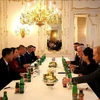
Deputy Prime Minister and Minister of National Defence Gen. Phan Van Giang (right) and Russian Defence Minister Andrey Belousov exchange souvenirs. (Photo: VNA)

Vietnam, Russia promote defence cooperation

In order for bilateral defence ties to truly match its role as a strategic pillar of the Vietnam-Russia Comprehensive Strategic Partnership in the new period, the two sides agreed to focus on promoting several key areas, including delegation exchanges and contacts at all levels, particularly high-level one; maintaining effective defence strategic consultation and dialogue mechanisms; training; and United Nations peacekeeping operations.

At the meeting between General Secretary of the Communist Party of Vietnam Central Committee and President To Lam and Russian Prime Minister Mikhail Mishustin in Moscow on September 8. (Photo: VNA)

Vietnamese, Russian leaders call for stronger trade cooperation

General Secretary of the Communist Party of Vietnam Central Committee and President To Lam and Russian Prime Minister Mikhail Mishustino agreed to study the establishment of new cooperation mechanisms and specialised working groups in various fields, and pledged to encourage businesses from both countries to expand their operations in each other’s markets.

General Secretary of the Communist Party of Vietnam Central Committee and President To Lam (L) meets with Chairman of the State Duma of the Federal Assembly of Russia Vyacheslav Volodin in Moscow on September 8. (Photo: VNA)

Top Vietnamese leader meets with Chairman of Russia’s State Duma

General Secretary of the Communist Party of Vietnam Central Committee and President To Lam reaffirmed that Vietnam attaches great importance to its traditional friendship and Comprehensive Strategic Partnership with Russia, considering Russia one of Vietnam’s leading important partners in its foreign policy.

Vietnam, US seek to boost cultural and educational exchanges

Vietnam, US seek to boost cultural and educational exchanges

Vietnam consistently regards education and training as a top national priority and a key driver of the country’s breakthrough development. The country is prioritising the development of high-quality human resources in science and technology, innovation and digital transformation.

Professor Reena Marwah of the University of Delhi. (Photo: VNA)

Indian expert highlights Vietnam’s important role in BRICS

Vietnam has the potential to play a deeper role in BRICS if the grouping continues to expand and strengthen its role in global economic governance. It should engage substantively in BRICS cooperation mechanisms while maintaining a balance among BRICS, ASEAN and other partners to consolidate its strategic position.

General Secretary of the Communist Party of Vietnam Central Committee and President To Lam (left) meets with Russian Presidential Aide and Chairman of the Maritime Board Nikolai Patrushev on September 8, 2026. (Photo: VNA)

Top leader highlights promising Vietnam–Russia maritime cooperation

Welcoming the two sides’ identification of orientations for maritime cooperation in 2026–2030, General Secretary and President To Lam called on relevant agencies of both countries to urgently translate them into highly feasible programmes and projects, avoiding a situation in which agreements remain merely at the level of orientations and policies.

President of the Vietnamese National Assembly Tran Thanh Man (R) meets with Chairman of the Korea-Vietnam Parliamentary Friendship Group Moon Jin Seok in Seoul on September 8. (Photo: VNA)

NA President meets RoK-Vietnam Parliamentary Friendship Group chief

President of the Vietnamese National Assembly Tran Thanh Man said the Vietnamese delegation was the first foreign one to make an official visit at the invitation of NA Speaker of the Republic of Korea (RoK) Cho Jeong Sik, with representation from the Party, NA, Government and localities.

National Assembly President Tran Thanh Man (R) receives Mongolian Ambassador to Vietnam Ganbaatar Hulan in Hanoi on August 26, 2026. (Photo: VNA)

Vietnam, Mongolia work to deepen bilateral ties in substantive, effective, sustainable manner

This is the second visit by a top Vietnamese legislator to Mongolia since the two countries established diplomatic relations in 1954, and the first official visit by NA President Man to Mongolia in his capacity. The visit demonstrates Vietnam’s high regard for bilateral relations and the important role of parliamentary diplomacy in the countries’ overall relations.