Syndicated lending proposed to reduce impacts of loan limit policy

A new regulation on reducing the loan limit under the amended Law on Credit Institutions will adversely affect capital supply for enterprises so commercial banks should cooperate in providing syndicated loans for businesses, experts said.
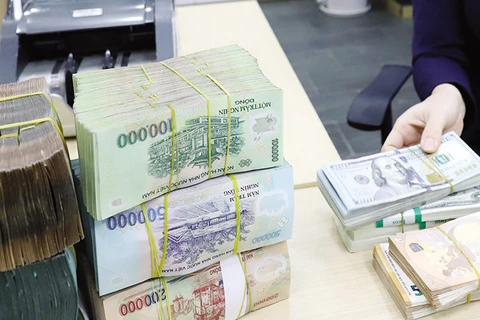
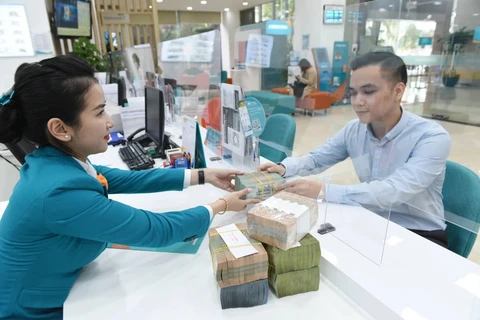
Syndicated lending proposed to reduce impacts of loan limit policy ảnh 1A bank teller counts money at a transaction office in Hanoi. (Photo: congthuong.vn)
Hanoi (VNS/VNA) - A new regulation on reducing the loanlimit under the amended Law on Credit Institutions will adversely affectcapital supply for enterprises so commercial banks should cooperate inproviding syndicated loans for businesses, experts said.

At a dialogue held by Vietnam Investment Review on March 11, expertssaid under the Law on Credit Institutions, which will take effect from July 1this year, banks must reduce the loan limit for a customer from 15% to 10%, andfor a customer and their related parties from 20% to 15% according to a roadmapfrom July 1, 2024 to January 1, 2029.

Dr. Pham Xuan Hoe, former Deputy Director of the State Bank ofVietnam (SBV)’s Institute of Banking Strategy, said at the dialogue that thenew regulation in the law will definitely affect enterprises.

According to Hoe, the capital of large and medium-sized banks iscurrently about 70-80 trillion VND and 35-50 trillion VND, respectively. Thus,if the credit limit is reduced to 10%, customers can borrow only about 5trillion VND, which is not enough for real estate, infrastructure and energyenterprises with huge capital demands. Therefore, projects with investmentcapital of more than 5 trillion VND must think about syndicated loans.

Besides, the credit limit regulation for a customer and theirrelated parties under the law also has a very broad meaning. For example, acorporation has many independent subsidiaries, or related parties, so thecredit limit of a bank for the corporation is also limited.

Therefore, Hoe said, to implement this regulation, the SBV needsto very clearly define the roles and tasks of State management agencies.Commercial banks also need to review very carefully, especially large customergroups, so as not to encounter difficulties when implementing the newregulation of the law.

He said the business culture of commercial banks needs to change,with an aim to enhance the cooperation to share both benefits and risks.

To lighten the impact of reducing the credit limit on enterprises,Nguyen Quoc Hung, General Secretary of the Vietnam Banks Association (VNBA),suggested that banks should cooperate to co-finance good projects.

A bank, whose customer has outstanding debt exceeding theregulated credit limit, needs to proactively invite other banks to participatein co-financing the customer’s projects, Hung said.

If the project is good, it is possible to ask other banks toco-finance it, Hung proposed.

In addition, syndicated loans with the participation of more thanone bank in managing and evaluating projects also help increase thetransparency and efficiency of the projects, he said.

Hung believed the five-year roadmap from 2024 to 2029 for banks toreduce credit limits is appropriate. He expected that banks will unite todeploy lending so that all people and enterprises can have access to bank loansand there need be no fear of lack of capital for large projects./.
VNA
See more

Toy production at a Hong Kong-invested factory (Photo: VNA)

Vietnam targets deeper market penetration in Hong Kong in 2026

Vietnam-Hong Kong trade hit 62.3 billion USD in the first 11 months of 2025, soaring 73.1% annually. Vietnamese exports to Hong Kong amounted to 36.8 billion USD, a 90.6% hike, ranking fourth among Hong Kong’s import sources, while imports from Hong Kong stood at 25.5 billion USD, up 52.9% and ranking third.

Vietnam’s start-up market enters restructuring phase

Vietnam’s start-up market enters restructuring phase

In 2026, venture capital inflows into Vietnam’s start-up ecosystem are expected to recover gradually, though in a more selective manner. VinVentures forecasts that capital will focus on start-ups that have survived the rigorous screening of 2024–2025, possess clear business models, strong commercialisation capacity, and the ability to generate real cash flows.

Workers process tra (pangasius) for export (Photo: VNA)

Vietnam–Singapore trade continues to thrive

For the year as a whole, Vietnam retained its position as Singapore’s 10th largest trading partner. Bilateral trade reached a record high of nearly 40 billion SGD, up 26.2% from the previous peak of 31.67 billion SGD recorded in 2024.

Eric Van Vaerenbergh, an energy expert and lecturer at the Brussels Engineering School (ECAM) (Photo: VNA)

Belgian expert optimistic about Vietnam’s economic outlook

Vietnam should move from a growth model based mainly on expanding capital and labour to one driven by productivity improvements. He said that this requires enhancing the quality of the workforce, particularly engineers, technicians, and managers in industrial sectors.

Workers at the VSIP Hai Phong industrial and urban complex, which specialises in producing electronic components for office equipment. (Photo: VNA)

Roadmap aims to improve business climate and boost competitiveness

By the end of 2026, Vietnam aims to rank among the world’s top 50 performers in the United Nations Sustainable Development Goals, advance at least three places in the International Property Rights Index, and climb at least one position in the Global Innovation Index.

Vietnam is strengthening its position in the technology value chain, becoming a major manufacturing hub for complete consumer electronics products. (Photo: VNA)

ESG standards offer opportunities to reposition Vietnam’s electronics firms

The 2025-2027 period will be a critical turning point, as exporters to the European market will be required to strictly comply with ESG standards, including net-zero emissions roadmaps, labour standards, corporate governance and transparency requirements. As a key export sector, the electronics industry is being directly and strongly affected by this shift.

A production line for camera modules and electronic components at the factory of MCNEX VINA Co. Ltd, a Republic of Korean-invested company in Phuc Son Industrial Park, Ninh Binh province. (Photo: VNA)

Science, technology, innovation as engines of economic growth

To ensure that science and technology truly act as a powerful growth engine, experts emphasised the need for the Government to put in place supportive mechanisms and policies that encourage enterprises to invest in research and development, while strengthening cooperation among the State, research institutions and the business sector.

The headquarters of the Ministry of Industry and Trade in Hanoi (Photo: VNA)

PM updates lead roles to drive UKVFTA forward

The Ministry of Industry and Trade (MoIT) is named the lead agency, with overall responsibility for the agreement’s general goals and definitions, trade remedies, non-tariff barriers to trade and investment in renewable energy, competition policies, State-owned enterprises, enterprises with special or exclusive rights and those with designated monopolies, as well as institutional, general and final terms.