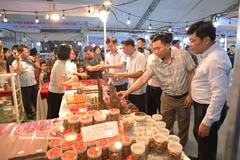
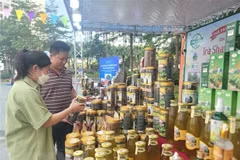
A workshop was held in Hanoi on October 16 to seek measures to improve the cooperation of agricultural cooperatives associated with the development of OCOP (one commune one product) products in the capital city.
Booming e-commerce in Vietnam is providing significant opportunities to promote sales while cooperatives are trying to improve the quality of their products to meet consumers' demands better.
A total of 1,640 agri-businesses were newly established and resumed operation in 2021, raising the number of firms in the sector to over 14,400, according to the Ministry of Agriculture and Rural Development.
Many agricultural cooperatives have achieved high safety standards and quality in recent years thanks to their increasing adoption of technology, enabling them to achieve sustainability and improve farmers’ incomes.
Although the collective economy in Ho Chi Minh City has gained positive results, limitations still exist, district officials and cooperative leaders have said.
HCM City has prepared plans to develop 300 cooperatives and five cooperative alliances in the 2021-2030 period, thus reaching the targeted growth of 7 percent in the cooperative economic sector.
Hanoi aims to have additional 700 products qualified for standards of the One Commune - One Product (OCOP) programme by the end of this year, heard a recent conference of the municipal Party Committee on the implementation of the programme.
The south-central province of Ninh Thuan plans to provide vocational training for 2,600 workers living in rural areas this year, with the aim of providing 82 percent of them with jobs.
The Government and the banking sector are paying more attention in enabling those involved in the agricultural sector to obtain loans from the bank, but the number of farmers and agricultural cooperatives to get access to bank loans remains modest, experts said at a seminar held in HCM City on December 27.
Developing a farm-based economy with mass production has been defined as a key task by localities in the Red River Delta province of Bac Ninh as they look to become new-style rural areas.
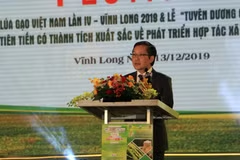
The fourth Vietnam Rice Festival is taking place in the Mekong Delta province of Vinh Long with a wide range of events designed to promote agro-economy and rice trade in domestic and foreign markets.
Forty seven of HCM City’s 56 rural communes have met all 19 criteria set in the national target programme on building new-style rural areas, according to the municipal Party Committee.
Deputy Prime Minister Vuong Dinh Hue highlighted that the collective economic sector has escaped from the prolonged weakness while addressing a forum in Hanoi on October 14.
Farmers' incomes in the Mekong Delta have risen as a result of membership in agricultural cooperatives, but the effectiveness of the groups is still limited, experts have said.
Agricultural production in the northern midland and mountainous provinces has gradually shifted towards commercial scale over the past years, creating remarkable changes in the sector.
Thailand’s Cooperative Promotion Department (CPD) has come up with a three-point plan to fix the problem of farmers’ debts instead of having them rely on the government’s price-guarantee policy.
Collective economy and agricultural cooperatives have developed in both quantity and quality, contributing to the restructuring of agriculture and new rural building.