Hanoi (VNS/VNA) - The view that it is necessary to tax gold purchases so that people 'love' gold less, according to experts, needs to be done in a calculated way, not to tax arbitrarily, to avoid a tax on tax.
Taxes are not the universal key
To reduce the attractiveness of gold, some experts recommend reconsidering taxing gold purchases.
Associate Professor, Dr. Nguyen Thi Mui, a member of the National Financial and Monetary Policy Advisory Council, proposed that the State Bank of Vietnam should soon propose to the Ministry of Finance to develop tax policies for gold.
According to Mui, the tax solution will contribute to reducing the demand for gold of certain investors, affecting consumer psychology and causing them to switch to other investment channels, thereby helping to control gold prices.
Tax is also a management tool to ensure fairness in production and business activities in general. Currently, the securities and real estate sectors are regulated by personal income tax, so it is also necessary to consider appropriate solutions for gold, according to Mui.
However, Nguyen Van Phung, a member of the Central Executive Committee of the Vietnam Federation of Accountants and Auditors and former Deputy Director of the finance ministry’s Tax Policy Department, said that the current tax policy on gold now is extremely clear. Consideration should be given when applying additional taxes to gold because taxes are not the universal key.
There are currently two main types of gold on the market, including foreign exchange gold managed by the State Bank of Vietnam and jewellery gold. For foreign exchange gold (imported exclusively by the State Bank to increase foreign exchange reserves), a zero % tax is applied because gold in this case is money.
As for gold jewellery - a conditional business - import tax is less than 3% and value-added tax is applied like normal goods at 10%.
Currently, gold businesses must pay value-added tax and corporate income tax.
"I think that this way of tax management is good, transparent and clear. For small business households, the level of predetermined revenue may still be problematic, not reflecting true revenue, but the tax industry is promoting the use of electronic invoices, through which data will be more accurate and tax collection will be more accurate," Phung said.
Taxing gold buyers is a tax-on-tax
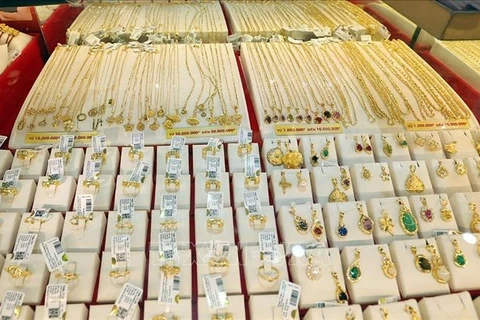
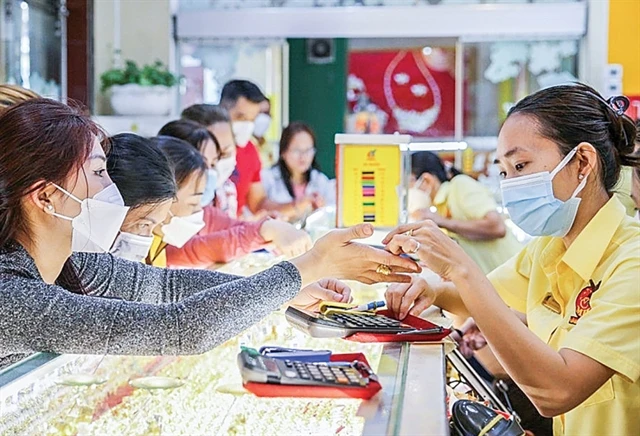
The gold fever that has taken place since the beginning of the year has raised concerns about 'goldenisation' of the economy. To reduce people's rush to hold physical gold, many experts suggest taxing gold transactions, just like taxing real estate transfers and securities transfers.
However, other experts say that the government should be cautious with this proposal.
According to Phung, people own gold as a type of personal property. The habit of hoarding gold and buying gold as a dowry for weddings has become a habit of Vietnamese people. That is a legitimate need. For a long time, the act of selling gold to gold businesses and converting it into money has not been taxed.
Sharing a similar opinion, Phạm Xuan Hoe, former Deputy Director of the Institute of Banking Strategy, said that people buy gold to store with their income. They have worked and had to pay taxes many times.
“The current tax policy on gold is adequate. If we continue to tax the total value of people's gold purchases - that is tax people's personal assets - it means tax on tax,” said Mui.
According to some experts, taxation - no matter any item - must have an economic basis, must come from production and business activities and cannot be taxed arbitrarily.
In fact, according to experts, the current tax policy on gold is relatively adequate. The long-standing problem with the gold market is tax evasion. Therefore, it is necessary to have strict management of the gold market by enhancing statistics and better tax collection.
For people to stop hoarding gold, experts suggested that the Government should have solutions to stabilise the macroeconomy, ensure the value of Vietnamese dong and stimulate production and business development. So that cash flows into production, business and other investment channels, instead of flowing into gold./.

See more
Measures sought to help Vietnamese firms expand investment in Indonesia
Vietnamese officials and businesses have explored measures to strengthen economic and trade ties with Indonesia and promote the Vietnam–Indonesia comprehensive strategic partnership, focusing on supporting Vietnamese companies to expand investment and operations in Indonesia.
Green industrial parks become new magnet for FDI
Statistics show that about 80% of FDI enterprises prioritise investing in industrial parks with green energy infrastructure, reflecting a growing shift in investment preferences amid tightening global environmental standards.
Vietnamese businesses ride wave of investment in green manufacturing
Recent developments in private investment show that as confidence in the private sector has grown and is a key driver of economic development, investors are strengthening support for enterprises not only through capital but also management expertise and market connectivity.
Fishing solidarity groups help Vietnam with IUU “yellow card” warning removal
Over the years, coastal authorities in Da Nang have intensified efforts to educate fishermen about regulations, particularly the need to avoid illegal fishing in foreign waters. Local administrations and competent forces have also strengthened vessel registration and inspection procedures, installed vessel monitoring systems and ensured transparent declarations of catches at ports.
Vietnamese firms step up cooperation with international distribution chains
Connecting Vietnamese businesses with international distribution networks has been a key component of government-led trade promotion programmes for many years, which are designed to help domestic companies place goods directly into global retail systems rather than exporting solely through intermediaries.
Viettel tops global telecom rankings in brand strength
Viettel achieved a Brand Strength Index (BSI) score of 89.9 out of 100 and was awarded the highest possible AAA+ rating.
Vietnam Airlines to launch direct Hanoi–Amsterdam service on June 16
Under the plan, the Hanoi–Amsterdam route will commence operations on June 16, 2026, with an expected frequency of three return flights per week using modern wide-body Airbus A350 aircraft. This will be the first direct air link between Vietnam and the Netherlands, helping to shorten travel time and enhance connectivity between Vietnam and one of Europe’s key economic, logistics and aviation transit hubs.
An Giang accelerates export shift to meet green consumption trends
To enhance competitiveness, authorities are assisting businesses in obtaining globally recognised certifications such as GlobalG.A.P., Organic and HACCP, enabling key exports including rice, seafood and clean agricultural products to strengthen their position in global markets, according to Quang Xuan Lua, Director of the An Giang Centre for Trade and Investment Promotion.
E5 RON92 biofuel price falls in latest adjustment
Since the beginning of this year, domestic fuel prices have undergone 14 adjustments, including five decreases and nine increases for RON95 and six declines and eight hikes for E5 RON92. Meanwhile, diesel price has fallen three times and risen 11 times.
Reference exchange rate goes up on March 13
With the current trading band of +/- 5%, the ceiling rate applicable for commercial banks during the day is 26,318 VND/USD, and the floor rate 23,812 VND/USD.
Vietnamese agricultural products boost global brand recognition
Vietnam aims to achieve about 74 billion USD in agro-forestry-fishery export turnover this year. Expanding value-added products, improving quality standards and strengthening brand building, especially through international supermarket systems, will be key to enhancing the competitiveness and global recognition of Vietnamese agricultural products.
Resolution 68 boosts businesses entering market
By the end of 2025, Vietnam had more than one million active enterprises. In the first two months of 2026, about 64,500 enterprises entered or re-entered the market, up 29.4% year-on-year, averaging 32,200 newly established or returning businesses per month.
Hung Yen accelerates land clearance for Khoai Chau urban, eco-tourism, golf complex
The high-profile project is expected to boost economic growth and facilitate economic restructuring in Hung Yen province and the country.
Dong Thap steps up fishing vessel management to combat IUU fishing
Dong Thap province currently has 1,510 registered fishing vessels engaged in fisheries exploitation. To date, 100% of active vessels have been registered, inspected, licensed and properly marked in accordance with regulations.
Vietnam, Western Australia seek broader ties during business forum
An official of Western Australia has hailed Vietnam as a strategic partner in her state's strategy to expand markets and diversify supply chains.
UOB remains upbeat on Vietnam’s economic outlook despite global uncertainty
UOB maintained its forecast for Vietnam’s gross domestic product (GDP) growth at 7.5% in 2026, with first-quarter growth projected at around 7%.
Vietnam Airlines adds nearly 1,000 seats on Europe routes
According to the national flag carrier, it will increase the use of wide-body aircraft with larger seating capacity on several European routes to better meet rising travel demand.
Vinh Long courts Korean investment in key sectors
Vice Chairman of the provincial People’s Committee Nguyen Truc Son vowed to accompany investors and provide them with optimal conditions, while building a transparent and stable business environment to secure long-term engagement from foreign enterprises, particularly those from Daejeon.
Vietjet launches Da Nang – Jakarta, Nha Trang – Singapore routes
To mark the launch of the new routes, Vietjet is offering promotional fares across all flights linking Vietnam with Singapore and Indonesia.
Digital platform on overseas market development launched
With Vietnam’s network of 64 trade offices overseas, Deputy PM Son noted that connecting them through a modern digital platform could help establish a unified national trade information system that operates efficiently, transparently and with strong forecasting capacity.