Thirty-seven percent of Vietnamese consumers use contactless payments

Findings from a recent Visa Consumer Payment Attitudes survey showed 37 percent of Vietnamese consumers are now using contactless card payments.
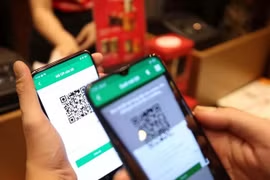
Thirty-seven percent of Vietnamese consumers use contactless payments ảnh 1Illustrative photo (Source: Vietnam Plus)

Hanoi (VNA) - Findings from a recent Visa Consumer Payment Attitudes survey showed 37 percent of Vietnamese consumers are now using contactless card payments.

The survey said among those that use contactless card payments, 85 percent shared that they use the method at least once a week.

It also revealed that four out of five consumers who have not used contactless payments are interested in doing so. More than 80 percent expressed interest in biometric authentication technology, which uses fingerprints or facial or voice recognition to authenticate payments.

With contactless payments, consumers can tap to pay at checkout counters anywhere they see the contactless symbol without handing their cards to cashiers. Contactless payments are secured with dynamic EMV® Chip technology. The cards have a tiny antenna which can be read by POS (point of sale) terminals when they are 4cm away or less from the terminal. POS terminals can typically read a contactless card or device in less than half a second. Shoppers can even pay with their mobile phones, using PINs, passwords or biometrics for extra security. Merchants can benefit by serving more customers, reducing their cash handling costs, and providing a better payment experience for customers.

The COVID-19 pandemic also appears to have further encouraged people to adopt the method due to increasing concerns about hygiene and social distancing measures.

Contactless payments are already deployed at some of Vietnam’s biggest retailers and restaurant chains, including Lotte Mart, The Pizza Company, and BHD with promotional campaigns that seek to drive and normalize the use of digital payments.

Visa has provided support to Starbucks in Vietnam to drive contactless activation, with Starbucks implementing swivel stands for terminals to give customers more control over transactions, and offering discounts to customers paying with Visa contactless. Half of all Visa transactions at Starbucks Vietnam are now contactless. Similarly, Visa has also partnered with Saigon Co-op to offer a range of exciting prizes to cardholders using this payment technology at their outlets.

Dang Tuyet Dung, Visa Country Manager for Vietnam and Laos, said: “At Visa, we’re incredibly excited to be working with our partners in Vietnam to help bring this new payment technology to more consumers and businesses across the country. As the Vietnamese economy continues to grow, the demand for faster, smarter methods of payment will increase and contactless technology is just one of the ways in which we’re working to meet this need.”

“We’re incredibly glad to be working with some of the most well-loved businesses in Vietnam to offer consumers an even easier way to pay. We look forward to continuing this work with other businesses in the future,” she added.

Visa contactless transactions grew more than 500 percent in the first half of 2020 compared to the same period last year. The total value of Visa contactless transactions increased more than 600 percent over the same period.

Following the trend, more domestic banks have converted their cards into contactless smart cards, such as Techcombank, BIDV, Vietcombank, Kienlongbank and TPBank, among others.

TPBank, Vietinbank, and Sacombank allow cash withdrawals using a QR Code at their ATMs, while customers can scan their fingerprints to receive cash at either ATMs or transaction offices of Eximbank and VietBank without a debit card, an ID card, or a passport.

These technologies make money transfers, cash withdrawals, and payments easier and more secure as they reduce the possibility of card loss, card theft, or data theft, according to Dr Nguyen Tri Hieu, a banking and financial specialist.

When fintech firms began to appear a few years ago, banks viewed them as competitors, Chief Information Officer (CIO) at VietCapitalBank Phan Viet Hai said. Now, they view them as partners to together provide more convenient services for customers./.

VNA

See more

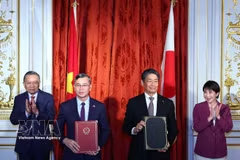
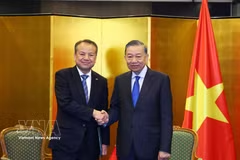
General Secretary and President To Lam and Japanese Prime Minister Takaichi Sanae witness the exchange of cooperation documents in Tokyo on November 9, 2026. (Photo: VNA)

Vietnam, Japan exchange three loan and grant aid documents

The exchange of the three documents on loans and grant aid reaffirms Japan's position as one of Vietnam's leading economic partners and reflects the strong commitment of both governments to translating high-level agreements into concrete cooperation projects, contributing to further strengthening the Vietnam-Japan Comprehensive Strategic Partnership.

North central region targets marine hub status with 10.5% growth goal

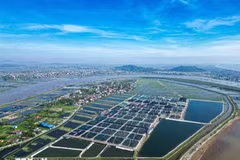
North central region targets marine hub status with 10.5% growth goal

The region’s GRDP rose 8.37% in 2025 and contributed 6.47% to national growth. Drivers are increasingly complementary. Ha Tinh’s industry and construction sector grew 24.25% in the first half; Nghe An’s industrial production index rose 23.02% and exports hit 3.1 billion USD, up 58.4%.

The conference on Vietnam-Cambodia trade connectivity will be held in AN Giang province on November 13, 2026. (Suource: Bnews)

Vietnam, Cambodia to boost trade connectivity

The Vietnam–Cambodia trade connectivity conference is part of a scheme to boost cross-border trade and exports to Cambodia in 2026, aiming to help raise bilateral trade to 20 billion USD by 2030.

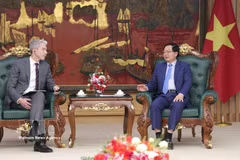
Deputy Prime Minister Ho Quoc Dung (right) receives Per Narvinger, President and CEO of Swedish telecommunications equipment maker Ericsson, in Hanoi on November 9. (Photo: VNA)

Vietnam, Sweden step up cooperation in telecom infrastructure, cybersecurity

Vietnam is accelerating institutional reforms, improving its investment and business environment, developing infrastructure and enhancing human resources quality. The Government stands ready to cooperate with leading global corporations investing in sectors of strategic importance to the country's development.

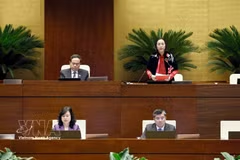
Vice President of the National Assembly Nguyen Thi Thanh speaks at the NA agenda on November 9. (Photo: VNA)

NA approves 2027 central budget allocation plan

The National Assembly (NA) on November 9 adopted a resolution on the allocation of the 2027 central budget, with all 469 deputies present voting in favour. Under the resolution, total central budget revenue in 2027 is estimated at more than 1.7 quadrillion VND (66.62 billion USD), while total expenditure is projected at over 2.3 quadrillion VND.

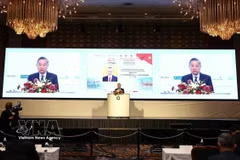
General Secretary of the Communist Party of Vietnam Central Committee and President To Lam attends the Vietnam-Japan Public-Private Forum on Economic, Science and Technology Cooperation in Tokyo on November 9, as part of his official visit to Japan. (Photo: VNA)

Vietnam-Japan relations evolve amid changing economic landscape: Nikkei Asia

Vietnam and Japan are seeking to improve the quality and added value of cooperation. During Party General Secretary and President Lam’s visit, they are expected to promote collaboration in artificial intelligence (AI), small modular reactor (SMR) technology, nuclear power and human resource training, Nikkei Asia reported.

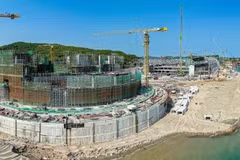
The APEC Convention Centre and related facilities are taking shape on Phu Quoc special zone, An Giang province. (Photo published by VNA)

Phu Quoc special zone envisioned as new growth engine

For 2026–2030, the Phu Quoc special economic zone will focus on high-value-added services, marine ecotourism and the digital economy. Total investment across society is expected to surpass 195 trillion VND.

Production line at Hana Micron Vina Co., Ltd in Bac Ninh city (Photo: VNA)

Processing and manufacturing continue to drive industrial growth

The sector’s industrial production index (IIP) rose 13% year on year, contributing 10.2 percentage points to overall industrial growth. Mining increased 7.1%, adding 1.1 percentage points, while electricity generation and distribution grew 10.6%, contributing one percentage point. Water supply, waste and wastewater management and treatment expanded 9.2%.

Vietnamese workers at a Japanese oyster processing factory (Photo: VNA)

Vietnam-Japan trade machine has room to run

Economic, trade and investment cooperation remains the core pillar and the main engine of comprehensive, sustainable bilateral ties. General Secretary of the Communist Party of Vietnam Central Committee and President To Lam’s official visit to Japan is therefore a key moment to reinforce political trust, deepen the Comprehensive Strategic Partnership and open new cooperation opportunities in the next growth phase.