Hanoi (VNA) - The COVID-19 pandemic has had a heavy impact on every aspect of life in 2020, and the global economy had been especially hard hit. The Vietnam News Agency has selected the ten most significant global economic issues during the year.
1. COVID-19 pandemic has devastating toll on global economy
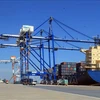
 The Lansdowne Port of Entry with Canada in the US state of Ontario is closed due to COVID-19 on March 22, 2020 (Photo: AFP/VNA)
 The global economy experienced its worst recession since World War II due to adverse impacts of the COVID-19 pandemic. Lockdowns and border shutdowns to contain its spread triggered stagnations in global trade, disruptions to supply chains, and a wave of business bankruptcies worldwide, especially in the aviation, tourism, and retail sectors. Countries have introduced economic stimulus packages totalling trillions of US dollars, as well as unprecedented monetary measures and emergency loans. The International Monetary Fund (IMF) has predicted a contraction of 4.4 percent in 2020 global GDP. The impact of the pandemic is also forecast to linger.
2. RCEP forms world’s largest free trade area
 The teleconferenced signing ceremony for the Regional Comprehensive Economic Partnership on November 15 (Photo: VNA)
 The Regional Comprehensive Economic Partnership (RCEP) was signed by the 10 ASEAN countries and five partners: the Republic of Korea, China, Japan, Australia, and New Zealand, on November 15 after eight years of negotiations. It forms the world’s largest free trade area, with 2.2 billion people, or 30 percent of the global population, and a combined GDP of 26.2 trillion USD, equivalent to 30 percent of global GDP, and nearly 28 percent of global trade. The RCEP signing is considered be a driving force for promoting economic integration and protecting the multilateral trading system at a time when multilateralism is gradually losing its foothold and global growth is slowing.
3. Wave of investment diversion accelerated
 An Apple factory in Shenzhen city of China's Guangdong province (Photo: AFP/VNA)
 The COVID-19 pandemic has disrupted trading activities and many global supply chains, particularly in automobiles and medical equipment manufacturing. Facing this, a number of countries have diversified their foreign investment and stepped up the relocation of supply chains to domestic markets or to other regions to prevent risks and ensure stability. The pandemic and US-China trade tensions have been described as “catalysts” for the diversion of a lot of production back to investors’ home nations or other countries, to capitalise on cost, labour, or logistical advantages. The Bank of America has estimated that it could cost US and European companies up to 1 trillion USD and take five years to relocate their production activities away from China.
4. Crisis in global labour market
 People line up outside the Kentucky Career Centre in Frankfort city, the US, on June 18, 2020 (Photo: Reuters/VNA)
 The global labour market has suffered a great deal from COVID-19, which has resulted in job losses or salary cuts around the world. In its “COVID-19 and the world of work” report, the International Labour Organisation (ILO) said that as many as 81 million jobs in Asia and the Pacific and another 30 million in Latin America were lost during the year. In the first three quarters alone, incomes fell 10.7 percent, or 3.5 trillion USD on a global basis. The crisis in the labour market may have long-term consequences in the form of poverty and socio-economic uncertainty.
5. Global trend to cut interest rates to almost zero
 The headquarters of the US Federal Reserve in Washington DC on July 29, 2020 (Photo: Xinhua/VNA)
 To help economies overcome these difficult days of COVID-19, for the first time in history, central banks in 60 percent of economies around the world cut interest rates to less than 1 percent, even negative rates in many economies. In March alone, the US Federal Reserve slashed interest rates twice as an emergency move. The central banks of Europe, China, Japan, the UK, and Australia also cut rates to record lows.
Despite efforts to cut interest rates and apply unusual monetary policies, inflation has remained low. The global economy faces a risk of falling into a “liquidity trap”, where monetary policies are scarcely effective.
6. UK leaves European Union
 The UK's Prime Minister Boris Johnson and President of the European Commission Ursula von der Leyen (R) at a meeting in Brussels, Belgium, on December 9, 2020 (Photo: Xinhua/VNA)
 The UK officially left the EU at 11pm on January 31, 2020, and entered into a transition period that lasts through to December 31, 2020. After 47 years in the bloc, Brexit is expected to change the UK’s relations with EU countries in all fields, from politics and economics to society, culture, and security. The UK has been promoting talks over free trade agreements (FTAs) to facilitate trade flows. It secured its first post-Brexit FTA, with Japan, signed a temporary trade deal with Canada, inked FTAs with Singapore and Vietnam, and signed a trade continuity agreement with Mexico.
7. Tech groups face cross-border tax pressure
 Logos of tech giants Google, Amazon, Facebook and Apple on a mobile phone (Photo: VNA)
 A multilateral plan on the cross-border taxation of technology businesses, promoted by the Organisation for Economic Cooperation and Development (OECD) and the G20, may make digital enterprises such as Google, Amazon, and Facebook pay up to 100 billion USD in taxes each year. France has begun levying a 3 percent tax on tech firms with global revenues of over 750 million EUR (918 million USD) and sales of at least 25 million EUR within the country. Indonesia, meanwhile, is working on a taxation plan based on the tech companies’ revenues.
OECD countries have yet to reach consensus on the taxation of tech businesses to put an end to multilateral firms conducting online business in many countries but posting most of their profits in nations with low tax rates.
8. Unprecedented market fluctuations
 A stock index screen at the New York Stock Exchange of the US (Photo: AFP/VNA)
 Commodities and financial markets around the globe recorded historic trading sessions in 2020 after COVID-19, restriction measures and disagreements over economic aid packages of countries strongly affected investor demand and sentiment. Global gold prices exceeded 2,000 USD per ounce for the first time, while WTI (West Texas Intermediate) crude oil prices hit a record low of minus 40 USD per barrel. In March, the US stock market experienced its sharpest decline since 1987, triggering a “circuit breaker”. Most notably, prices of medical supplies, especially face masks and vaccines, skyrocketed.
9. E-commerce booms
 A worker counts items before delivering to customers at an Alibaba service cemtre in Jiangsu province of China on November 6, 2020 (Photo: AFP/VNA)
 According to market research company Statista, global e-commerce sales are forecast to reach 3.9 trillion USD for 2020, including 2.45 trillion USD in the Asia-Pacific region. Social distancing measures to curb the spread of COVID-19 encouraged consumers to change their shopping behaviour. Retailers swiftly reformed their business models and applied digital financial tools to adapt to the change, thus fostering e-commerce. During the shopping spree on Singles’ Day (November 11), Alibaba and JD.com, two e-commerce giants in China, earned a record 115 billion USD. In the US, online sales on Black Friday also hit an all-time high of 9 billion USD, while revenues on Cyber Monday stood at 10.8 billion USD.
10. Global aviation industry grounded by COVID-19
 Planes of AirAsia at Kuala Lumpur International Airport of Malaysia (Photo: EPA/VNA)
 Since COVID-19 broke out in early 2020, aviation has been one of the worst-hit sectors due to travel restrictions imposed by governments to contain the coronavirus transmission. The International Air Transport Association (IATA) estimates that full-year air traffic fell 66 percent and airlines’ revenues halved to 419 billion USD. A large number of carriers have gone bankrupt or scaled down operations by suspending routes, selling aircraft, temporarily laying off staff, or cutting salaries. Despite total aid to the sector already amounting to 160 billion USD, the IATA estimates that it still needs an additional 70-80 billion USD in support./.