Hanoi (VNA) – Although Vietnam has opened its doors to international tourists, formidable challenges remain in the non-smoke industry, requiring further efforts to accelerate recovery, according to insiders.
 Tourism information is introduced at the Vietnam International Travel Mart (VITM) (Photo: VientamPlus)
 At a forum held as part of the ongoing Vietnam International Travel Mart (VITM), Deputy Minister of Culture, Sports and Tourism Doan Van Viet said the tourism sector needs to develop technical facilities, tourism products and human resources, which require investment, time and efforts from the whole industry.
“State policies should aim to solve specific problems, or which areas of development should be the key to lure international visitors”, he said.
Meanwhile, other experts and businesses discussed barriers to welcome back foreign tourists, and solutions to the sluggish tourism recovery.
Managing Director of the Viet Image Hop On – Hop Off Tourist Co., Ltd Nguyen Khoa Luan suggested the tourism industry will go forward, with tourism products and human resources at issue, not visa – the prerequisite condition to receive foreigners.
 Vietnamese tourists are ready for “revenge tourism” post pandemic. (Photo: VietnamPlus)
 “Vietnam resumes visa waivers for only 13 countries while the number in neighbouring countries is much higher, with Thailand 64, Indonesia 70 and the Philippines 160”, he said.
According to Luan, measures to increase the number of countries and territories enjoying Vietnam’s visa exemption scheme should be prioritised, followed by promotional programmes, and then human resources development for potential markets.
Inbound tour operators said they are struggling with a huge amount of work while a worker shortage makes it hard to maintain pre-pandemic markets and tourism products.
Former general director of Jetstar Pacific Airlines and managing director of Air Mekong Luong Hoang Nam, said Vietnam should implement multiple entry visas with longer exemption period from 30-45 days.
The current visa exemption forces foreign visitors to go to another country after 15-day stay in Vietnam, and they may not come back, he explained, adding this regulation prevents Vietnam from becoming a tourism and aviation hub.
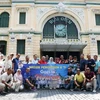
 Visitors at the Vietnam International Travel Mart (Photo: VietnamPlus)
Meanwhile, Chairman of Da Nang Tourism Association Cao Chi Dung believed that travel firms and tourism service providers need to think globally and act locally.
This means safe tourism, healthcare tourism and MICE tourism should be a focus, he said. He suggested the images used for promotion of Vietnamese people and landscapes should be enhanced, making it easier for international tourists to find Vietnam’s tourism information.
For his part, General Director of the Vietnam National Administration of Tourism Nguyen Trung Khanh stressed five orientations for tourism recovery .
"We should exploit traditional markets, markets where airlines resumed and have favourable visa policies like those before the pandemic [in 2019]," he said.
The second point focuses on green products, ecological tourism, community tourism, relaxation tourism and healthcare tourism.
 It would be good news for foreign visitors if Vietnam implements multiple entry visas with longer exemption period from 30-45 days.
 The third pillar, according to the official, is effective marketing.
"We should increase e-marketing to maximise the effectiveness for tourism recovery and development," he said.
He also stressed digital transformation after the pandemic and noted that developing human resources was a key task for recovery.
"Enterprises should enhance recruitment, training and re-training," he said. "Workers in the field should be trained in special skills and know-how to use technology. Technology needs to be at the forefront for serving guests. Enterprises and localities should have favourable policies for high-quality staff."
| The number of international arrivals to Vietnam in March increased by 41.4 percent over the previous month and 2.2 times against the same period last year as Vietnam has fully reopened and many international flights have been restored, according to General Statistics Office (GSO). In the first quarter of this year, the number of foreign tourists to the country reached nearly 91,000, a year-on-year rise of 89.1 percent. Among them, visitors arriving by air accounted for nearly 90.5 percent of the total international arrivals to Vietnam, an increase of 165.2 percent. Revenue from accommodation and food services in the January-March period increased by 1.2 percent year on year, while tourism revenue rose by 1.9 percent year on year. From March 15, tourism activities have been fully reopened for both international and domestic tourism, via air, road, rail, and sea routes. Conditions and regulations on immigration and health for international tourists are much more favourable now as compared to before the pandemic./. |