TPP negotiators meet to hash out changes after US pullout

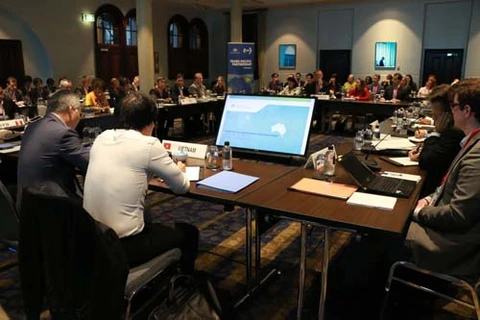
Chief negotiators of the 11 remaining countries of the Trans-Pacific Partnership (TPP) agreement began two-day talks in Tokyo, Japan on September 21 to discuss changes and freezes to parts of the deal following the withdrawal of the US earlier this year.
TPP negotiators meet to hash out changes after US pullout ảnh 1Right after taking office in January 2017, US President Donald Trump announced the country was pulling out the pact as it hurts US jobs and he prefers bilateral trade negotiations. (Photo: internet)

Tokyo (VNA)
– Chief negotiators of the 11 remaining countries ofthe Trans-Pacific Partnership (TPP) agreement began two-day talks in Tokyo,Japan on September 21 to discuss changes and freezes to parts of the dealfollowing the withdrawal of the US earlier this year.

Atthe meeting, Japanese chief negotiator Kazuyoshi Umemoto expressed his hopethat the countries would take a big step forward towards the Asia-Pacific EconomicCooperation (APEC) Economic Leaders’ Meeting scheduled for November in Vietnam.

He reaffirmed the significance of establishing a free and multilateral tradesystem based on high-standard rules in the Asia-Pacific which really fits the21st century.

“It is also important to continue to pursue the possibility of the US comingback to this framework and for that purpose it’s very important to implementthe TPP as early as possible”, he added.

The talks are expected to cover proposals such as a clause to preservecopyrights and trademarks for 70 years after the creators die and a clause thatcalls TPP members to open public procurement, allowing foreign companies tojoin bids.

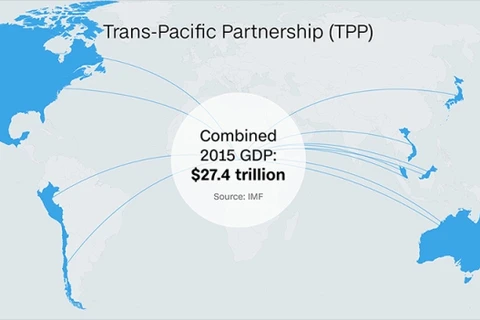
Another issue that needs to be addressed is a clause stating that the TPP canonly come into force after six economies, accounting for 85 percent or more ofthe original 12 signatories’ combined gross domestic product, complete domesticprocedures. So far, just Japan and New Zealand have ratified the deal. As theUnited States alone represents more than 60 percent of the initial members’GDP, it is impossible for the pact to come into effect under the current terms.

The TPP was inked inFebruary 2016 by Australia, Brunei, Canada, Chile, Japan, Malaysia, Mexico, NewZealand, Peru, Singapore, the United States and Vietnam, covering around 40percent of the global economy.

Right after takingoffice in January 2017, US President Donald Trump announced the country waspulling out the pact as it hurts US jobs and he prefers bilateral tradenegotiations.

Currently, Japan is the largest economy among the remaining negotiators. Tokyowishes to reach an agreement among the countries to maintain the pact which hadtaken long time of negotiations before it was inked in February 2016.

However, it is possible that some countries can call for re-negotiations onimport and export tariffs.-VNA
VNA
See more

Indonesia to add 30 urban trains in Jakarta

Indonesia to add 30 urban trains in Jakarta

The addition of new trains is expected to help Indonesia ease traffic congestion, improve the quality of public transport services, and promote sustainable socio-economic development in Indonesia’s most densely populated urban area.

Illustrative image (Photo: Antara)

Indonesia to end diesel imports by 2026

Indonesian Minister of Energy and Mineral Resources Bahlil Lahadalia has reported to President Prabowo Subianto that Indonesia is on track to stop importing diesel fuel by early 2026, marking a major milestone in national energy independence.

Director General of the Metal, Machinery, Transportation Equipment, and Electronics (ILMATE) Industry at the Ministry of Industry Setia Diarta during the Opening of GIIAS Makassar on November 5. (Photo: ANTARA)

Indonesia to downstream EV batteries in two years

Indonesia is projecting the downstreaming of electric vehicle (EV) batteries for motorcycles and cars within the next two years, according to Director General of the Metal, Machinery, Transportation Equipment, and Electronics (ILMATE) Industry at the Ministry of Industry Setia Diarta.

At the launch of the programme. (Photo: nationthailand.com)

Thailand launches programme to reduce healthcare costs for citizens

Under the new Memorandum of Understanding (MoU), private hospitals in Thailand must provide complete and accurate prescriptions listing drug names and usage details. This transparency allows patients to choose whether to buy their medicines directly from the hospital or from registered pharmacies outside.

Illustrative photo (Photo: bangkokpost.com)

Thailand delivers tepid rice export forecasts for 2026

Thailand maintains its export target for next year at 7.5 million tonnes, including 3.5 million tonnes of white rice, 1.7 million tonnes of hom mali rice, 1.4 million tonnes of parboiled rice, 600,000 tonnes of Thai fragrant rice and 300,000 tonnes of sticky rice.

ASEAN Secretary-General Kao Kim Hourn (Photo: Bernama)

ASEAN Secretary-General: Higher education will shape the region’s future

The ASEAN chief revealed that the ASEAN Socio-Cultural Community (ASCC) Strategic Plan designates education as a driver for equity and sustainable development. Its agenda calls for enhancing access to quality education, promoting lifelong learning, and integrating green skills into curricula. In short, academic purpose serves societal and community purpose.

Thailand aims for 129 gold medals at 33rd SEA Games

Thailand aims for 129 gold medals at 33rd SEA Games

At the 32nd SEA Games held in Phnom Penh, Cambodia, from May 5–17, 2023, Thailand ranked second overall with 108 gold, 96 silver, and 108 bronze medals. Vietnam topped the standings with 136 gold, 105 silver, and 114 bronze medals.

Rescuers evacuate residents in a flooded area due to Typhoon Kalmaegi in Cebu province, the Philippines, on November 4, 2025. (Photo: Xinhua/VNA)

Typhoon Kalmaegi leaves 66 dead in Philippines

The Philippines, which experiences an average of 20 storms annually, frequently suffers heavy losses, especially in poverty-stricken areas. Scientists warn that climate change is making storms increasingly intense and destructive.