Tra Vinh province enhances poverty reduction work

A string of measures have been carried out in the Mekong Delta province of Tra Vinh to realise the National Target Programme on Sustainable Poverty Reduction.
Tra Vinh province enhances poverty reduction work
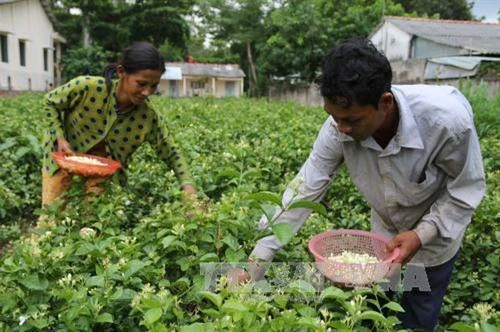
Tra Vinh province enhances poverty reduction work ảnh 1Jasmine planting helps Khmer people in Tra Vinh province escape poverty. (Photo: VNA)

Tra Vinh (VNA) – A string of measures have been carried out in theMekong Delta province of Tra Vinh to realise the National Target Programme onSustainable Poverty Reduction.

According to Director of the provincial Department of Labour, Invalids andSocial Affairs Nguyen Van Ut, the province aims to cut the rate of poorhouseholds by 1.5 percent (equivalent to more than 4,000 households), includinga reduction of 3 percent of impoverished Khmer ethnic families (or 2,683households), and near poor households by 1.5 percent (or 4,137 households).

Agencies are enhancing communication work to raise public awareness ofsustainable poverty alleviation, while local authorities are providingvocational training, teaching farming techniques to locals and generating jobsfor poor and near poor people.

Ut said his department is working with the education sector to encouragedisadvantaged children to go to school, prevent school drop-outs, as well asbuild vocational training courses for rural people, ensuring they all have jobsafter graduating.

The department has worked with the Department of Construction and the Bank forSocial Policies to build houses for poor households in the locality.

Additionally, it has coordinated with the provincial departments of NaturalResources and Environment and Agriculture and Rural Development to build a cleanwater supply system for rural families.

As of the end of 2018, Tra Vinh province had 16,414 poor households (nearly 6 percentof the total population), more than 10,000 of which are Khmer ethnic families.

Under two national programmes, one on rural development and the other onsustainable poverty reduction, the province has been allocated more than 124billion VND (5.33 million USD) to build infrastructure in communes anddistricts, develop poverty alleviation models, branch out effective farmingmodels for poor and near poor households, and help impoverished and ethniclabourers work overseas.-VNA 
VNA

See more

Staff members of the Hanoi Public Administrative Service Centre handle administrative procedures for local residents. (Photo: VNA)

Hanoi: 95% of administrative procedures to be handled from home

The plan targets that at least 80% of administrative procedures under the city’s authority will be provided as fully online public services, while more than 95% of applications will be received and processed entirely online. By June 30, 2026, about 80% of administrative procedures are expected to be restructured based on integrated data systems, with the figure rising to 95% by the end of the year.

Delegates at the SEAN Future Forum NextGen Workshop 2026 held in Jakarta, Indonesia on March 9 (Photo: VNA)

Vietnam contributes youth perspectives to AFF NextGen initiative

The ambassador expressed confidence that fresh perspectives, innovative thinking and lessons drawn from the workshop will be proposed to AFF 2026, representing the voice of the younger generation in shaping ASEAN’s future in line with their aspirations.

A young volunteer donates blood during the 2026 Red Sunday programme. (Photo: VNA)

Nearly 5,000 people join blood donation campaign in Ho Chi Minh City

According to health authorities, Vietnam collected nearly 1.75 million units of blood in 2025, with 98% from volunteer donors, equivalent to around 1.75% of the population participating in blood donation. Large-scale campaigns such as Red Sunday have played a key role in achieving these results.

More than 30 kilogrammes of various drugs trafficked from Cambodia to HCM City were seized in a police operation in March 2025. (Photo: VNA)

Ho Chi Minh City aims to become drug free by 2030

Every commune, ward or residential area in Ho Chi Minh City is expected to meet official drug-free standards by the end of 2029, while schools, hospitals, government offices, businesses and social organisations across the city are to remain free of drug activity.

Military forces take a resident from a flooded area. Photo: VNA

Da Nang, Oxfam join hands to support flood victims

In the coming time, the Da Nang Red Cross Society will continue to coordinate with Oxfam to implement support activities in Nong Son commune, helping residents overcome difficulties and stabilise their livelihoods.

Training on response to reservoir incidents (Photo: VNA)

Central Civil Defence Fund established to bolster disaster response

The Central Civil Defence Fund is authorised to receive, manage and use voluntary contributions from domestic and foreign entities and individuals, plus transfers from provincial civil defence funds in line with the PM’s decisions and allocations from relevant state financial sources outside the state budget, all earmarked for incident and disaster response and recovery efforts.

Vietnamese women shine in the traditional Ao dai (Photo: VNA)

March shines with elegance of “Ao dai”

In early March, scenes of women in flowing Ao dai taking spring photos by lakes, parks, offices, temples and historical sites have become a familiar sight on the streets of Hanoi. Social media is also filled with images and stories surrounding the elegant attire, which has become a symbolic signal of the season dedicated to honouring women.

Hanoi voters learn about candidates’ biographies and action programmes. (Photo: VNA)

Hanoi thoroughly prepares for NA, People’s Council election

According to the municipal Election Committee, the capital city has established election committees in 126 communes and wards. In addition, 11 electoral boards for National Assembly deputies, 31 electoral boards for the city-level People’s Council, 831 commune-level electoral boards and more than 4,000 polling teams have been set up to serve the election process.