Hanoi (VNA) – While the influx of imported goods has presented challenges, with signs of dumping and subsidisation impacting domestic industries, Vietnam has effectively countered these threats.
To prevent unfair competition of imported goods in line with legal regulations and international commitments, the industry and trade sector is focusing on implementing the Prime Minister’s Decision No. 1659/QD-TTg dated October 2, 2021 on the project "Improving trade defence capacity in the context of participating in new-generation free trade agreements" to protect domestic products from the wave of imported goods.
According to experts, over the past time, trade defence measures against imported goods have protected domestic manufacturing industries and secure jobs for hundreds of thousands of workers.
In the long run, such measures will help the economy not to be completely dependent on imports, bringing stability and better resilience to external impacts and shocks.Vietnam has free trade relations with 60 trading partners through the signing of 16 free trade agreements (FTAs), including new-generation ones such as the Comprehensive and Progressive Agreement for Trans-Pacific Partnership (CPTPP) and the EU-Vietnam Free Trade Agreement (EVFTA).
For domestic goods, most of the tariffs have been cut to zero, making Vietnam one of the most open countries in the world.
Some domestic manufacturing industries are unable to adapt to complex and even unhealthy competition after following the roadmap with major trading partners.
This includes dumping and receiving subsidies for imported goods from foreign countries.
Therefore, with the increase in import tax, the applied trade remedies have contributed to increasing State budget revenue with the amount collected reaching trillions of VND.
Chu Thang Trung, Deputy Director of the Department of Trade Remedies Authority under the Ministry of Industry and Trade, said that the implementation of tariff reductions under commitments in FTAs has brought the special preferential import tax rates down to very low levels, with many tax lines at 0%.
The trend of trade protection in many countries, and high input goods and transportation costs have caused many manufacturing industries to suffer losses due to imported goods.
Statistics show that to date, Vietnam has conducted 29 trade defence investigations, including 20 anti-dumping cases, one anti-subsidy case, two anti-circumvention cases, and six defence cases.
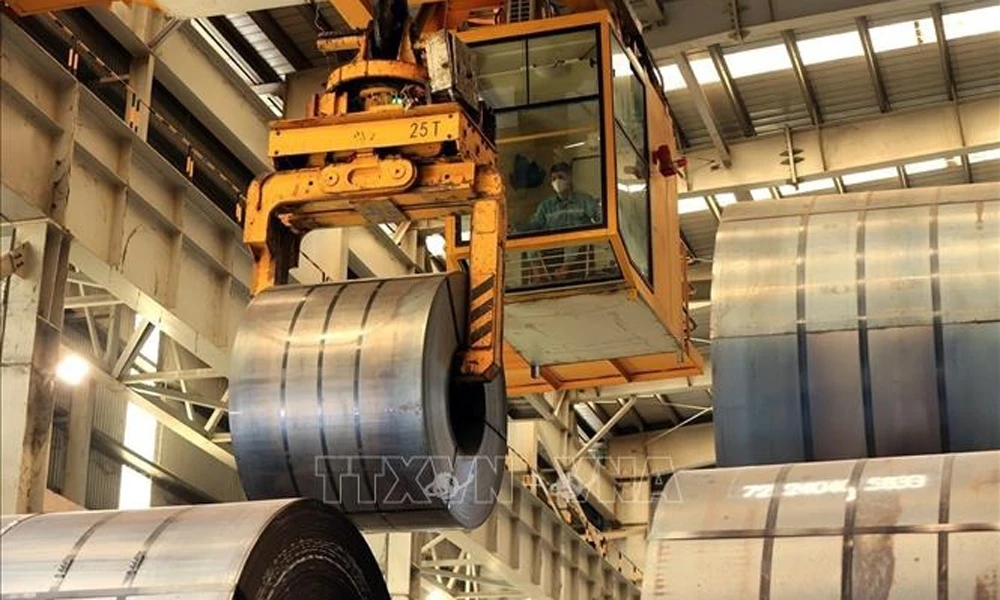
The ministry has also issued Decision No. 1535/QD-BCT on the anti-dumping investigation on galvanised steel products originating from China and the Republic of Korea (case code: AD19).
Trung also pointed out that at the end of July, the ministry issued Decision No. 1985/QD-BCT on the anti-dumping investigation on some hot-rolled steel products originating from India and China, based on a request filed by domestic manufacturers.
He said along with increasing warnings about the risks of trade defence investigations against Vietnamese exports, the ministry has promoted the application of reasonable trade defence measures in line with international commitments against unfair competition.
Nguyen Thi Thu Trang, Director of the WTO and Integration Centre under the Vietnam Chamber of Commerce and Industry (VCCI), emphasised that in many trade defence cases, businesses that file lawsuits requesting the application of trade remedies, especially anti-dumping measures, are well prepared and have tools and evidence that meet legal requirements.
However, according to lawyer Nguyen Thanh Ha, Chairman of SBLaw, the use of trade remedies by Vietnamese businesses to prevent imported goods from entering Vietnam is still limited.
He explained that most businesses and associations do not have much experience in initiating trade defence investigations.
Moreover, to apply trade remedies, businesses must have experience in conducting investigations as well as preparing accurate data and arguments to submit to competent state agencies.
Sharing this view, many experts believed that trade defence lawsuits are not just a game of each enterprise but of the entire domestic production industry of related products.
When engaging in the global playground, enterprises need to support each other, aiming to create national advantages and promote like-minded economic interests./.