Urgent response discussed for Mekong River

As many as 18 million residents in the Mekong Delta are suffering serious consequences as the Mekong River is drying up due to over exploitation of hydropower plants in upstream countries.
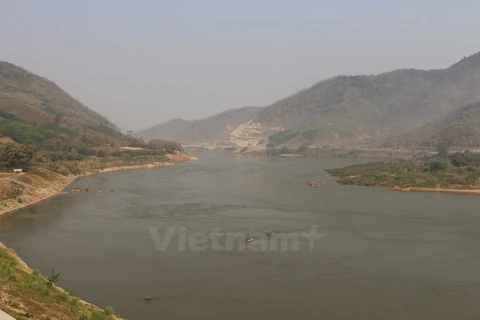
Urgent response discussed for Mekong River ảnh 1Upstream hydropower dams are believed to have a great impact on the Mekong Delta (Photo: VNA)

HCM City(VNA) – As many as 18 million residents in the Mekong Delta are sufferingserious consequences as the Mekong River is drying up due to over exploitationof hydropower plants in upstream countries, delegates heard at a recent conferencein the Delta province of An Giang.

According to the reportfrom the Vietnam Mekong River Commission (VMRC), while China has basicallycompleted the first development stage of its hydropower-shaped ladder on theMekong river, Laos has strengthened hydropower exploitation by constructing twoplants, Xayaburi and Don Sahong, on the main stream of the river and ispreparing for the construction of Pakbeng on a branch of the river.

“Around 95 percent of totalwater flow in the Vietnamese Mekong Delta depends on water from upstream andthe Delta has suffered great consequences,” Nguyen Thi Thu Linh, deputy head ofthe commission office, said at the Vietnam Mekong River Commission Conference2017.

“The Mekong Delta is nowfacing strict water shortage in dry season, a significant increase of salineintrusion, serious water flow change and severe erosion, which strongly impactagricultural and aqua-cultural cultivation as well as daily lives,” she added.

Linh said a study showedthat with these two Laotian hydropower dams, total water volume would reduce 13percent, saline intrusion would come 3 – 4 km further into the Mekong Delta,alluvium would drop 5 percent and aquatic productivity would fall 9 percent.

Furthermore, Thailand andCambodia are planning to divert a huge amount of the river’s water flow intoother regions, and if this happens, 17 percent of the water resource and 90 percentof fish would never come to Vietnam, she concluded.

[Mekong basin dams pose danger: experts]

“Related authorities shouldset up different response scenarios with climate change based on the currentsituation rather than worry about information of upstream nations keeping allthe water of the Mekong River,” said Hoang Van Thang, Deputy Minister of theAgriculture and Rural Development.

“Related authorities shouldcollect more inter-regional information as a database for setting up climatechange response scenarios, as well as call for more international support inwater resource protection,” he added.

“We need officialinformation of water volume from upstream countries to build a propercultivation plan, but there is no way to get such information,” said Lam QuangThi, Vice Chairman of the Mekong Delta province of An Giang.

He suggested the ministryof Natural Resource and Environment set up automatic measurement stations alongthe border with Cambodia to collect accurate and timely information aboutwater.

“A master plan for MekongDelta development should be established immediately. The master plan must updateerosion in rivers and beaches, fix the road system and infrastructuredevelopment in order to restructure agricultural and aqua-culturalcultivation,” he added.

“Information sharing aboutthe Mekong River’s water resource among ministries and localities is veryweak,” Minister of Natural Resource and Environment Tran Hong Ha admitted.

He requested the VMRC inco-operation with relevant authorities to closely supervise an adjustment ofthe master plan on irrigation, transport infrastructure and agriculturalcultivation.

“The commission shouldconsider reserving water in Mekong river branches,” Ha said.-VNA
VNA

See more

Each location is equipped with three bins for residents to sort waste at source. (Photo: baotayninh.vn)

Tay Ninh partners with RoK to pilot waste-sorting at source

The project, with KECO serving as a technical consultant, aims to strengthen integrated waste management, develop effective systems for classification, collection and recycling, and enhance public awareness of turning waste into resources, thus contributing to a cleaner and more sustainable Tay Ninh.

A camera trap photo of a Chinese serow (Capricornis milneedwardsii) in the Dong Chau – Khe Nuoc Trong Nature Reserve (Photo published by VNA)

Quang Tri province approves wildlife restoration project

The project has a total non-refundable grant value of 48,310 USD and will be implemented in Kim Ngan commune until December 31, 2027. This initiative aims to restore wildlife populations, enhance biodiversity, and reduce illegal hunting through patrolling and the removal of snares.

Houses in Xuan Canh commune, Dak Lak province, completely collapse. (Photo: VNA)

Typhoon Kalmaegi damages over 26,470 houses and causes extensive losses

The typhoon and its aftermath left five people dead, three missing, and 17 injured. It also damaged 3,721 ha of rice and crops, and 3,958 ha of industrial and perennial fruit trees, up by 14 ha from the previous report. For aquaculture, 54,335 cages and 18 ha of shrimp and fish farms were destroyed, along with 118 cattle and 3,593 poultry. Additionally, 21 boats were sunk and 44 others damaged.

Nguyen Thi Vang is the oldest member of the scrap-collecting cooperative group in An Dong ward in Hue city. (Photo: VNA)

Hue turns waste into resource through tech-enabled scrap collectors

Through the mGreen application, women who once earned their living by collecting recyclable waste have become “green warriors” connected to a digital recycling supply chain. The initiative is not only improving livelihoods and enhancing social status but also forming a sustainable waste circulation loop, reinforcing Hue’s image as a green city.

Vice Chairman of the Hanoi People’s Committee Nguyen Manh Quyen receives Sylvain Ouillon, Chief Representative of the French National Research Institute for Sustainable Development (IRD) in Vietnam (Photo: Hanoi Moi)

Hanoi strengthens ties with IRD to tackle air pollution

Vice Chairman of the Hanoi People’s Committee Nguyen Manh Quyen on November 6 received Sylvain Ouillon, Chief Representative of the French National Research Institute for Sustainable Development (IRD) in Vietnam, to discuss potential cooperation in air quality monitoring and pollution reduction in the capital city.

Houses inundated by storm-triggered flooding. (Photo: VNA)

Central, Central Highlands localities race to recover from Storm Kalmaegi

According to Vietnam Disaster and Dyke Management Authority (VDDMA), the storm left five people dead and six injured. As of 7 a.m. on November 7, 52 houses had collapsed and 2,593 others were damaged or unroofed, including 2,412 in Gia Lai province. Nine fishing vessels were reported sunk.

High waves in Ly Son island, Quang Ngai province due to Typhoon Kalmaegi. (Photo: VNA)

Central, Central Highlands localities respond to Typhoon Kalmaegi

As Typhoon Kalmaegi, the 13th storm to hit the East Sea this year, intensifies and heads toward Vietnam’s central coast, localities across the central and Central Highlands regions, including Dak Lak, Lam Dong, Da Nang and Quang Ngai, have activated their highest-level disaster response measures to ensure the safety of people and property.

A map released at 2pm on November 4, tracking the path of Typhoon Kalmaegi (Source: National Centre for Hydro-Meteorological Forecasting)

PM urges proactive measures in response to Typhoon Kalmaegi

As Typhoon Kalmaegi is expected to enter the East Sea on the morning of November 5, with sustained winds of level 13–14 and gusts reaching level 17, Prime Minister Pham Minh Chinh has ordered ministries, sectors, and local authorities to implement the highest-level response measures to protect lives and minimise damage.