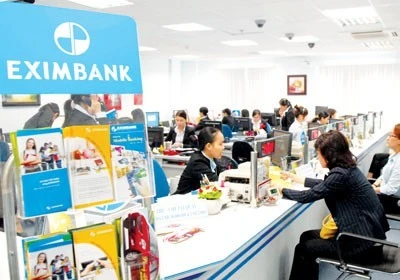
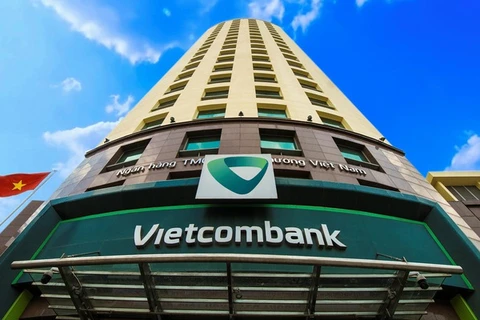
Vietcombank now holds less than 5 percent of the charter capital of MBB and EIB (Photo: Vietcombank)
 Hanoi (VNS/VNA) - The Joint Stock Commercial Bank for Foreign Trade of Vietnam (Vietcombank) has officially completed a plan to reduce its holding ratio at other credit institutions to below 5 percent as required by the central bank.
This week, the bank announced it was no longer a major shareholder of Military Bank (MBB) and Eximbank (EIB), holding less than 5 percent of the banks’ charter capital.
The bank reduced its stake in MBB to 4.98 percent, equal to 107.5 million MBB shares, after selling 19.39 million shares on the stock market from December 3-7.
Vietcombank’s holding at EIB was lowered to 59.5 million shares, or 4.84 percent of EIB’s charter capital, after offloading nearly 6.7 million EIB shares on December 6.
At a price of 22,000-22,500 VND per MBB share traded on the stock market from December 3-7, it was estimated that Vietcombank earned 426-436 billion VND from MBB divestment. The revenue from EIB divestment was estimated at some 96 billion VND as EIB closed at 14,300 VND on December 6.
Offloading holdings at MBB and EIB was necessary for Vietcombank to comply with the central bank’s Circular 36/2014/TT-NHNN, which allows commercial banks to hold shares in a maximum of two other credit institutions, with the stake in each not exceeding 5 percent of the total equity of that institution.
Vietcombank has already finalised the divestment of all its holdings at Saigonbank and Orient Commercial Joint Stock Bank (OCB).
According to analysts, the favourable stock market and the country’s positive economic growth have helped large banks, including Vietcombank, step up divestment from other financial institutions to meet the central bank’s regulation.
Banks also have to speed up divestment as the central bank has planned to apply stricter measures to effectively prevent cross-ownership at commercial banks.
According to the central bank, it will impose harsh penalties on banks that fail to meet the divestment deadline by bringing their ownership in other credit institutions to below 5 percent before June 30 next year. Penalties include possible rejection of bank proposals regarding top positions, such as members of the board of directors and supervisory board and the CEO.
Non-compliant shareholders will also have their dividend rights and right to serve on the board of directors suspended, and will be prohibited from increasing their stake in their respective banks.
Expert Bui Quang Tin said the strict regulations on cross ownership were necessary, as the practice has had a negative impact on the banking system, evident in the high ratio of non-performing loans.
Due to cross ownership, many banks increased their charter capital to several thousand billions of Vietnamese dong; however, the source of the capital was unreal as it came from loans taken from other banks. — VNS/VNA
This week, the bank announced it was no longer a major shareholder of Military Bank (MBB) and Eximbank (EIB), holding less than 5 percent of the banks’ charter capital.
The bank reduced its stake in MBB to 4.98 percent, equal to 107.5 million MBB shares, after selling 19.39 million shares on the stock market from December 3-7.
Vietcombank’s holding at EIB was lowered to 59.5 million shares, or 4.84 percent of EIB’s charter capital, after offloading nearly 6.7 million EIB shares on December 6.
At a price of 22,000-22,500 VND per MBB share traded on the stock market from December 3-7, it was estimated that Vietcombank earned 426-436 billion VND from MBB divestment. The revenue from EIB divestment was estimated at some 96 billion VND as EIB closed at 14,300 VND on December 6.
Offloading holdings at MBB and EIB was necessary for Vietcombank to comply with the central bank’s Circular 36/2014/TT-NHNN, which allows commercial banks to hold shares in a maximum of two other credit institutions, with the stake in each not exceeding 5 percent of the total equity of that institution.
Vietcombank has already finalised the divestment of all its holdings at Saigonbank and Orient Commercial Joint Stock Bank (OCB).
According to analysts, the favourable stock market and the country’s positive economic growth have helped large banks, including Vietcombank, step up divestment from other financial institutions to meet the central bank’s regulation.
Banks also have to speed up divestment as the central bank has planned to apply stricter measures to effectively prevent cross-ownership at commercial banks.
According to the central bank, it will impose harsh penalties on banks that fail to meet the divestment deadline by bringing their ownership in other credit institutions to below 5 percent before June 30 next year. Penalties include possible rejection of bank proposals regarding top positions, such as members of the board of directors and supervisory board and the CEO.
Non-compliant shareholders will also have their dividend rights and right to serve on the board of directors suspended, and will be prohibited from increasing their stake in their respective banks.
Expert Bui Quang Tin said the strict regulations on cross ownership were necessary, as the practice has had a negative impact on the banking system, evident in the high ratio of non-performing loans.
Due to cross ownership, many banks increased their charter capital to several thousand billions of Vietnamese dong; however, the source of the capital was unreal as it came from loans taken from other banks. — VNS/VNA
VNA