Vietnam aims to foster space technology
Vietnam hopes to lead ASEAN in satellite development in the coming
decades, Dr. Pham Anh Tuan, Director of the Vietnam Satellite Centre,
told the Ha Noi Moi (New Hanoi) newspaper.
Vietnam hopes to lead ASEAN in satellite development in the coming
decades, Dr. Pham Anh Tuan, Director of the Vietnam Satellite Centre,
told the Ha Noi Moi (New Hanoi) newspaper.
*Will the Vietnam Satellite Centre (VNSC) function like USA's NASA or Japan's JAXA when its construction is completed?
The Vietnam Academy of Science and Technology (VAST) thought of establishing the VNSC in 2007 after the Prime Minister approved a national research and development for space technology.
Work on the centre is underway at the Lang Hoa Lac Hi-Tech Park, some 40km from Hanoi. Fund for the centre's construction comes from two main sources: Japanese ODA (over 600 million USD) and government's counterpart contribution. The centre is expected to open in 2020 as scheduled.
Vietnam's strategy for space technology development has two main objectives: the first is that by 2020, Vietnam will be able to design, integrate and test small satellites orbiting the earth; the second is to collect and process data sent back from the satellites in order to provide timely information about natural disasters like floods and storms, and assist with climate change adaptation.
For this, the centre needs to investment in three components at the same time - technical infrastructure, technology transfer, and human resources development.
*According to the plan, following the launch of micro satellite "PicoDragon" in 2013, the VNSC will improve its technological capabilities and launch its first commercial satellite by 2020. Is this feasible?
Yes, it is feasible. The PicoDragon we sent is programmed to capture images of the earth, collect space environment data and test communication systems. Weighing nearly one kg, it was developed by young engineers and researchers of the centre.
In 2016, a 10kg weight NanoDragon will be launched into space and a 50kg MicroDragon will be launched into space by 2020.
To make sure everything will be completed on schedule, the centre has worked hard on all fronts, including building infrastructure and training human resources so as to absorb new technology.
*How can we focus on developing space and aviation technology when our electronics, communications or engineering industries have yet fully developed?
Every country adopts a different approach to technological development.
When we talk about a "made-in-Vietnam" satellite, it should be understood that it has been designed by Vietnamese engineers. Some of its spare parts are imported and some are made in Vietnam. But, the important assembling step will be done in Vietnam.
The first telecommunications satellite VINASAT-1 was successfully launched on April 19, 2008. It marked a turning point in the development of Vietnam's telecommunications and information technology sector. It has also served as a base for further research and launching of more satellites.
Then, four years later, in 2012, the ground breaking ceremony for constructing VNSC was launched. Then a year later, we successfully launched the PicoDragon.
*Can you tell us a bit more about satellite images of our natural resources as also how they help in natural disaster prevention and mitigation?
So far we have been very active in conducting research and applying satellite technology to serve daily life.
For example, we have used satellite images to assess damage caused by storms and other natural disasters. We have also developed the mathematical models to evaluate the impacts of climate change and other phenomena.
The centre plans to research satellite application in surveillance and early natural disaster warning, including forest fires, flooding, landslides, oil spills and others. It will also expand its international cooperation, particularly with countries in the region.
*Can you talk a bit about cooperation in the production chain for Japanese commercial satellites?
No, it is not in the production chain for Japanese commercial satellites. The plan is to share satellite images among countries in the region towards gaining early warnings of natural disasters. For example, our centre is preparing to join the Japanese Quasi-Zenith Satellites System (QZSS). The Japanese QZSS uses multiple satellites that have the same orbital period as geostationary satellites with some orbital inclinations - their orbits are known as "Quasi-Zenith Orbits".
These satellites are placed in multiple orbital planes, so that one satellite always appears near the zenith above the region of Japan. The system makes it possible to provide high accuracy satellite positioning services covering close to 100 percent of Japan, including urban canyon and mountain terrain.
*How is VNSC developing the human resources it needs?
I should say that human resources development is the most important part of developing satellite technology in Vietnam. They are trained at home and abroad, in countries like Japan, the Republic of Korea and Germany.
The centre has sent about 100 people to Japan for further training in the application and management of satellite. As of now, up to 60 percent of VNSC staff are under 30 years old.-VNA
*Will the Vietnam Satellite Centre (VNSC) function like USA's NASA or Japan's JAXA when its construction is completed?
The Vietnam Academy of Science and Technology (VAST) thought of establishing the VNSC in 2007 after the Prime Minister approved a national research and development for space technology.
Work on the centre is underway at the Lang Hoa Lac Hi-Tech Park, some 40km from Hanoi. Fund for the centre's construction comes from two main sources: Japanese ODA (over 600 million USD) and government's counterpart contribution. The centre is expected to open in 2020 as scheduled.
Vietnam's strategy for space technology development has two main objectives: the first is that by 2020, Vietnam will be able to design, integrate and test small satellites orbiting the earth; the second is to collect and process data sent back from the satellites in order to provide timely information about natural disasters like floods and storms, and assist with climate change adaptation.
For this, the centre needs to investment in three components at the same time - technical infrastructure, technology transfer, and human resources development.
*According to the plan, following the launch of micro satellite "PicoDragon" in 2013, the VNSC will improve its technological capabilities and launch its first commercial satellite by 2020. Is this feasible?
Yes, it is feasible. The PicoDragon we sent is programmed to capture images of the earth, collect space environment data and test communication systems. Weighing nearly one kg, it was developed by young engineers and researchers of the centre.
In 2016, a 10kg weight NanoDragon will be launched into space and a 50kg MicroDragon will be launched into space by 2020.
To make sure everything will be completed on schedule, the centre has worked hard on all fronts, including building infrastructure and training human resources so as to absorb new technology.
*How can we focus on developing space and aviation technology when our electronics, communications or engineering industries have yet fully developed?
Every country adopts a different approach to technological development.
When we talk about a "made-in-Vietnam" satellite, it should be understood that it has been designed by Vietnamese engineers. Some of its spare parts are imported and some are made in Vietnam. But, the important assembling step will be done in Vietnam.
The first telecommunications satellite VINASAT-1 was successfully launched on April 19, 2008. It marked a turning point in the development of Vietnam's telecommunications and information technology sector. It has also served as a base for further research and launching of more satellites.
Then, four years later, in 2012, the ground breaking ceremony for constructing VNSC was launched. Then a year later, we successfully launched the PicoDragon.
*Can you tell us a bit more about satellite images of our natural resources as also how they help in natural disaster prevention and mitigation?
So far we have been very active in conducting research and applying satellite technology to serve daily life.
For example, we have used satellite images to assess damage caused by storms and other natural disasters. We have also developed the mathematical models to evaluate the impacts of climate change and other phenomena.
The centre plans to research satellite application in surveillance and early natural disaster warning, including forest fires, flooding, landslides, oil spills and others. It will also expand its international cooperation, particularly with countries in the region.
*Can you talk a bit about cooperation in the production chain for Japanese commercial satellites?
No, it is not in the production chain for Japanese commercial satellites. The plan is to share satellite images among countries in the region towards gaining early warnings of natural disasters. For example, our centre is preparing to join the Japanese Quasi-Zenith Satellites System (QZSS). The Japanese QZSS uses multiple satellites that have the same orbital period as geostationary satellites with some orbital inclinations - their orbits are known as "Quasi-Zenith Orbits".
These satellites are placed in multiple orbital planes, so that one satellite always appears near the zenith above the region of Japan. The system makes it possible to provide high accuracy satellite positioning services covering close to 100 percent of Japan, including urban canyon and mountain terrain.
*How is VNSC developing the human resources it needs?
I should say that human resources development is the most important part of developing satellite technology in Vietnam. They are trained at home and abroad, in countries like Japan, the Republic of Korea and Germany.
The centre has sent about 100 people to Japan for further training in the application and management of satellite. As of now, up to 60 percent of VNSC staff are under 30 years old.-VNA


You should also see
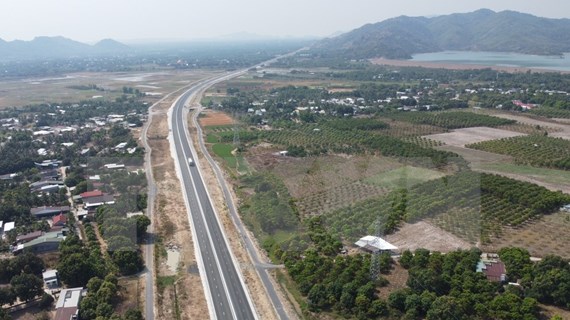
Cam Lam - Vinh Hao Expressway to help drive south-central region's economy
The 78.5km Cam Lam - Vinh Hao Expressway, one of the three sub-projects of the North - South Expressway project’s eastern wing, officially opened to traffic on April 26.

See more
 Sci-Tech
Lao minister seeks Vietnamese tech solutions in logistics
Lao Minister of Industry and Commerce Malaithong Kommasith on April 24 led a delegation to FSI Investment and Trading Technology Development JSC (FSI) to explore Make in Vietnam technology solutions that could support Laos' digital transformation in the logistics sector and, consequently, propel economic and trade cooperation between the two countries.
 Sci-Tech
Semiconductor workforce development a breakthrough: PM
Human resources development in semiconductors should be considered a breakthrough in personnel training, Prime Minister Pham Minh Chinh said at a conference in Hanoi on April 24.
 Sci-Tech
Completed legal framework helps better manage virtual assets
Vietnam needs to complete a legal framework to better manage virtual assets (VAs) as well as virtual asset service providers (VASPs), experts said at an annual forum on Blockchain and AI held by the Vietnam Blockchain Association in Hanoi on April 24.
 Sci-Tech
PM requires full legal corridor to promote national digital transformation
Prime Minister Pham Minh Chinh on April 24 requested more efforts to step up institutional improvement, create a full legal corridor to promote national digital transformation and develop the digital economy while addressing the eighth meeting of the National Committee for Digital Transformation.
 Sci-Tech
National awards honour 84 technical innovations
Eighty-four works were honoured with the 17th National Technical Innovation Awards at a ceremony held in Hanoi on April 23.
