Vietnam concerned about Brazil’s rules on aquatic imports

The Vietnam Sanitary and Phytosanitary Notification Authority and Enquiry Point (SPS Vietnam Office) has expressed the country’s concern over Brazil’s application of regulations that go beyond international practices on shrimp and tra fish imported from Vietnam.
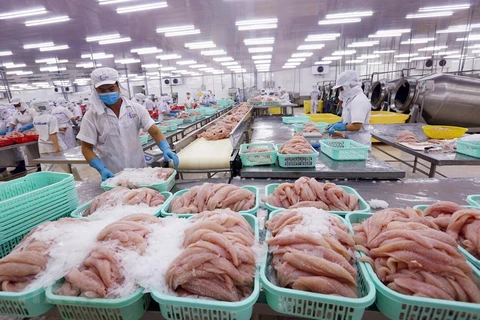
Vietnam concerned about Brazil’s rules on aquatic imports ảnh 1A tra fish processing factory in Dong Thap province (Photo: VNA)
HCM City (VNA) - The Vietnam Sanitaryand Phytosanitary Notification Authority and Enquiry Point (SPS Vietnam Office)has expressed the country’s concern over Brazil’s application of regulationsthat go beyond international practices on shrimp and tra fish imported from Vietnam.

SPS Vietnam has asked the country’s permanent missionto the UN, the WTO, and other international organisations in Geneva to liaise withBrazil’s permanent mission to the WTO to convey Vietnam’s concern.

Deputy Director of SPS Vietnam Ngo Xuan Nam saidthe office proposed online bilateral meetings be held to discuss the issue andthat necessary procedures be conducted to include Vietnam’s concern on the agendaof the Committee on Sanitary and Phytosanitary Measures’ March session.

Regarding Brazil’s rules on fish and shrimp importsthat do not match international practices, Ngo Hong Phong, Deputy Director of theNational Agro-Forestry-Fisheries Quality Assurance Department at the Ministry ofAgriculture and Rural Development, said Brazil is only permitting the use of phosphatefood additives on the ice cover of aquatic products.

This regulation is not in line with standards issuedby the UN’s Codex Alimentarius Commission and international practices, he noted,adding that other markets such as the EU, the US, and Canada allow the use of phosphatesfor aquatic products at certain levels and do not limit the use to the ice cover,he noted.

To facilitate bilateral trade, the Vietnamese sidehas asked Brazil to reconsider and align its regulations on phosphate use withthe Codex standards and international practices.

Truong Dinh Hoe, Secretary General of the VietnamAssociation of Seafood Exporters and Producers (VASEP), said Vietnam’s aquatic exportsto Brazil topped 44 million USD in 2020, including 43 million USD from tra fish.

Though shipments to the South American country makeup only a small proportion of Vietnam’s aquatic exports, it is considered a marketwith much room left for promoting tra fish exports. Therefore, the removal of regulationsthat fall outside of international practices will help Vietnamese businesses tapfurther into the market, Hoe said./.
VNA

See more

The completion of Can Tho - Ca Mau expressway has helped shorten travel time from Can Tho to Ca Mau to just one hour and a half (Photo: VNA)

Can Tho–Ca Mau expressway fully opens from January 19

The new section, together with the Can Tho–Hau Giang segment that has been operating smoothly since late December last year, has completed the entire 110.85-km route. With total investment exceeding 27.52 trillion VND (1.04 billion USD), the four-lane expressway is built to modern standards and serves as a key transport artery linking major economic and political centres, industrial zones and seaports in the southwestern region.

Vietnam aims to export 7 million tonnes of rice in 2026 (Photo: VNA)

Vietnam to proactively reduce rice exports from 2026

Do Ha Nam, Chairman of the Vietnam Food Association (VFA), said that 2026 presents numerous difficulties and challenges, and the global supply glut significantly impacts all exporters, including Vietnam.

Vietjet to operate nearly 1,800 additional flights for Lunar New Year peak (Photo: Vietjet Air)

Vietjet adds nearly 1,800 flights for peak Lunar New Year travel

Passengers planning to travel during the Tet peak period are advised to book tickets early to secure suitable flight schedules. They are also encouraged to complete online check-in within 24 hours prior to departure via Vietjet’s website at www.vietjetair.com, the Vietjet mobile application or the VNeID platform, in order to save time at airport check-in counters.

VinFast will provide each university with two electric cars, along with practical equipment and training materials on electric vehicle repair techniques that meet official standards (Photo: VNA)

VinFast collaborates with 30 colleges to standardise training for EV engineers

VinFast will work with leading institutions offering automotive engineering programmes, including the University of Transport and Communications, the Ho Chi Minh City University of Technology, the Hanoi University of Industry and the Hung Yen University of Technology and Education, to implement hands-on training aligned with industry needs.

Illustrative image (Photo: VNA)

E-commerce at turning point as new law sets higher standards in 2026

To propel the digital economy forward, experts said 2026 should be the year of foundational reforms, including standardised identification for sellers and marketers, real-time transparency in product details, enhanced logistics and financial infrastructure, and robust safeguards for authentic value creation.

Illustrative photo (Photo: VNA)

Billion-dollar capital seeks new opportunities in data centre real estate

Ho Chi Minh City is witnessing a strong investment wave in the data centre sector. The city has set up a dedicated task force to support investment procedures for a Hyperscale Data Centre serving AI development, with total investment estimated at around 2 billion USD. The investor consortium includes UAE-based technology company G42, Microsoft, FPT Corporation, VinaCapital, and Viet Thai Group.

Party General Secretary To Lam (C) and Prime Minister Pham Minh Chinh (third from left) and other delegates break ground Vietnam’s first semiconductor chip manufacturing plant (Photo: VNA)

Vietnam launches first semiconductor chip manufacturing plant

The plant, developed by Viettel Group in line with the mission assigned by the Ministry of Defence and based on the government’s resolution, is located on a 27-hectare site within the Hoa Lac High-Tech Park and is expected to serve national industries such as aerospace, telecommunications, Internet of Things (IoT), automotive manufacturing, medical equipment, and automation.

Vietnam’s cashew exports in 2025 are estimated at 766,600 tonnes, generating more than 5.2 billion USD (Photo: VNA)

Cashew sector faces economic efficiency challenge despite high export revenue

Vietnam’s cashew industry has faced a pressing challenge despite an export revenue of over 5 billion USD for the first time in 2025, as this impressive figure has yet to translate into commensurate economic efficiency for exporting enterprises, especially when the industry seeks to ensure that its position as the world’s leading cashew exporter is matched by sustainable profitability.