Havana (VNA) – Vietnam and Cuba have issued a joint statement on strengthening the traditional solidarity, special friendship and comprehensive cooperation in the new period.
The joint statement was issued right after General Secretary of the Communist Party of Vietnam (CPV) Central Committee and President of Vietnam To Lam, his spouse and the high-ranking delegation of Vietnam concluded a state visit to Cuba from September 25-27 at the invitation of First Secretary of the Communist Party of Cuba (PCC) Central Committee and President of Cuba Miguel Diaz-Canel Bermudez and his wife.
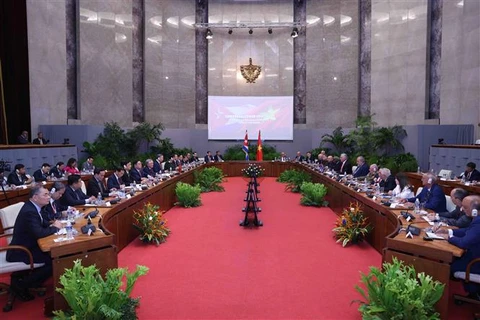
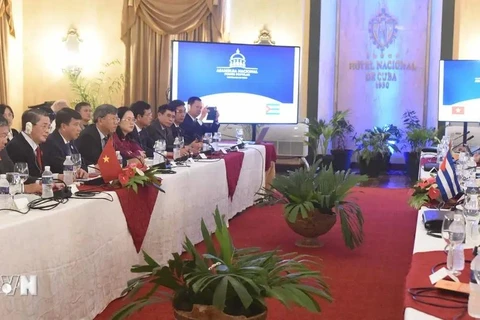
During the visit, the top Vietnamese leader held talks with Miguel Diaz-Canel Bermudez, and met with President of the National Assembly of People's Power of Cuba Esteban Lazo Hernandez and Politburo member and Prime Minister of Cuba Manuel Marrero Cruz.

General Secretary and President To Lam paid a courtesy visit to the Cuban revolutionary leader, General Raúl Castro Ruz, reaffirming the special nature of the Vietnam-Cuba friendship and the development of solidarity, cooperation, and mutual trust between the Parties, States, and people of both countries.
He laid wreaths at the monuments of Cuban national hero José Martí and President Ho Chi Minh, and visited the Mariel Special Development Zone. He also had friendly meetings with Cuban friends and younger generations.
Recognising Lam's valuable contributions to the bilateral relationship over the years, the President of Cuba awarded him the Order of José Martí, the highest honour in Cuba.
The two sides appreciated the outcomes of the state visit, stressing that this is the first visit of the General Secretary of the CPV Central Committee and President of Vietnam to Cuba. The visit marks an important milestone in the relationship between the two countries, ushering Vietnam-Cuba relations into a new phase of substantive and sustainable development for the benefit of their people, for socialism, and for peace, cooperation, and development in each region and globally. It reflects the appreciation, deep affection and unwavering support of the Vietnamese Party, State, and people for Cuba's noble revolutionary cause.
The Vietnamese side reaffirmed its solidarity and steadfast support for Cuba's efforts to overcome its difficulties and challenges. It believed that under the leadership of the Communist Party of Cuba and the direction of the revolutionary leader, General Raúl Castro Ruz, and First Secretary and President Miguel Díaz-Canel Bermúdez, the Party, State, and people of Cuba will consistently pursue their goals, maintain national unity, and further strengthen their position and role in the region and the world.
The Cuban side congratulated Vietnam on the tremendous achievements of historical significance attained after nearly 40 years of Doi moi (Renewal) process. It expressed strong support for Vietnam and believed that under the sound leadership of the CPV, led by General Secretary and President To Lam, the Party, State, and people of Vietnam will successfully implement the Resolution of the 13th National Party Congress and successfully organise the 14th congress in early 2026, realising the goal of making Vietnam a developed, high-income socialist-oriented country by 2045.
The two leaders reaffirmed that the special friendship, cooperation, and traditional solidarity between Vietnam and Cuba are a symbol of the era and a priceless asset of both Parties and the people of the two countries. They expressed their determination to continue inheriting and promoting the enduring legacies of President Ho Chi Minh and the historical leader of the Cuban revolution, Fidel Castro, who were pioneers in preserving and enhancing the fine, special and traditional friendship and cooperation between the two nations.
Expressing satisfaction with the growing Vietnam-Cuba relations across all levels and sectors, they reaffirmed their determination to elevate the bilateral special relationship to a new height, aiming for more comprehensive, substantive, effective and sustainable growth.
Both sides agreed to step up the exchange of delegations, especially those at the high level, increase theory exchanges and sharing of experience in building socialism and Party building. They also concurred on the need to improve the effectiveness of cooperation mechanisms between the two Parties and their advisory bodies.
They agreed on the importance of promoting exchanges and cooperation between cities, provinces, and specialised agencies of each country.
In terms of legislative coordination, they vowed to strengthen legal and judicial cooperation, creating a legal framework to facilitate bilateral economic, trade, and investment activities, ensuring that commitments can be implemented feasibly and sustainably.
In addition to forging closer ties in national defence-security and external relations, they promised to deepen economic, trade, and investment ties by enhancing exchanges, removing obstacles, and fully leveraging the Vietnam-Cuba Trade Agreement to boost trade turnover and diversify bilateral trade.
Ministries, agencies, and localities were tasked with expanding collaboration in potential and priority sectors such as agriculture, food processing, pharmaceuticals, biotechnology, healthcare services, energy, telecommunications, tourism, construction, transportation, high technology, digital transformation, and others.
A commitment was also made to jointly study and propose new models for agricultural cooperation. This initiative aims to help Cuba increase its production capacity, develop its agricultural sector, and ensure food security.
Both sides commended the outcomes of recent people-to-people exchanges and agreed to further enhance collaboration between their socio-political organisations and localities. They underscored the importance of nurturing and educating younger generations to cherish, preserve, and further develop the exemplary, loyal, and special relationship between the two nations. They declared 2025 as the "Vietnam-Cuba Friendship Year," and agreed to jointly organise practical activities to commemorate the 65th anniversary of the nations’ diplomatic relations (December 2, 1960 – 2025).
The two sides stressed their complete alignment on international issues of mutual concern. They agreed that international disputes must be resolved through peaceful means, based on respect for international law and the United Nations Charter. Relations between nations must be founded on the principles of respect for independence, sovereignty, equality, and the right to self-determination of peoples, in line with the basic principles of international law, including mutual respect for territorial integrity and non-interference in each other's internal affairs.

Both sides reaffirmed the inviolable right of all nations to develop equally, according to their own national conditions, without discrimination or external interference. They highlighted the necessity of responsible use of information technology, communications, the Internet of Things, particularly artificial intelligence, and social media to foster development, happiness, harmony, peace, and knowledge.
The two leaders expressed their satisfaction with the active mutual support and cooperation between the two nations at international organisations and multilateral forums of which they hold membership, particularly the United Nations.
Vietnam always supports the just cause of the Cuban people, calling for the immediate and unconditional lifting of unilateral, unjust economic, trade, and financial sanctions imposed on Cuba, as well as the immediate removal of Cuba from the unilateral list of state sponsors of terrorism. Vietnam supports efforts to improve Cuba-US relations and to expand cooperation between them on issues of mutual interest based on equality and respect for each country’s independence, sovereignty, and political system.
Both sides recognised the role of the Community of Latin American and Caribbean States (CELAC), the Association of Southeast Asian Nations (ASEAN), and the Forum for East Asia-Latin America Cooperation (FEALAC) in promoting friendship, peace, and cooperation, based on mutual respect, non-interference, tolerance, and peaceful coexistence, as stated in the declaration of Latin America and the Caribbean as a Zone of Peace.
Party General Secretary and State President To Lam thanked the Party, State and people of Cuba for the warm and thoughtful reception accorded to him and the high-level Vietnamese delegation. He extended an invitation to First Secretary of the Communist Party of Cuba Central Committee and President of Cuba Miguel Diaz-Canel Bermudez to make an official visit to Vietnam in 2025, and the latter graciously accepted the invitation. The visit will be arranged through diplomatic channels./.