Vietnam eyes green solutions for transportation sector

In the context of sustainable growth as a trend in the global economy, many transportation companies in Vietnam are striving to build environmentally friendly supply chains as a competitive advantage in delivery and market expansion, especially given that transportation accounts for up to 37% of global greenhouse gas emissions.

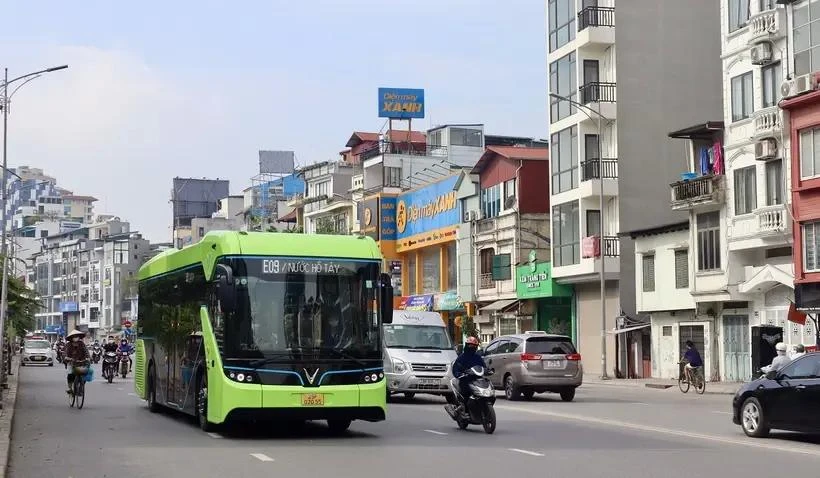
Hanoi launches additional electric bus routes to reduce greenhouse gas emissions into the environment. (Photo: VNA)

Hanoi (VNA) - In the context of sustainable growth as a trend in the global economy, many transportation companies in Vietnam are striving to build environmentally friendly supply chains as a competitive advantage in delivery and market expansion, especially given that transportation accounts for up to 37% of global greenhouse gas emissions.

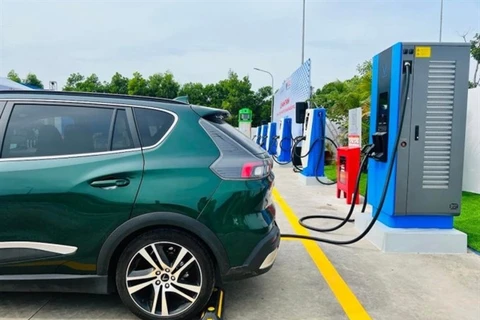
Green transportation refers to the use of environmentally friendly modes of transportation that minimize emissions and reduce reliance on fossil fuels by using electric or hybrid vehicles, as well as biofuels and other sustainable fuels.

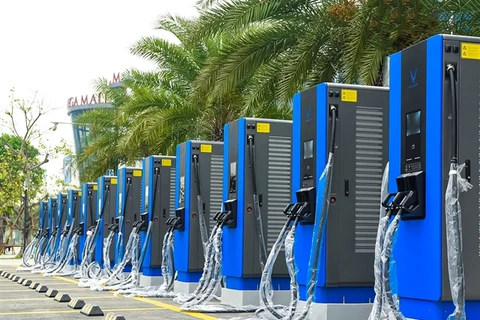
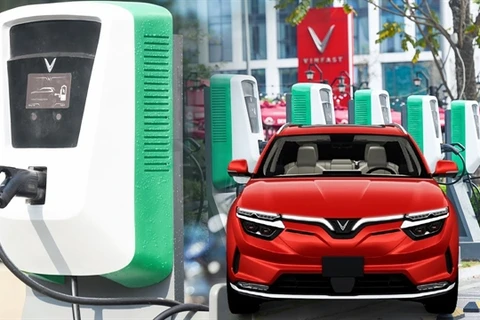
However, transportation infrastructure in Vietnam is still incomplete, especially in remote areas. This poses challenges for the use of environmentally friendly means of transportation, such as electric vehicles (EV). The lack of support infrastructure, such as EV charging stations, green warehouses, and distribution centres is also a barrier for businesses.

Nguyen Thi Phuong Hien, Deputy Director of the Transport Development & Strategy Institute, stated that the transportation development strategy aims to promote green logistics toward sustainable growth in Vietnam through the implementation of strategies for green freight transportation, as well as for maritime, aviation, railway, inland waterways, and road sectors. The ultimate goal is to achieve net-zero emissions in the transportation system by 2050.

Vice President of the Vietnam Maritime Corporation Le Quang Trung said that a large number of ships operated by Vietnamese shipping companies are aging and do not meet the carbon emission reduction requirements set by the International Maritime Organisation (IMO). When participating in international shipping routes, these vessels are forced to reduce engine power, which can lead to technical damage and significantly lower ship speeds. Some are aged to the point where it only makes sense to take them out of service.

To meet the IMO requirement of reducing carbon emissions by at least 2% annually, ship owners must not only equip their vessels with additional technology but also undertake significant structural modifications or invest in ships using alternative fuels such as liquefied natural gas (LNG) or methanol.

Currently, the Ministry of Transport is implementing the National Green Growth Strategy for the 2021-2030 period, with a vision to 2050, as approved by the Prime Minister. This involves reviewing and recommending adjustments to transportation development projects to ensure the restructuring of transportation market share towards green and sustainable growth.

In addition, the sector is focusing on applying digital technology to optimize the management and operation of transportation infrastructure and activities, ensuring safe and smooth transportation while reducing energy consumption./.
VNA

See more

Rice harvest in Xuan Giang commune, Ninh Binh province. (Photo: VNA)

Plan issued to develop agricultural logistics system

A key target is that by 2030, all concentrated agricultural, forestry and fisheries production areas will have access to essential services, including product traceability, quarantine, testing, quality certification, processing and market development. The move reflects growing international demand for stricter food safety, quality and traceability standards, which have become increasingly important for agricultural exports.

Delegates at the signing ceremony (Photo: VNA)

Vietnam, RoK boost micro-business cooperation

Vietnam's young population, dynamic market, and big growth potential are a perfect fit for the strengths that Korean micro-businesses bring in K-brands, technology, and service expertise, said KFME President Song Chi Young.

Cars at a public parking lot in Hai Phong city. (Photo: VNA)

Vietnam's auto sales rise 15%, hybrid, imported vehicles continue to outperform

With auto loan interest rates remaining competitive, stable vehicle supply, and an increasingly diverse product range, Vietnam's automotive market is expected to maintain its growth momentum through the remainder of 2026. SUVs, MPVs, and hybrid vehicles are likely to remain the main drivers of overall market sales.

The MoU signing ceremony between Becamex VSIP Binh Dinh and PV Gas CNG in Gia Lai province on June 26, 2026 (Photo: nhandan.vn)

Gia Lai positions itself as magnet for sustainable investment

Vice Chairman of the provincial People's Committee Nguyen Huu Que said ESG is no longer a communications message or a cost burden, but an essential requirement for accessing global capital. Gia Lai has chosen ESG as a pillar for building new competitive advantages and achieving sustainable development.

Chairman of the Tay Ninh provincial People's Committee Le Van Han delivers remarks at the inauguration ceremony. (Photo: VNA)

Suntory PepsiCo inaugurates 300-million-USD plant in southern Tay Ninh province

Built on nearly 20 hectares at Huu Thanh Industrial Park, the facility is the company's largest and most advanced plant in Vietnam and the biggest production site in Suntory PepsiCo's Asian manufacturing network. The factory has a designed annual production capacity of over 1.24 billion litres and is equipped with highly automated production, filling and warehousing systems.

Ho Chi Minh City inaugurates a UAV postal route linking Can Gio commune and Vung Tau ward on February 12, 2026. (Photo: VNA)

Ho Chi Minh City promotes UAV applications to develop low-altitude economy

With its enlarged development space, Ho Chi Minh City now combines strengths in urban development, industry and services with high-tech agriculture, the marine economy, logistics and diverse ecological areas. These conditions provide an ideal testing ground for UAV applications in urban management, land administration, environmental monitoring, disaster prevention and response, agriculture, logistics and public services.

Workers produce outdoor wooden furniture for export to Europe at the factory of Hong Ngoc Co., Ltd. in Phu Tai Industrial Park, Quy Nhon Bac ward, Gia Lai province. (Photo: VNA)

Vietnam's wood exporters race to stay on growth path

Despite headwinds from Middle East tensions that have pushed up freight and logistics costs, exports of wood and wood products were estimated at 1.53 billion USD in June, lifting first-half export turnover to 8.54 billion USD, up 4.4% from a year earlier, according to the Ministry of Agriculture and Environment (MAE).

Workers make clothes for export to the Japanese market at Hung Viet Garment Company in Hung Yen province. (Photo: VNA)

Vietnam seeks stronger export growth in H2

Despite the encouraging performance, Vietnam's exports remain heavily dependent on a limited number of major markets and product groups, while the domestic value added of many export products remains relatively low because of their reliance on imported raw materials and components.

Hiep Phuoc Industrial Park in Hiep Phuoc commune, Ho Chi Minh City. (Photo: VNA)

Ho Chi Minh City: Industrial, export processing zones attract over 2.6 bln USD in H1

Speaking at the at the city's regular socio-economic press briefing on July 9, Deputy Head of the Ho Chi Minh City Export Processing and Industrial Zones Authority (HEPZA) Tran Viet Ha said that foreign direct investment (FDI) accounted for nearly 1.6 billion USD of the total, including 65 newly licensed projects worth more than 867 million USD and 83 existing projects that added over 707 million USD in registered capital.