Vietnam on track to rank among world’s 30 largest economies

Key sectors such as textiles and garments, wood and furniture, electronics, food processing, seafood, and industrial equipment have become internationally competitive, contributing to a dynamic and diversified industrial ecosystem.

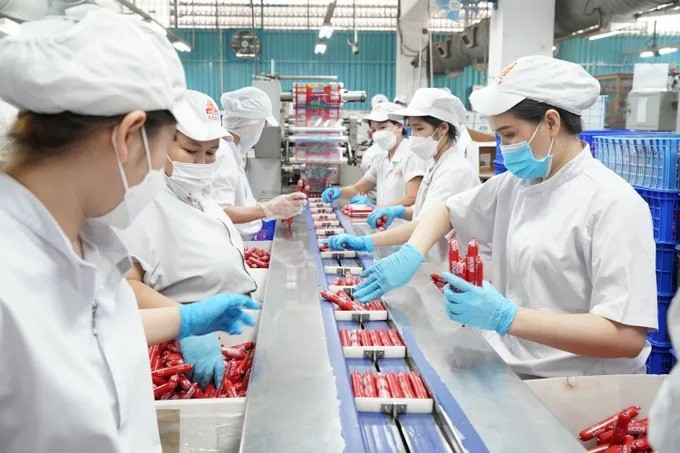
Product packaging line at the Vietnam Meat Industries Joint Stock Company (Vissan). (Photo: VNA)

Hanoi (VNA) – Vietnam’s economy is forecast to exceed 505 billion USD by the end of 2025, placing the country among the world’s 30 largest economies, according to projections by the World Bank.

Domestic momentum powering Vietnamese goods to global markets

Experts highlight that Vietnam is now one of the world’s 20 most open economies, with total import-export turnover in 2024 reaching over 786 billion USD, up more than 15% compared to the previous year.

Key sectors such as textiles and garments, wood and furniture, electronics, food processing, seafood, and industrial equipment have become internationally competitive, contributing to a dynamic and diversified industrial ecosystem.

Nguyen Quoc Khanh, Chairman of AA Corporation and Vice Chairman of the Vietnam Timber and Forest Products Association (VIFOREST), said Vietnam holds vast potential in deep-processing industries. In the green furniture segment alone, he noted, efficient use of resources could lift wood exports to 30 billion USD by 2035 while promoting globally competitive supporting industries.

Meanwhile, the food and beverage processing sector was valued at more than 79 billion USD in 2024, accounting for nearly one-fifth of national industrial output and maintaining average annual growth of around 7%, international research indicates. The packaged food market is expected to reach 26.9 billion USD by 2028, creating strong incentives for domestic firms to invest in sustainable packaging, modern processing technologies, and product traceability to meet growing global demand.

According to Vu Ba Phu, Director General of the Trade Promotion Agency under the Ministry of Industry and Trade, global markets continue to view Vietnamese enterprises as reliable producers and exporters. Vietnam’s textile and garment industry ranks among the world’s top three with export earnings of 42.1 billion USD in 2024, while wood and furniture exports rank second globally and seafood exports total 10 billion USD.

These results show that Vietnamese products, recognised for sustainability, cultural distinctiveness, and compliance with ESG standards, are increasingly acknowledged worldwide, affirming Vietnam’s rising status in global supply chains, he said.

Enhancing supply chain resilience

Despite robust growth, Vietnam’s industrial structure remains vulnerable, said Dr. Pham Thi Hong Phuong, Senior Advisor at the Innovation Centre of the Ho Chi Minh City University of Industry. Many firms still depend on processing, imported materials, and foreign supply chains, with up to 60% of raw materials in the food industry sourced from overseas.

To strengthen self-reliance, experts recommend that Vietnamese businesses adopt circular production models, invest in recycling and clean energy technologies, and implement green supply chain management aligned with ESG standards to qualify for major export markets such as the EU, the US, and Japan.

Enterprises also agree that Vietnam must move beyond its reliance on low-cost labour and basic processing. They emphasise the need to build “localisation alliances” linking companies, research institutions, and universities to develop domestic industrial clusters and complete component ecosystems.

As over 90% of Vietnamese firms are small and medium-sized, collaboration is essential to enhance competitiveness in global supply chains. Through joint efforts, the country aims to raise localisation rates to 50% by 2030, building an autonomous manufacturing base that supports the international expansion of Vietnamese products.

To create more room for domestic growth, Tran Tien Dung, General Director of Dai Dung Group, urged the State to open up opportunities for local enterprises to take part in national key projects. Across Vietnam, large-scale investments are underway in transport, metro systems, renewable energy, equipment manufacturing, and industrial construction, with total funding worth tens of billions of US dollars.

He described this as a “golden opportunity” for Vietnamese industry to leap forward, provided that policies are fine-tuned to enable deeper participation of domestic enterprises in the value chain.

However, businesses still face significant constraints, limited long-term financing, difficulty accessing green credit for technological upgrades, and industrial land costs that remain higher than those in regional peers.

Furthermore, existing bidding mechanisms often prevent Vietnamese firms from taking part in strategic projects such as metro lines, gas-fired power plants, and petrochemical complexes.

Experts propose establishing a network of local supporting industries through public-private partnerships, linking enterprises of different sizes to form a self-sufficient supply chain. They also recommend allowing conditional direct contracting for projects with at least 50% local content, allocating strategic industrial land for domestic investors, and expanding access to green credit for technology-driven development./.
VNA

See more

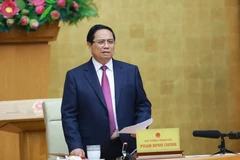
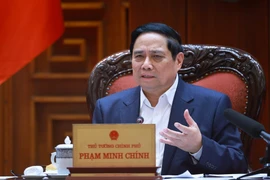
Prime Minister Pham Minh Chinh speaks at the 26th meeting of the National Steering Committee for Combating Illegal, Unreported and Unregulated (IUU) Fishing. (Photo: VNA)

Local leaders must be held accountable for IUU fishing violations: PM

PM Chinh requested the Government Inspectorate to promptly identify localities that lack determination or fail to handle violations thoroughly, including cases where vessels not meeting legal requirements are still allowed to leave ports, and to clarify responsibilities and impose sanctions without delay.

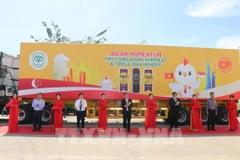
The ribbon-cutting ceremony marking the export of C.P. Vietnam's first container shipment to Singapore. (Photo: VNA)

C.P. Vietnam exports first processed chicken batch to Singapore

The CPV Food Binh Phuoc plant operates a closed-loop system and holds international certifications, including HACCP, BRC, ISO 22000, and Halal. Before reaching Singapore, the company’s processed chicken was already exported to Japan, Hong Kong (China), Cambodia, and Laos, with Japan alone importing 10,000 tonnes by November 2025.

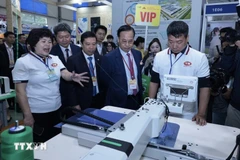
Delegates visit a booth at the exhibition (Photo: VNA)

HanoiTex & HanoiFabric 2025 kicks off

Running until December 18, HanoiTex & HanoiFabric is expected to contribute to sustainable development and stronger international integration of Vietnam’s textile and garment industry.

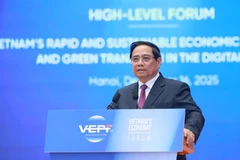
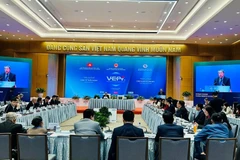
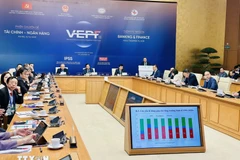
The thematic session on finance and banking of the Viet­nam Eco­nomy in 2025 and Pro­spects in 2026 Forum (VEPF). (Photo: VNA)

Vietnam economic forum 2025: balancing high growth and sustainability

At the thematic session on finance and banking, delegates focused on solutions for financial resources and eco­nomic growth tar­gets in the 2026-2030 period. The effective mobilisation of financial resources was identified as a key prerequisite for Vietnam to realise its target of double-digit economic growth during this phase.

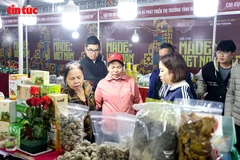
Local residents and visitors tour and shop at a fair. (Photo: VNA)

Made in Vietnam Fair set to open in Hanoi

The Made in Vietnam Fair will showcase a wide range of products, including industrial and consumer goods, processed foods, agricultural produce and handicrafts, with the participation of distribution systems, e-commerce platforms, digital platforms and digital financial solution providers operating in Vietnam.

2025 a good year for Vietnam’s securities sector: SSC

2025 a good year for Vietnam’s securities sector: SSC

During the year, the SSC made significant progress in improving the legal and policy framework. Institutional work was implemented in a coordinated manner, including the issuance of two decrees, one resolution, seven circulars and three major schemes. At the same time, the regulator strengthened policy dialogue and expanded cooperation with international organisations to support the market upgrade process.

Vietnam shows strong FDI performance in the first 11 months of 2025 (Source: vtv.vn)

Vietnam shifting FDI attraction focus from volume to quality

As production relocation to Southeast Asia accelerates and competition for FDI intensifies, Vietnam faces increasing pressure from regional rivals such as India, Malaysia and Indonesia, which are offering bold tax incentives and developing specialised industrial parks. This reality requires Vietnam to shift its focus from attracting large volumes of capital to drawing high-quality investment, prioritising core technologies, innovation, value chain linkages and higher localisation rates.

Vice Chairman of the Ho Chi Minh City People’s Committee Hoang Nguyen Dinh inspects IUU fishing prevention efforts at Hung Thai Port in Long Hai commune. (Photo: VNA)

Ho Chi Minh City steps up oversight of unqualified fishing vessels

HCM City currently has 4,475 fishing vessels, all of which have been registered and updated on the VNFishbase system. Among them, 4,268 vessels, or 95.37%, have been granted fishing licences, while 207 unqualified vessels are being strictly managed and kept ashore.

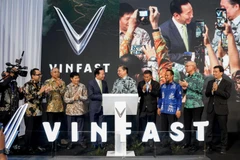
Airlangga Hartarto (fifth from right), Indonesian Coordinating Minister for Economic Affairs, and CEO of VinFast Asia Pham Sanh Chau (sixth from right) at the plant opening ceremony on December 15. (Photo: VinFast)

VinFast inaugurates EV plant in Indonesia

The VinFast Subang plant was completed and put into operation just 17 months after groundbreaking, demonstrating the company's rapid execution capability and strong implementation capacity. This is VinFast's fourth operational facility worldwide, and its first plant in Indonesia and Southeast Asia outside of Vietnam.