Vietnam owns abundant potential for renewable energy development

Vietnam has set a target of raising renewable energy production from 58 billion kWh in 2015 to 101 billion kWh in 2020, 186 billion kWh in 2030, and 452 billion kWh in 2050.
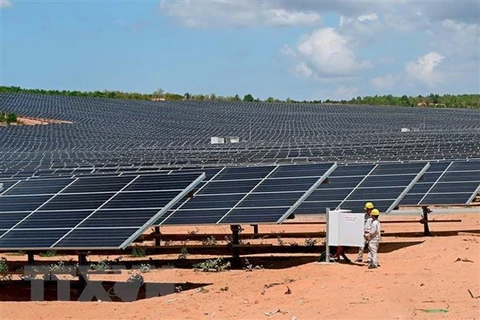
Vietnam owns abundant potential for renewable energy development ảnh 1Illustrative image (Source: VNA)

Hanoi (VNA) – Vietnam has set a target of raising renewableenergy production from 58 billion kWh in 2015 to 101 billion kWh in 2020, 186billion kWh in 2030, and 452 billion kWh in 2050.

Under the renewable energy development strategy of Vietnamtowards 2030 with a vision to 2050 that was approved by the Government in 2015,the country aims to increase the ratio of electricity from renewable sourcesfrom 35 percent of total electricity output in 2015 to 38 percent in 2020 and43 percent in 2050.

According to Nguyen Van Vy, Vice Chairman of the VietnamEnergy Association, Vietnam has abundant potential for renewable energy thanksto a long coastline and weather conditions favourable for the development ofhydro, wind, solar, biomass, geothermal power and bio-fuel.

Research shows that Vietnam can generate about 8,000MW of small-scalehydropower, 200MW of wind power, 3,000MW of biomass power, and 35,000MW ofsolar power in 2030.

In the mainland, Vietnam can produce about 30GW of windpower, along with 100GW from offshore wind farms.

As of the end of 2018, Vietnam had 285 small hydropowerplants with total output of 3,322MW, along with 8 solar power plants with 243MWin total output and 10 biomass power plants (212MW).

The Vietnam Electricity has signed power purchase agreements(PPA) with more than 100 solar power projects, two of which have becomeoperational with combined capacity of 86MW.

So far, electricity generation from renewable sources,excluding medium- and large-scale hydro power plants), has accounted for 2.1percent of the country’s electricity output.

Do Duc Quan, Vice Director General of the Electricity andRenewable Energy Authority under the Ministry of Industry and Trade said thatas of June 2019, total installation capacity of solar, wind and biomassprojects reached about 2.5GW, and 2GW more of solar power will be added.

Quan said that in order to encourage renewable energydevelopment, the ministry has submitted to the Government proposals on variousmechanisms such as Feed-in-Tariff mechanism, as well as incentives forinvestors in access to credit, corporate income tax, land use, and PPAs.

Besides, experts suggested Vietnam should create a transparentinvestment environment and a clear policy roadmap with long vision to helpinvestors make decision on long-term investment, he added.

However, Quan pointed out that the rapid growth of renewableenergy recently has also created a number of challenges such as high investmentcost, pressure on electricity grid infrastructure and large demand for land.

According to a report of the Vietnam Electricity, renewableenergy development has also faced problems in the operation system. Due to alack of official guidelines on payments, the EVN has yet to purchasehouseholds’ rooftop solar power. Alongside, big investment is also anotherproblem.-VNA
VNA

See more

UNESCO Representative to Vietnam Jonathan Wallace Baker and Japanese Ambassador Ito Naoki at the signing ceremony (Photo: baoquocte.vn)

UNESCO, Japan sign deal to bolster Vietnam’s disaster early warning

Climate change adaptation remains a top priority in Vietnam’s development strategy and national security outlook through 2050. Vietnam will maintain close cooperation with Japan, UNESCO and other partners to guarantee the project’s effectiveness and advance common goals.

The German Agency for International Cooperation (GIZ)'s Managing Director Thorsten Schäfer-Gümbel speaks at the working session with the Vietnamese-German University. (Photo: VNA)

Vietnam, Germany step up collaboration on energy transition, green hydrogen

Schäfer-Gümbel praised the strong commitment of Vietnamese partners to sustainable energy goals. He noted that the long-standing development cooperation between Germany and Vietnam is evolving, with energy transition emerging as a strategic area of collaboration in addressing global challenges.

Cat Ba langur is an extremely rare primate species found exclusively in the humid tropical forests of Cat Ba island (Photo: VNA)

Belgian TV spotlight: Vietnam's wild nature reborn

Through the lens of “Le Jardin Extraordinaire”, Vietnam was portrayed not simply as a travel destination but as a still-emerging realm of discovery: a nation whose nature, though heavily wounded in the past, demonstrates extraordinary powers of recovery, quietly upholding its pristine essence against the pressures of time.

The macaque, scientifically known as Macaca arctoides. (Photo: VNA)

Quang Tri receives endangered stump-tailed macaque

The Cam Lo-Dong Ha forest protection unit in the central province of Quang Tri has received a rare stump-tailed macaque, a species listed as endangered, precious and rare in the Vietnam Red Data Book.

At a ceremony to donate 100,000 trees to the Naval Region 4 (Photo: HANE)

Tree planting programme spreads green momentum in islands

The Ho Chi Minh City Association for Conservation of Nature and Environment (HANE) on January 11 announced 10 outstanding green programmes and activities carried out in 2025, including a programme to plant 1 million trees in Vietnam’s island areas.

Lam Dong releases hundreds of wild animals into the wild. (Photo: VNA)

Lam Dong releases hundreds of wild animals back into the wild

According to the Ta Dung National Park Management Board, the park has for years served as a trusted destination for authorities and residents to hand over and release wildlife. Such actions not only contribute to biodiversity conservation but also help reduce illegal hunting and captivity of wild animals.

According to the Hanoi Department of Agriculture and Environment, air quality index (AQI) readings have at times reached poor and very poor levels. (Photo: VNA)

Hanoi targets 20% reduction in PM2.5 levels

Hanoi has affirmed its commitment not to trade environmental protection for economic growth. The city is moving to establish low-emission zones (LEZs) as a core measure to control emissions and promote green, sustainable urban development.