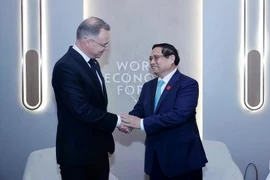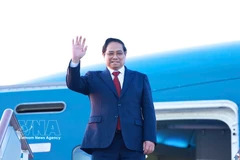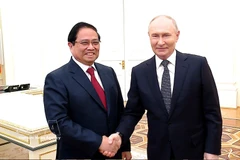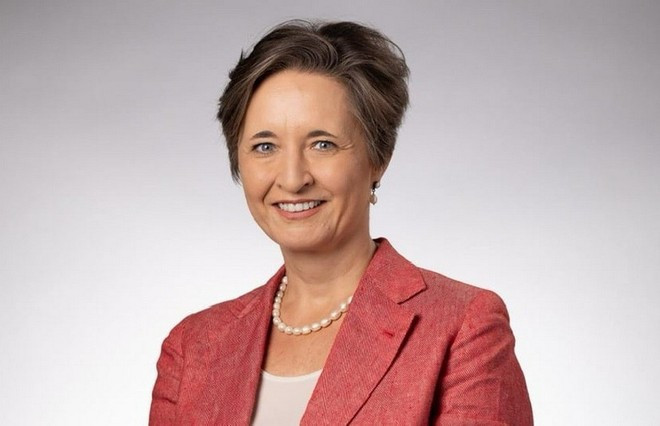
Hanoi (VNA) – Poland and Vietnam, which are important partners of each other with long-standing friendship, mutual understanding and support, need to make efforts to promote the partnership through concrete actions and projects, Polish Ambassador to Vietnam Joanna Skoczek has told local media ahead of Prime Minister Pham Minh Chinh's official visit to Poland.
Speaking about the significance of the visit, the ambassador said that PM Chinh's visit, on the threshold of the 75th anniversary of bilateral diplomatic relations (February 4, 1950 - 2025), is very meaningful. This will be the first trip by a Vietnamese PM to Poland in 15 years.
In addition to its political significance, the visit will also boost economic cooperation with great potential and enhancing business partnerships between the two countries.
It is an opportunity for both sides to review their bilateral cooperation and identify areas of mutual interest that can be further strengthened in the coming time. Many Vietnamese businesses will accompany PM Chinh on this visit, making it an opportunity for direct interactions between businesses of both countries, thus promtoing mutual interest and understanding, trade turnover, as well as scientific and academic exchanges.
The ambassador held that mutual understanding will be the key to successful cooperation and a foundation for boosting peace and prosperity in the current international security context.
While the two countries may sometimes have different viewpoints, what connects them lies in their respect for international law and the United Nations Charter, and the steadfastness in safeguarding sovereignty over land and at sea, she opined.
She said countries like Poland and Vietnam, which used to undergo wars to defend their homelands, are well aware that the principles of international law and effective multilateralism are key to peace, security, and prosperity of nations. Therefore, the visit will be an opportunity to demonstrate the two countries’ common stance on these issues.
According to Skoczek, the greatest asset in the bilateral relationship is the human element. They have a long-standing tradition of academic exchange. Particularly in the 1970s and 1980s, thousands of Vietnamese students came to Poland and graduated from its universities, and later held important positions in the Vietnamese Government, military, and industry.
Today, Poland has many diverse programmes for international students, she said, expecting to see more young Vietnamese coming to Poland.
Another important pillar of bilateral ties lies in the historical factor. Poland actively participated in international monitoring and control committees after the Geneva Accords were signed in 1954 and the Paris Peace Accords in 1973. This created a close-knit bond between the two countries, with Vietnam being an integral part of the map of countries important to Poland. From 1954 to 1956, Polish ship Kiliński helped transport more than 80,000 people, along with equipment and supplies from the South to the North of Vietnam.
Highlighting the two countries’ cooperation in cultural heritage, archaeology, and conservation, Skoczek said Kazik Kwiatkowski, a Polish archaeologist and conservator, helped rescue, protect, and introduce Vietnam's most important treasures during the 1980 - 1997 period such as the ancient capital of Hue, the Hoi An ancient town, and the Hindu temples in My Son.
More recently, during the COVID-19 pandemic, in response to Vietnam's call for help, Poland provided the Southeast Asian nation with 1.4 million vaccine doses and various medical equipment.
Last but not least, Poland has become the second home to a large, dynamic, and entrepreneurial Vietnamese community numbering tens of thousands.
Vietnamese people in Poland have integrated well into the host country’s society. Vietnamese restaurants and bars are among the most popular ones in Warsaw and other cities. The Vietnamese cuisine also attracts many Poles, inspring their interest in learning more about Vietnam, the ambassador said.
Regarding potential for Poland and Vietnam to promote cooperation in the coming time, the diplomat said both countries have experience in fast and continuous economic growth in recent years.
For Poland, it has been over 30 years since it carried out systematic economic and social reforms, facilitating the development of a market economy. Additionally, the countries are facing several development challenges such as energy transition and digitalisation demand.
She said this time's visit by PM Chinh, particularly activities related to economic cooperation, will bring about many opportunities for business-to-business (B2B) interactions, thereby fostering cooperative ideas.
Poland is ready to share its successes in the digitalisation of public services, as well as achievements in green transition, including recycling, emissions reduction, wastewater treatment, and renewable energy, Skoczek went on, noting she expects to see many B2B exchanges to boost business negotiations and contract signing in the coming months.
As the sixth largest economy in the EU and the 21st globally, Poland is ready to share its experiences, lessons, and expertise with Vietnamese partners and also learn from Vietnam, according to the ambassador./.