Vietnam resolved to defeat Jordan at Asian Cup qualifier

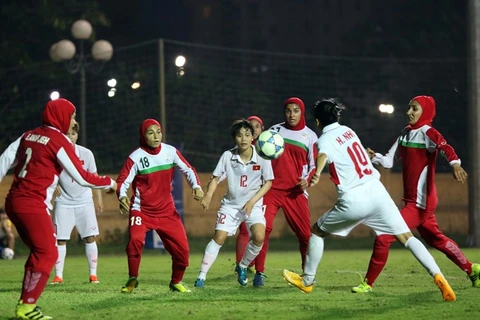
Vietnam will make use of its home advantage, spectators’ support and tactics to obtain three points in the June 13 game with Jordan, part of the 2019 AFC Asian Cup qualification, coach Nguyen Huu Thang said.
Vietnam resolved to defeat Jordan at Asian Cup qualifier ảnh 1Coach Nguyen Huu Thang of team Vietnam (Photo: VNA)

HCM City (VNA) – Vietnam will make useof its home advantage, spectators’ support and tactics to obtain three pointsin the June 13 game with Jordan, part of the 2019 AFC Asian Cup qualification,coach Nguyen Huu Thang said.

At a press conference on June 12, he said theJordanian team is a strong rival in the qualifying round as its players havegood physical strength and most of them are playing in developed footballcountries.

However, Vietnamese footballers also have goodbasis, he noted, adding that they are undergoing intensive training and haveprepared thoroughly for the match.

Playing on the home field with the support ofthousands of spectators, the Vietnamese team will exert every effort to achievethe best result, the coach added.

Meanwhile, coach Abdallah Mesfer of Jordan alsosaid they are determined to gain three points in the game.

He noted most of his Jordanians are playingfootball overseas and have learned much experience and tactics from manyplaces, which will be their advantage in the match against Vietnam.

The match between Vietnam and Jordan will takeplace at Thong Nhat Stadium in Ho Chi Minh City at 7 pm of June 13.-VNA
VNA

See more

Visitors to the exhibition at the Ho Chi Minh Museum in Hanoi. (Photo: VNA)

Exhibition on Lenin portraits opens in Hanoi

Featuring more than 156 photos of archival paintings, the exhibition introduces visitors to the life and legacy of Lenin, a prominent political theorist, revolutionary leader, and founder of the Soviet state.

Students of the Hung Vuong University visit the exhibition. (Photo: VNA)

International art exhibition bridges Vietnamese, Korean cultures

Through artistic works, the public gain deeper insights into the cultures and people of both nations, contributing to peace, cooperation, and development. The exhibition also helps younger generations better understand a dynamic Vietnam and a culturally rich RoK.

The illustrated book “100 Dieu tu hao Viet Nam” (Photo: nhandan.vn)

Book introduces 100 remarkable facts about Vietnam

The illustrated book “100 Dieu tu hao Viet Nam” (100 Proud Facts about Vietnam) compiles 100 highlights of Vietnam’s legacy across 11 major themes, including heroic history, cultural beauty, literature and the arts, medicine, education, architecture, science, cuisine and community values.

Children perform Xoan folk singing at the cultural camp. (Photo: VNA)

Hung Kings festival opens with vibrant cultural, tourism activities in Phu Tho

Beyond its role as a sacred national commemoration, the event helps promote cultural values, strengthen national unity and enhance cultural exchanges. A notable feature is the flexible organisation in 18 commune and ward clusters, encouraging the localities' participation and enriching the festival’s content.

A corner of the Book Street in Hanoi (Photo: VNA)

Hanoi celebrates Reading Culture Day with book street activities

Organised by the Book Street’s management board in collaboration with publishers and distributors, the programme will brings together 14 publishing and distribution units across 15 booths, offering readers access to a rich and diverse selection of book titles spanning literature, children’s books, life skills, economics, history, science-technology and education, among others.

Vietnam’s Consul General in Osaka Nguyen Truong Son speaks at the 9th Vietnam cultural festival in Osaka on April 19, 2026. (Photo: VNA)

Vietnam cultural festival in Osaka draws tens of thousands of attendees

Saito Naoki, Mayor of Ikuno Ward – where the event took place, expressed his pleasure at the rapid growth of the Vietnamese community in the area. He praised such cultural festivals for helping Vietnamese residents maintain their traditions while fostering mutual understanding and closer ties with Japanese locals.

Urawadee Sriphiromya, Thai Ambassador to Vietnam (third from left); Camila Polo Florez, Colombodian Ambassador to Vietnam (C); and Saadi Salama, Ambassador of Palestine to Vietnam (fifth from left), experience indigenous coffee culture in a coffee garden in Dak Lak. (Photo: doanhnghiepkinhtexanh.vn)

World Coffee Heritage Forum: A dialogue connecting coffee culture, knowledge

The recognition of "The knowledge of coffee cultivation and processing in Dak Lak” as a National Intangible Cultural Heritage marks an important milestone. It affirms the value of indigenous knowledge, creative labour, and the harmonious connection between local livelihoods, culture and nature in the Central Highlands.

The artwork "Harvest Day" by Doan Thi Thu Huong. (Photo: cand.com.vn)

Vietnam to join Venice Art Biennale with first national showcase

As Vietnam makes its debut at the Biennale, the exhibition “Vietnam: Art in a Global Flow” does not seek to assert its position through scale or grand statements, but rather opens up a space for meaningful artistic dialogue - an invitation to listen to subtle voices, contemplate in stillness, and reflect on the capacity to nurture sustained creative energy in a dynamic and ever-evolving art world.

Viet Youth Readiness Hub debuts at the event (Photo: VNA)

Vietnamese Canadian youth hub launched to fight mother tongue erosion

The Viet Youth Readiness Hub is seen as a dedicated platform to connect, support, and empower Vietnamese-Canadian youth. It aims to emerge as a central force to host social events, advance heritage education, foster exchange and integration among young Vietnamese in Canada.

At the event “Vietnamese Language in the heart of Kyushu, Japan” (Photo: VNA)

Vietnamese in Japan revive mother tongue among young generations

While the number of Vietnamese-origin children in Japan is surging, opportunities to actually speak Vietnamese in daily life are vanishing fast. Many children can understand the language but default to Japanese in response, gradually relegating their mother tongue to a secondary role, sometimes even treating it as a “second foreign language” inside their own houses.