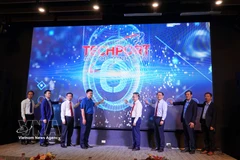
Hanoi (VNA) – The Ministry of Science and Technology (MoST) on June 30 officially launched the Vietnam Science and Technology Exchange, and outlined its future development direction.
The MoST positions the platform not just as a technical tool but as a core institutional infrastructure for building a knowledge-based economy. It aims to act as a “long arm” linking research, production, and the market.
In its current first phase, the exchange platform has integrated information on 600 technologies for sale, mainly equipment and machinery, over 50 registered technology procurement needs, a directory of 150 consultants and brokers, and online exhibition booths for showcasing technologies.
In the second phase, the platform will expand to offer interactive supply-demand matching, consulting and brokerage services, transaction tracking and analytics, advisory services in finance, IP, and technology transfer, as well as integration with national science, technology, and innovation databases, supporting hybrid (online/offline) modes.
The platform operates under a public–private partnership (PPP) model. The Government provides infrastructure, platform development, and data-sharing policies, while encouraging businesses to engage in safe, transparent, and efficient transactions.
Expected to be fully operational by this November, the Vietnam Science and Technology Exchange is poised to become a new engine of growth, modernising national science and technology institutions and driving depth-oriented economic development.
Amid global trends in digital transformation and innovation, technology markets have become crucial drivers of economic growth, especially in advanced economies.
According to the World Intellectual Property Organisation (WIPO) and the World Bank, countries with structured tech exchange systems typically see three to five times higher levels of R&D investment and patent commercialisation than those without.
In OECD nations, tech markets play a vital role in boosting productivity, bridging research and application, and commercializing intellectual property. Since the 1990s, countries like the US, European nations, and China have developed tech exchanges offering services such as valuation, legal and financial consulting, standards compliance, and IP protection.
A standout example is China’s Shanghai Technology Exchange (STEX), launched in 1993. Once a small brokerage center, STEX has grown into a core institution in Shanghai’s innovation ecosystem. By 2023, it had facilitated over 4,000 transactions, valued at approximately USD 60 billion, demonstrating how such platforms can match tech supply and demand and make technology a tradable commodity.
Vietnam has laid strong groundwork for a tech exchange market through strategic directives on science, technology, innovation, and digital transformation, notably Resolution No. 57-NQ/TW and Resolution No. 193-NQ/TW, aimed at breaking policy bottlenecks. Simultaneously, digital infrastructure is rapidly advancing.
Driving this effort is the growing demand from businesses to modernize and escape the low value-added trap, making a formal tech marketplace increasingly essential.
Over the past decade, Vietnam has developed 22 local tech portals and held national-scale events like Techmart, Techconnect and Innovation, and Techfest, which have laid the foundation for a more professional, transaction-based model./.
See more
Resolution 57: Removing institutional bottlenecks, opening space for innovation-led development
Deputy Minister of Home Affairs Nguyen Thi Ha said the forum took place at a particularly meaningful moment, marking one year since the implementation of Politburo Resolution No. 57-NQ/TW on breakthroughs in science, technology, innovation and national digital transformation, and ahead of 2026 which is described as the starting year of a new era for the country.
MobiFone, CMC join forces to deliver digital solutions for state agencies, businesses
The partnership between two leading Vietnamese telecoms and technology groups is expected to help advance national digital transformation programmes, bringing technology more effectively into governance, production and public service delivery.
Vietnamese fish, bee named among 70 species newly identified in 2025
One of the most notable “hidden” finds is a small sucker-mouthed minnow endemic to Vietnam’s highlands, discovered in the Lo River. Scientifically named Supradiscus varidiscus, the specimen was collected and shelved some 25 years ago but has only now been studied and formally described.
Vietnam pushes sci-tech, innovation as growth drivers under Resolution 57
The Ministry of Science and Technology (MoST) bears the responsibility of “paving the way”, guided by a consistent spirit of transitioning from a management-oriented mindset to a facilitative one, from “input-based management” to “output-based evaluation”, and from fragmented investment to a focused approach centred on strategic technologies.
Conference on electronics, communications, IT: Strong momentum for “Make in Vietnam” spirit
The conference served as an important policy forum where experts, researchers, and businesses discussed current science and technology policies and proposed measures to accelerate digital transformation and semiconductor development.
Contest links young Vietnamese intellectuals in Australia with Vietnam’s innovation ecosystem
The event was designed as a strategic bridge rather than a purely academic contest, enabling research conducted in Australia to address Vietnam’s practical development needs.
Journalists’ club names top 10 sci-tech events of 2025
The events were chosen from categories including policy and mechanisms, applied science and technology, social sciences and humanities, and honours for distinguished scientists.
Naval region 4 safely brings 52 fishermen to Song Tu Tay island
The Naval Region 4 Command reported on December 19 that it had coordinated efforts to safely bring 52 fishermen from a distressed fishing vessel to Song Tu Tay island in the Truong Sa special zone.
Gov't leader requests greater efforts to step up development of sci-tech, innovation
Emphasising three strategic digital breakthroughs - digital institutions, digital infrastructure and digital human resources - PM Chinh called for close integration of science and technology development, innovation, administrative reforms, digital transformation and Project 06 with efforts to streamline the organisational apparatus and modernise leadership, management and working styles.
Vietnam sets orientations for applying nuclear energy across sectors
The plan aims to ensure the effective implementation of Decision No. 245/QD-TTg dated February 5, 2025, which approved the national master plan, while concretising objectives, orientations, solutions and resources for applying radiation and radioisotopes across sectors. It also assigns responsibilities to ministries, sectors and localities, and sets roadmaps and priorities for key programmes and projects.
Viettel’s “Internet for Schools” project wins top honour at Human Act Prize 2025
The accolade recognises Viettel's nearly two-decade journey of expanding digital access to educational establishments, especially in rural, mountainous and island areas where technological limitations have long hindered learning and development opportunities for younger generations.
Internet Day 2025 highlights trust as cornerstone of digital development
Vietnam aims to develop a safe, humane, and trustworthy Internet that serves socio-economic development, with trust as the foundation, innovation as the driving force, and institutions as the pillar.
Ward- and commune-level comprehensive digital transformation ecosystem launched
The ecosystem aims to build unified operational capacity at the grassroots level, reduce information delays and improve public service quality. It is structured around three key pillars.
Resolution No. 57: Digital transformation largely benefits people, businesses
The Law on Digital Transformation lays an important legal basis for implementing the Politburo’s Resolution No. 57-NQ/TW on breakthroughs in science – technology development, innovation, and national digital transformation.
AI hackathon connects Vietnamese tech engineers in Japan
A total of 32 teams registered for Vietnam–Japan AI Hackathon 2025 and competed through three rounds, with the eight strongest advancing to the final held on December 13.
Vietnam to become attractive destination for tech talent, innovative startups: PM
TechFest Vietnam 2025, held from December 12 to 14, is expected to attract more than 60,000 participants both in person and online, with the participation of over 20 corporations, 50 investment funds, more than 100 supporting organisations and incubators, and delegates from Southeast Asia, Northeast Asia, Central Asia, the Middle East, North America, and Europe.
Hanoi eyes turning Hoa Lac into Vietnam’s Silicon Valley
The ambition reflects the city’s vision to nurture world-class research, high-tech manufacturing and a thriving startup ecosystem capable of powering long-term growth.
Vietnam emerges as attractive destination for technology capital in Southeast Asia
The report notes that after more than a decade of development, Vietnam’s startup ecosystem has entered a phase of deeper growth and stronger international integration. The country is now home to more than 4,000 startups, two unicorns, and dozens of companies approaching unicorn status.
Vietnam, Japan enhance cooperation in intellectual property protection
Tran Huu Linh, Director of the Agency for Domestic Market Surveillance and Development, said IP infringements have recently become more sophisticated, particularly in fast-moving consumer goods, fashion, cosmetics and electronic components.
Applying the Internet of Things in smart transport
The project aims to build a unified, safe and efficient IoT platform to support the management, operation and exploitation of smart transport systems under the Ministry of Construction, with data shared across ministries and localities.