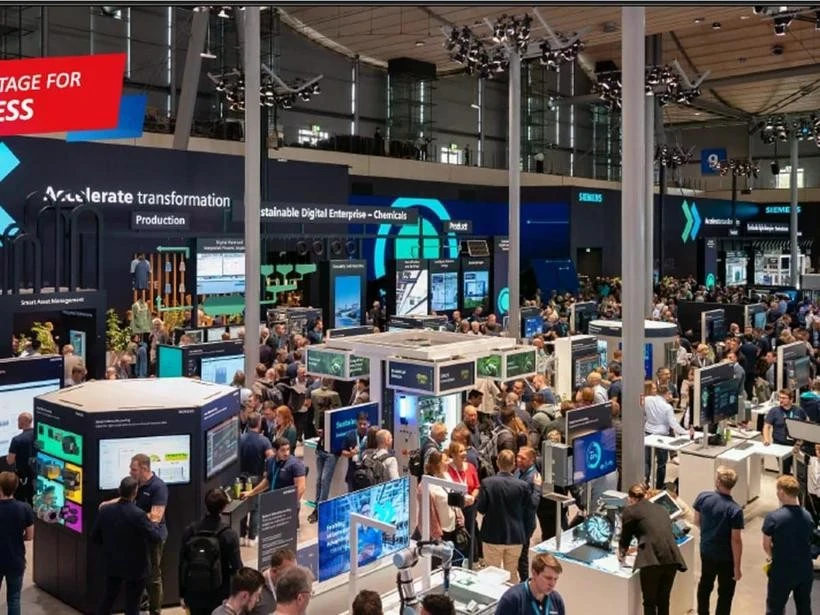
Vietnam showcases cutting-edge technologies at Hannover Messe 2025

Beyond traditional IT outsourcing (ITO) and digital transformation services, Vietnamese firms also present innovative solutions in AI, manufacturing, green transition, and semiconductor technologies, sectors that are drawing increasing global interest at Hannover Messe 2025.

Hannover Messe 2025 is taking place in Lower Saxony, Germany, from March 31 to April 4. (Photo: Manufacturing Today India )

Hanoi (VNA) – Twelve Vietnamese enterprises are making their marks at Hannover Messe 2025, one of the world’s largest industrial and technology trade fairs, running from March 31 to April 4 in Lower Saxony, Germany.

With over 4,000 exhibitors from 150 countries, the event provides a vital platform for Vietnam to explore global markets and expand partnerships, especially in Europe. This year’s edition spotlights advancements in artificial intelligence (AI), robotics, mechanical engineering, and fluid energy production.

Organised by the Vietnam Software and IT Services Association (VINASA) for the sixth time, the Vietnamese delegation aims to boost the presence of the country’s IT and tech firms in strategic markets like Germany. The Vietnam pavilion features leading companies such as FPT, TMT, Luvina, GMO-Z.com, Meey Group, VEDAX, SphinX, Bac Ha, Deha, Fabbi, DBIZ, and Vconnex.

Beyond traditional IT outsourcing (ITO) and digital transformation services, Vietnamese firms also present innovative solutions in AI, manufacturing, green transition, and semiconductor technologies, sectors that are drawing increasing global interest.

During the first two days, VINASA held key meetings with industry leaders, including the Asia-Pacific Business Association (OEV), the German Electrical and Digital Industry Association (ZVEI), and the German Chamber of Commerce and Industry. Vietnamese firms also connected with the German Small and Medium Business Association, the Berlin-Brandenburg Automotive Association, and companies from Germany, Belgium, the Czech Republic, and the Netherlands, opening doors for future collaborations.

Hannover Messe 2025 is taking place amidst global economic uncertainties, Germany’s slowdown, and trade challenges stemming from US President Donald Trump’s "America First" policy. However, these complexities have only amplified the fair’s role as a crucial hub for industry leaders navigating the evolving technological landscape.

With its expansive focus on automation, cloud computing, AIOT (Artificial Intelligence of Things), digital and clean energy, mobility infrastructure, embedded systems, and logistics, Hannover Messe remains an essential stage for companies worldwide to connect, innovate, and drive the future of technology./.
VNA

See more

Phuc Loi ward in Hanoi has launched the “Digital Literacy for All” movement, forming support teams to help residents install applications such as iHanoi and eTax. (Photo: VNA)

Hanoi advances technological innovation in key economic sectors

The municipal People's Committee recently issued Plan No. 109/KH-UBND on technological innovation in key economic sectors through 2035, which serves as both a catalyst and a strategic move to systematise, elevate and reinforce the capital’s leading role in the digital era.

General Secretary of the Communist Party of Vietnam (CPV) Central Committee and State President To Lam (first, right, front row) listens to a presentation about the China-ASEAN AI Application Cooperation Centre (Photo: VNA)

Top Vietnamese leader visits China–ASEAN AI Application Cooperation Centre

The China–ASEAN AI Application Cooperation Centre, jointly established by the Guangxi Zhuang Autonomous Region and ASEAN countries, aims to promote inclusive and mutually beneficial development of AI globally. It is regarded as a flagship project in advancing the “Digital Silk Road” initiative in Nanning.

A view of the 224th session of the UNESCO Executive Board in Paris. (Photo: VNA)

UNESCO extends recognition of 2 Category II science centres in Vietnam

The continued operation and enhancement of the two Category II centres under UNESCO’s auspices reflect Vietnam’s policy of positioning science, technology and innovation as key drivers of development, while closely linking scientific advancement with deeper and more substantive international integration in the current context.

China–ASEAN Artificial Intelligence Application Cooperation Centre deeply integrates future technologies with distinctive ASEAN cultural characteristics. (Photo: VNA)

China–ASEAN AI cooperation centre drives regional tech cooperation

With strong policy support and growing participation from businesses and research institutions, the China–ASEAN Artificial Intelligence (AI) Application Cooperation Centre is expected to act as a digital bridge, promoting technological integration and opening new avenues for Vietnam–China cooperation in the digital era.

Politburo member and Chairman of the Party Central Committee’s Organisation Commission Nguyen Duy Ngoc (ninth, left) and the Vietnamese delegation pose for a group photo with leaders of the Zhongguancun Science Park and Beijing city. (Photo: VNA)

Vietnam, China step up cooperation in science, technology, innovation

Politburo member and Chairman of the Party Central Committee’s Organisation Commission Nguyen Duy Ngoc, who also serves as Standing Deputy Head of the Central Steering Committee for the Development of Science, Technology, Innovation and Digital Transformation, toured the park’s exhibition area and was briefed on the formation and development of Zhongguancun, along with Beijing’s achievements in science, technology and innovation.

A technician from Viettel Bac Ninh examines equipment at a 5G base transceiver station. (Photo: VNA)

Bac Ninh accelerates development of 5G, data infrastructure

In the first quarter, Bac Ninh’s telecommunications infrastructure continued to develop in a synchronous manner. All communes have been connected to dedicated data transmission networks, and 100% of the population is covered by mobile services.

Illustrative photo (Photo: VNA)

An Giang identifies key tasks in science-technology development

The priorities focus on four pillars: science and technology, innovation, digital transformation, and real-world applications to boost socio-economic development. These are expected to create breakthroughs in governance, production, and daily life.

Illustrative image (Photo: VNA)

Vietnam Research Excellence Fellowship for 2026-2030 approved

Under the Vietnam Research Excellence Fellowship (VREF) for the 2026–2030 period, PhD students are identified as a core research force directly contributing to breakthroughs in sci-tech and innovation. Investing in top-tier doctoral candidates is more than workforce development, but a high-stakes strategic bet to forge a cohort of world-class scientists and technologists who can power Vietnam’s long-term economic ambitions.

Participants in the ASEAN Plus Photonics Symposium in Gia Lai province on April 8 (Photo: baogialai.com.vn/)

Gia Lai province hosts ASEAN Plus Photonics Symposium

Participants presented and discussed a wide range of advanced topics shaping the future of photonics, including nanophotonics and metasurfaces; topological and non-Hermitian photonics; photonic crystals and optical lattices; light–matter interactions and polariton systems.

Vietnamese Ambassador to Brazil Bui Van Nghi (right) and Professor and quantum physicist Olival Freire Juniorin, President of Brazil's National Council for Scientific and Technological Development, at their meeting on April 7. (Photo: Vietnamese Embassy in Brazil)

Vietnam, Brazil to strengthen cooperation in science, technology

Ambassador Bui Van Nghi expressed Vietnam’s interest in strengthening cooperation with Brazil in areas such as renewable energy and environmental technologies, as well as high-tech sectors including artificial intelligence (AI), quantum technology, and the semiconductor industry.