Vietnam sparks remarkable growth in industrial production in 2024

Vietnam's industrial sector marked a remarkable growth in 2024 with the industrial production index (IIP) surging by 8.4% year-on-year, a record high over the past four years, the General Statistics Office (GSO) has said.

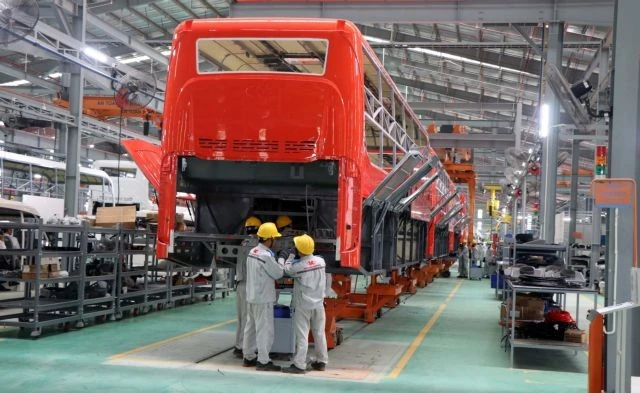
Coaches are manufactured at a plant of Kim Long Motor Hue JSC in the central province of Thua Thien-Hue. (Photo: VNA)

Hanoi (VNS/VNA) - Vietnam's industrial sector marked a remarkable growth in 2024 with the industrial production index (IIP) surging by 8.4% year-on-year, a record high over the past four years, the General Statistics Office (GSO) has said.

According to the GSO, the figure exceeded the annual target of 7-8%.

Head of the GSO's Industry and Construction Statistics Department, Phi Thi Huong Nga, said 2024 was a year of fluctuations, with many unfavourable factors both at home and abroad.

The global economy was recovering slowly, trade competition was fierce and geopolitical conflicts were escalating, all of which created significant challenges for Vietnam.

Domestically, although Vietnam prioritised stabilising the macro-economy, controlling inflation and maintaining growth, the country still had to face difficulties such as the impact of natural disasters.

However, overcoming those difficulties, the nation experienced impressive industrial production growth in 2024, with the highest growth rate in the past four years, Nga told Vietnamplus.

She attributed last year's encouraging result to the flexible and effective management of the Government. Last year, many policies were issued by the State to remove difficulties for businesses, especially tax policies.

For example, Decree 109 reducing 50% of registration tax for domestically produced and assembled cars created a big drive in demand, helping the motor vehicle manufacturing industry grow strongly. Accordingly, the production index of this industry surged by 44% year-on-year in the fourth quarter and 21% year-on-year in 2024.

At the same time, significant efforts from local authorities to reform administrative procedures, improve infrastructure and promote investment encouraged businesses to invest and develop production, Nga said.

She added that effective investment and trade promotion campaigns contributed to the growth.

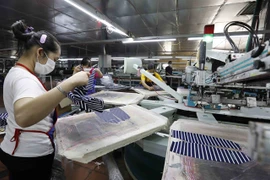
In 2024, the manufacturing and processing industry saw the highest IIP growth at 9.6%, compared to 1.5% in 2023. It was followed by the water supply sector at 10.7% and the electricity production and distribution sector at 9.5%. In contrast, the mining sector posted a decline of 6.5%.

Several key industries also recorded impressive growth rates compared to 2023. Rubber and plastic products rose by 25%, furniture production (24%), automotive production (21%), leather and leather-made goods (14%), coke and refined petroleum products (13%) and textiles (12%).

Conversely, some others posted an IIP decline such as crude oil and natural gas exploitation at 11%, coal at 6%, maintenance and installation of machinery and equipment with 5% and beverage production at 1.5%.

The IIP over 2024 also showed notable variation across localities, with 60 out of 63 provinces recording increases, the GSO said, adding that some provinces recorded exceptional growth in the manufacturing and processing industries such as Phu Tho (45%), Lai Chau (36%), Bac Giang (28%) and Thanh Hoa (20%).

Meanwhile, Khanh Hoa, Tra Vinh, Dien Bien, and Cao Bang saw strong growth in electricity production and distribution at 136%, 50%, 49% and 48%, respectively.

As of December 31, 2024, the inventory index of the processing and manufacturing sector was estimated to rise 10% compared to the previous month and 10.6% compared to the same period last year. The average inventory ratio of the industry in 2024 was 77.1%, compared to 88 in 2023.

The GSO also said that the number of workers in industrial enterprises as of December 1, 2024, increased by 1% month-on-month and by 3.2% year-on-year.

According to Nga, this year would see both challenges and opportunities. In terms of the global situation, several risks including the impact of monetary policy, financial market risks, public debt stress, difficulties in the Chinese real estate market, commodity price fluctuations due to climate change, geopolitical conflicts and rising trade protectionism could negatively impact a highly open economy like Vietnam.

Domestically, many positive factors such as a stable macro-economy, controlled inflation, stronger inflow of foreign direct investment (FDI), and the State's focus on public investment, especially in key national projects, along with shifting international supply chains would bring great opportunities for Vietnam, Nga predicted.

Nga said she believed that Vietnam could create a breakthrough in industrial growth in 2025 and the following years, if the country took full advantage of these opportunities, while facilitating digital and green transformation, meeting the increasingly stringent requirements of the international market./.
source

See more

Activities in Chan May Bay, part of the Chan May–Lang Co Economic Zone in Hue city. (Photo: VNA)

Hue steps up investment drive in Chan May–Lang Co Economic Zone

Covering more than 27,000ha, the Chan May–Lang Co Economic Zone is emerging as a key economic, urban, industrial and eco-tourism centre in southeastern Hue, with functional areas dedicated to seaports, industry, non-tariff activities, urban development and tourism.

The Ministry of National Defence's inter-agency inspection team visits La Gi Fish Port in Phuoc Hoi ward, Lam Dong province. (Photo: VNA)

Lam Dong's IUU fishing prevention efforts inspected

According to the Lam Dong provincial IUU Fishing Prevention Steering Committee, all 8,177 fishing vessels measuring at least 6 metres in length have been registered and updated in the national fisheries database VNFishbase.

A member of Minh Quang Cooperative in Hung Yen province works on a farm. (Photo: VNA)

Vietnam aims to link half of farm cooperatives with enterprises by 2030

The Ministry of Agriculture and Environment will promote links between cooperatives, enterprises, science and technology organisations and other economic entities along with carrying out programmes to develop concentrated agricultural, forestry and fisheries raw material areas and enhance value chain production.

The night-time economy is increasingly seen as an important avenue for Vietnam’s tourism sector to extend visitors’ stays (Photo: VNA)

Revitalising growth momentum for night-time economy

The night-time economy has moved beyond being merely an add-on service to become a new growth driver for tourism. Night-time activities can “awaken” familiar heritage spaces and breathe new life into them. Art, light and music experiences after dark can create distinctive attractions while meeting the desire of middle- and high-end visitors to explore cultural depth.

A livestream session promotes green-skinned pomelos grown in Cho Lach commune, Vinh Long province. (Photo: VNA)

E-commerce reshapes rules of game

Once fixed fees, payment fees, infrastructure charges and service packages are included, sellers may have to spend around 24.5-27.6% of their revenue on platforms. The figure shows that the era of easy selling and low costs in e-commerce has officially come to an end.

Ho Chi Minh City targets third-quarter growth of over 11% (Photo: VNA)

Ho Chi Minh City targets third-quarter growth of over 11%

Ho Chi Minh City will continue to implement drastic measures to achieve double-digit growth, targeting GRDP growth of at least 11.07% in the third quarter of 2026, 9.43% in the first nine months and 12.3% in the fourth quarter, with a view to completing the full-year goal of 10% or more.

MM Mega Market An Phu supermarket in Ho Chi Minh City is brightly decorated for the National Day holiday. (Photo: VNA)

Domestic consumption up over 13%, tourism continues strong growth

The total retail sales of goods and consumer service revenues in August were estimated at 679.8 trillion VND (26 billion USD), up 1.6% from the previous month and 14.9% year-on-year. In the January-August period, the figure reached 5.24 quadrillion VND, representing a 13.3% increase year-on-year.

A production line of Onaga Co., Ltd. (Japan) at HANSSIP (Photo: nhandan.vn)

Hanoi moves to maintain appeal to FDI inflows

In the first eight months of 2026, the capital city attracted more than 3.7 billion USD in FDI, equivalent to 83% of the plan set for the year. Newly registered FDI exceeded 572 million USD across 450 projects, up 175.78% in project numbers and 209.46% in capital compared to the same period last year. Additional registered capital topped 492 million USD, while capital contributions and share purchases exceeded 2.6 billion USD.

Saigon Marina IFC is the first private-sector project contributing to realising the goal of developing the Vietnam International Financial Centre in Ho Chi Minh City. (Photo: VNA)

VIFC offers various opportunities to attract forein investment

Turning the VIFC into an effective channel for international capital will require clear rules, quality projects and strong connections between investors and domestic businesses. Meeting these requirements will be key to transforming investor interest into concrete capital flows and investment projects in Vietnam.

Production line at Yadea Vietnam’s smart manufacturing plant, which has an investment of more than 100 million USD, in Tan Hung Industrial Park, Bac Ninh province. (Photo: VNA)

Development model for new era – An inevitable trend

International organisations broadly agree that shifting the growth model from reliance on traditional factors toward technology and innovation is no longer an option for Vietnam, but an imperative of the times.

At a commune administrative service centre in Hung Yen province (Photo: VNA)

Government determined to cut administrative procedures to drive double-digit growth

Resolution No. 258/NQ-CP, dated August 31, 2026, calls for substantive and comprehensive reform, with a focus on maximum cuts and simplification of administrative procedures and business conditions. It also seeks to shift management from pre-licence inspection to post-licence inspection based on risk management, while strengthening real-time, data-driven oversight and putting people and businesses at the centre of public services.