Vietnamese products gain market share in ASEAN countries

Vietnamese products are gaining traction and increasing their market share in the ASEAN bloc, particularly in neighbouring countries such as Cambodia and Laos, according to businesses and a report by the Ministry of Industry and Trade (MoIT).

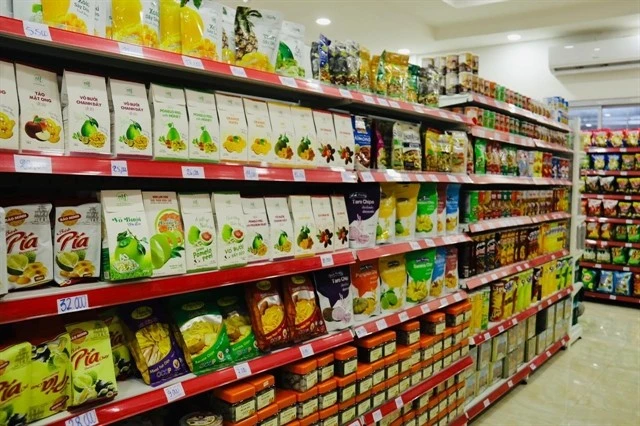
Vietnamese products at a supermarket in Laos. (Photo: VNA)

Hanoi (VNS/VNA) - Vietnamese products are gaining traction and increasing their market share in the ASEAN bloc, particularly in neighbouring countries such as Cambodia and Laos, according to businesses and a report by the Ministry of Industry and Trade (MoIT).

The global economy has undergone significant shifts since the COVID-19 pandemic, prompting many businesses to pivot from major markets in Asia, Europe and the Americas to closer and more accessible ones like ASEAN.

A 2024 report by the MoIT highlights substantial opportunities for Vietnam to expand exports of agricultural products, food and consumer goods to ASEAN countries, including Indonesia and Malaysia.

Trade promotion activities have also been ramped up. In Ho Chi Minh City, the Investment and Trade Promotion Centre (ITPC) has organised numerous market-connection conferences, offering businesses insights into regional markets and export strategies.

According to ITPC Director Tran Phu Lu, ASEAN represents a highly promising export market for Vietnamese businesses. Often overlooked, it aligns well with the capabilities of small and medium-sized enterprises (SMEs). In 2024, trade turnover between Vietnam and ASEAN reached a record 83 billion USD, an increase of 10 billion USD compared to 2023.

Hoa Mai Co. Ltd., a company specialising in wooden household goods, began exporting to Cambodia in 2021 through a distributor based in HCM City. Over the past three years, the company’s export revenue in Cambodia has tripled.

Similarly, in Laos, products such as chopsticks, ladles, mortars and pestles have shown steady growth, with monthly shipments becoming routine.

At the start of 2025, Hoa Mai Co. Ltd. is ramping up production to meet new orders, including a significant kitchenware order worth over 10,000 USD, marking a promising step in strengthening its foothold in the Cambodian market.

The company’s founder, Nguyen Le Thai Hoa, attributes this success to understanding market demands and tailoring products accordingly. For instance, the company developed sugar palm wood chopsticks priced lower than competitors in Cambodia, enabling smooth market penetration.

These chopsticks, along with other kitchenware, are now sold in supermarkets and convenience stores in Cambodia and Laos. With the company’s export portfolio steadily expanding, it anticipates significant revenue growth in these markets.

“On average, we handle 2–3 orders per month for Cambodia, with prices 15–20% higher than in Vietnam. For 2025, our focus is on consolidating our strengths in Laos and Cambodia while gradually entering Thailand and Myanmar,” said Thai Hoa.

Dony Garment Co. Ltd. has also experienced notable growth in ASEAN markets. CEO Phạm Quang Anh shared that the company’s first Cambodian order came in 2018, but its focus on the Southeast Asian market began in mid-2022.

“We carried out online and offline marketing campaigns, compiled a list of potential clients, and spent months visiting countries like Singapore, Malaysia, and Cambodia to meet them. By late 2022, we secured our first order from Malaysia. Orders surged in 2023 and exceeded expectations in 2024,” Anh said.

“Most businesses focus on major markets like the US, Japan, or the Republic of Korea, overlooking closer opportunities.

Additionally, he noted that once businesses establish themselves in major markets, transitioning to regional ones becomes much easier. ASEAN countries share cultural and economic similarities with Vietnam while offering distinct opportunities.

“Vietnamese products hold strong competitive advantages in Cambodia. Even in Laos, where Thai goods dominate, the diversity of Vietnamese products still provides opportunities for Vietnamese businesses willing to enter the market,” Hoa added./.

VNA

See more

Professor Tao Yitao, Director of the China Centre for Special Economic Zone Research (Photo: VNA)

Stable beginnings, powerful breakthroughs for Vietnam’s private economic sector

Vietnam is now at a critical juncture in pursuing what its leadership has described as a new era of national rise. In the long term, the development of the private economic sector will depend not only on supportive policies but also on a stable, transparent institutional environment that guarantees fair competition, said Professor Tao Yitao, Director of the China Centre for Special Economic Zone Research.

The trade policy review of Uruguay at the WTO headquarters. (Photo: VNA)

Vietnam participates in WTO review of Uruguay's trade policy

Vietnam also welcomed Uruguay's active engagement in the multilateral trading system as a founding member of the WTO. Uruguay has ratified the Agreement on Fisheries Subsidies, joined the Multi-Party Interim Appeal Arbitration Arrangement (MPIA), and contributed to Joint Statement Initiatives (JSIs) on e-commerce and micro, small and medium-sized enterprises (MSMEs).

Experts discuss cooperation opportunities in Vietnam-Germany manufacturing value chains at the forum. (Photo: VNA)

Vietnam-Germany cooperation creates new opportunities for sustainable manufacturing

Germany is an important partner of Vietnam and a global leader in green technology, smart manufacturing, automation and circular economy solutions. The combination of German technological expertise and Vietnam's manufacturing capabilities and strong commitment to transformation would create significant opportunities in green production, supporting industries, digital transformation, supply chain management and eco-industrial park development.

Businesses introduce Halal market products at the workshop. (Photo: VNA)

Da Nang businesses eye growth in booming global Halal market

Huynh Xuan Son, Deputy Director of the Da Nang Department of Industry and Trade, said the Halal market has emerged as a strategic destination for Vietnamese exporters amid persistent global economic uncertainties. Serving more than two billion consumers across over 110 countries and territories, the market offers significant opportunities for business expansion.

Vietnamese bananas are sold at an AEON supermarket in Japan. (Photo: VNA)

Vietnamese products promoted at AEON stores across Japan

Speaking at the opening ceremony, Deputy Minister of Industry and Trade Phan Thi Thang highlighted the significance of 2026, which marks a decade of cooperation between the ministry and AEON in organising Vietnam Week in Japan.

Growing demand for financing for infrastructure and green transition projects is driving Vietnam’s search for new sources of capital. In the photo: A section of Noi Bai – Lao Cai Expressway. (Photo: VNA)

Vietnam seeks to unlock capital for infrastructure, green transition

As Vietnam advances its sustainable growth agenda and commitment to achieving net-zero emissions by 2050, the need for long-term capital is rising rapidly. Experts say meeting these financing requirements will depend not only on expanding available resources but also on broadening funding sources and improving project financing models.

Private technology enterprises are increasingly viewed as a driving force at the heart of the innovation ecosystem. (Photo: VNA)

Vietnam pushes to develop world-class technology startups

Vietnam’s startup ecosystem now comprises roughly 4,000 startups, 208 investment funds, 84 incubators and more than 20 startup support centres. With an estimated valuation of 75 billion USD, the ecosystem has established most of the key foundations needed for long-term growth.