Vietnam, US work to address post-war consequences

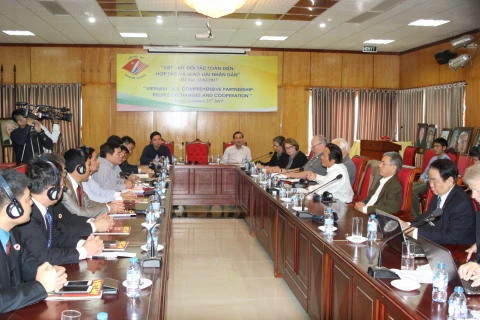
The Vietnam-US Society (VUS) and the Vietnam Union of Friendship Organisations (VUFO) held a workshop in Hanoi on March 6 to address post-war consequences such as Agent Orange (AO)/Dioxin, and leftover bombs and mines in Vietnam.
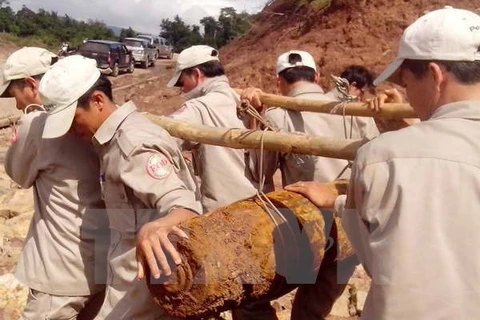
Vietnam, US work to address post-war consequences ảnh 1Disarming bombs and mines in the central province of Quang Tri (Photo: VNA)
Hanoi (VNA) – The Vietnam-US Society(VUS) and the Vietnam Union of Friendship Organisations (VUFO) held a workshopin Hanoi on March 6 to address post-war consequences such as Agent Orange(AO)/Dioxin, and leftover bombs and mines in Vietnam.

President of the VUS Nguyen Tam Chien welcomedthe US war veteran delegation to visit Vietnam, and recognised their activecontributions to healing the pain of war between the two countries in the past.

He said the Vietnam – US cooperative relationshave changed with significant strides in recent years.

Post-war matters such as AO/Dioxin and bombs andmines have received much attention from the two sides’ governments and peoples,he added.

He called on the two countries to increasemutual understanding, friendship and collaboration via enhancingpeople-to-people exchanges and joining hands to actively address war aftermath.

Vice President of the US Veterans for PeaceChuck Searcy said all members from the visiting war veteran delegation have acommon goal of protesting against war and healing the pain of war in Vietnam aswell as promoting peace and friendship between the two nations.

The US guests want to study the settlement ofAO/Dioxin and bombs and mines in Vietnam, he noted.

Lieutenant General Nguyen The Luc, VicePresident and Secretary General of the Vietnam Association of Victims of AgentOrange/dioxin, suggested Vietnam and the US actively seek modern technologiesto deal with contamination caused by the toxic chemical.

He called on the US war veterans to support thefight for justice for AO/dioxin victims in Vietnam.

From 1961-1971, US troops sprayed more than 80million litres of herbicides - 44 million litres of which were AO, containingnearly 370 kilograms of dioxin - over southern Vietnam.

As a result, around 4.8 million Vietnamese wereexposed to the toxic chemical. Many of the victims have died, while millions oftheir descendants are living with deformities and diseases as a direct resultof the chemical’s effects.-VNA
VNA

See more

A view of Place Ho Chi Minh in Persan, France. (Photo: VNA)

Place preserving memories of President Ho Chi Minh in France

Although there is little publicly available documentation confirming exactly when Place Ho Chi Minh was established, French urban historians suggest that most streets and public spaces named after the Vietnamese leader in France emerged between the 1960s and 1980s, during the height of anti-war movements and solidarity campaigns supporting Vietnam across working-class towns and left-leaning suburbs around Paris.

Vietnamese Ambassador to Bangladesh Nguyen Manh Cuong speaks at the seminar. (Photo: VNA)

President Ho Chi Minh’s thought on national unity remains relevant today

President Ho Chi Minh's ideology of national unity continues to carry profound significance amid growing global challenges, including conflicts, social divisions and economic instability. His message of solidarity, consensus and placing national interests above sectional differences remains a valuable lesson for many developing nations.

Assoc. Prof. Dr. Nguyen Duc Son presents the decision establishing the Vietnamese Language Proficiency Test Council in Japan to a representative of the Vietnam Studies Centre in Japan. (Photo: VNA)

Japan hosts first standardised Vietnamese language proficiency test

As bilateral ties between Vietnam and Japan continue to expand, demand for Vietnamese language learning in Japan has also grown rapidly among OVs, educational institutions, businesses and Japanese people interested in Vietnam. Against this backdrop, the introduction of a standardised proficiency test is expected to provide an official and widely recognised benchmark for Vietnamese language skills.

The “I Love My Fatherland" Journey 2026 kicks off in Nghe An province on May 16. (Photo: VNA)

"I Love My Fatherland” journey features diverse activities

The “I Love My Fatherland” journey will span seven stages across historical and cultural sites and “red addresses” nationwide. There will be a combination of education on traditions, field-based programmes, and digital communications.

At the handover of 33 Chinese nationals who had violated Vietnamese law to Chinese authorities in Quang Ninh on May 15, 2026. (Photo: VNA)

Vietnam hands over 33 law violators to China

Investigations found that the individuals had violated Vietnamese laws relating to illegal entry and unlawful residence in Vietnam. The handover was conducted safely and in compliance with Vietnamese law and international practice.

At the talks between authorities of the northern province of Lang Son and Pingxiang city in the Guangxi Zhuang Autonomous Region of China (Photo: VNA)

Vietnam, China seek to build modern, smart border gates

Authorities of the northern province of Lang Son and Pingxiang city in the Guangxi Zhuang Autonomous Region of China held talks on May 15 at Tan Thanh (Vietnam) – Po Chai (China) clearance point near markers 1090–1091 in Hoang Van Thu commune of Lang Son to promote trade, develop smart border gates and expand cross-border tourism cooperation.