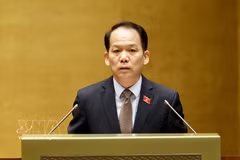
Deputy Prime Minister Trinh Dinh Dung orders efforts to prevent real estate bubble (Photo: VietnamPlus)
Hanoi (VNA) – Relevant ministries, sectors and localities should focus demand-supply forecast, and be cautious of the property market developments to prevent a housing bubble this year, Deputy Prime Minister Trinh Dinh Dung said at a recent meeting.
Major challenges facing the realty market
According to Deputy PM Dung, the housing market development has attracted many resources to create large fixed assets for the economy, met housing demand while pushing ahead urbanisation progress and promoting economic shifting. Besides, it has driven stable growth of the capital market, building material production, and labour market, making significant contributions to stablising the macro-economy and socio-economic development.
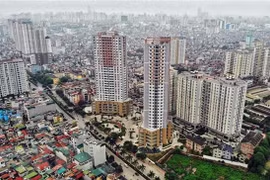
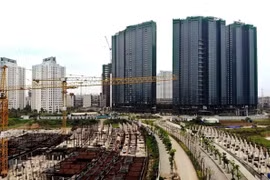
However, he pointed out several challenges of the realty market, such as oversupply of mid- and high-end units but a shortage in the affordable segment despite huge demand.
Renovating and rebuilding dilapidated apartment blocks in big cities remained a tough work, with major obstacles related to planning, while development of social housing in urban areas and industrial zones lagged behind the set target, he added.
A lack of information on housing and realty market has made it difficult for state management as well as market participation of both businesses and local people.
Additionally, enterprises face inconsistencies in regulations on investment procedures and approval of development projects among relevant laws such as the Investment Law, Housing Law and Land Law.
Efforts needed to prevent housing bubble
In a bid to remove such bottlenecks, Dung requested ministries, sectors and localities to provide good supply-and-demand forecast based on the study of planning, build development plan for each housing product, have thorough understanding of the property market, as well as implement timely measure to stablise the market.
He laid stress on the importance to enhance inspection on real estate projects to see whether they are carried out in line with current regulations.
Relevant authorities need to complete housing laws, and study to amend laws on housing and property business.
He particularly ordered the Ministry of Construction to pen an evaluation report on the real estate market during 2016-2020, and urge localities to complete and put into use the housing information system.
The Ministry of Finance was asked to join hand with competent ministries and sectors to map out mechanisms to mobilise resources for the real estate market, he added, saying the move will help reduce dependence on capital from financial institutions alone.
In the meantime, the State Bank of Vietnam should keep close watch, continue flexible monetary policies, manage credit size in line with the developments of the macro-economy, and keep credit for realty business under strict control.
Domestic housing market faces uncertainties
The domestic real estate market is hoped to have growth in the fourth quarter of this year and before the Lunar New Year 2021 if, by this year-end, the domestic economy is restored to levels from before the COVID-19 pandemic.
This is the most positive scenario forecast by Tran Kim Chung, Deputy Director of the Central Institute for Economic Management, about the real estate market this year.
However, in the second and more likely scenario, the domestic and global economies will recover only gradually and the local real estate market will be quiet but not collapse.
In the worst scenario, Chung said the market would freeze and trading would stop due to the domestic economy facing many difficulties in the context of an uncontrolled pandemic and unsatisfactory global economy.
Chung also said agricultural real estate was still looking for measures to develop because of a lack of mechanisms, policies and products to develop the market.
Meanwhile, housing real estate market had three segments attracting customers, including land plots in suburban areas, affordable housing and social housing, Chung said. The high-end housing segment needed new drivers.
Trang Bui, JLL Vietnam's Market Director, said the housing market was expected to have stable growth due to housing demand. Mid-price housing products consistent with the financial ability of the majority of customers would lead the market in the long term. Investors and customers who have real demand would seek finished housing products.
Le Hoang Chau, Chairman of the HCM City Real Estate Association (HoREA), said in the coming years, the domestic market would still have high demand for affordable apartments while the supply of this segment was limited at present.
Therefore, to have sustainable development on the domestic property market, there is a need for more investment in the affordable apartment segment, according to Chau.
This kind of property attracts many customers and investors, especially middle- and low-income people and workers in big urban areas. Affordable apartments also have high liquidity./.
 Illustrative photo (Photo: VNA)