Vietnamese scientists win China-ASEAN innovation contest

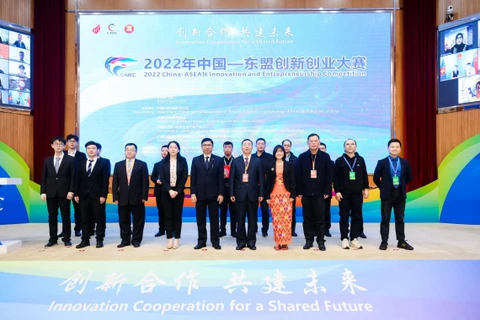
A group of Vietnamese researchers has won the second prize of the 2022 China-ASEAN Innovation and Entrepreneurship Competition (CAIEC) for their Brain Analytics project, AI software to detect Alzheimer disease by analysing MRI brain images.
Vietnamese scientists win China-ASEAN innovation contest ảnh 1Pham Thi Nhu Trang speaks on behalf of the Vietnamese team at the awarding ceremony. (Photo: VNA)
Jakarta (VNA) – A group of Vietnamese researchers haswon the second prize of the 2022 China-ASEAN Innovation and EntrepreneurshipCompetition (CAIEC) for their Brain Analytics project, AI software to detectAlzheimer disease by analysing MRI brain images.

The team from the International University (IU), one ofseven members of the Vietnam National University - Ho Chi Minh City, consists of about20 members, including doctors, engineers, and students.

Speaking on behalf of the group at the awarding ceremonyheld in Jakarta, Indonesia, on February 17, Pham Thi Nhu Trang, a senior at theuniversity’s faculty of biomedical engineering, said Brain Analytics initiallyaimed to gain support from the Asian startup and medical community in order todevelop the project outside of Vietnam in the future. The team also wants tolook for funding to build local database to improve their product’s efficiency,she added.

Also obtaining the second prizes, the highest for projectsfrom ASEAN, were the ‘Castomize - CastsMade with 4D Printing’ and ‘FormaCyte Therapeutics - Injection-free CellularImplant for Diabetes Management’ projects, both from Singapore.

Meanwhile,two third prizes were presented to enterprises from Cambodia and Myanmar fortheir works in the fields of digital economy and modern agriculture.

The CreativityStars prizes and other certificates were also handed over to collectives and individuals at the ceremony./.
VNA

See more

Illustrative photo: AFP

AI Law takes effect, anchors national governance framework

Taken together, the new AI Law and its implementation roadmap not only complete Vietnam’s legal architecture for AI, but also lay a structured foundation for risk management, innovation and ecosystem development, aiming to ensure coherent and effective enforcement in the years ahead.

Viettel Networks and Ericsson sign their cooperation agreement on the sidelines of the Mobile World Congress 2026. (MWC 2026)

Viettel Networks, Ericsson partner to advance autonomous telecom networks

Under a newly signed cooperation agreement, Ericsson will provide network automation platforms and artificial intelligence (AI) technologies while working with Viettel to conduct real-world trials. The collaboration marks a new step forward, combining Viettel’s large-scale network operation expertise with Ericsson’s strengths in automation solutions and advanced technologies.

Prime Minister Pham Minh Chinh speaks with students at Hanoi University of Science and Technology (Photo: VNA)

Resolution 57: Developing high-quality sci-tech human resources key to master strategic technologies

After one year of implementing Resolution No. 57-NQ/TW of the Politburo, alongside notable achievements, the Central Steering Committee for science and technology development, innovation, and digital transformation has identified persistent shortcomings and bottlenecks requiring urgent attention - most notably a shortage of high-quality human resources in strategic technology fields.

The Saigon Hi-Tech Park (Photo: VNA)

Vietnam advances toward mastering UAV technology

Products are already making their way into the US market, but this is not merely a story of applying new technology in practice, but a gradual process of mastering core details and affirming international capabilities in the UAV industry, one of Vietnam’s strategic high-tech sectors.

Tran Quang Hung, Chairman of the Board of Directors of HIC, presents the company’s operating model at the launch event. (Photo: hanoimoi.vn)

Hanoi’s innovation centre to drive digital transformation, creative industries

HIC is envisioned as a central “brain” connecting data, resources, policies, technology and culture to address urban development challenges, operate the national innovation ecosystem, promote a sustainable digital economy and digital society, improve the quality of life for local residents, and foster creative industries, particularly cultural industries linked to Hanoi’s identity.

Participants pose for a group photo at the International Conference on Advanced Microscopy for Life Sciences and Materials held in Gia Lai on February 25. (Photo: ICISE)

International conference spotlights advanced microscopy in life sciences, materials

The microscopy user community in Vietnam remains fragmented, lacking a common platform for sharing technical expertise, research experience and collaboration opportunities. This limited connectivity has, to some extent, curtailed the full potential of microscopy technologies in advancing scientific progress and industrial applications at home and abroad.

With just a smartphone, travellers can search for and book a variety of travel services for their journey. (Photo: VNA)

Digital transformation – a lever for building a smart tourism ecosystem

In recent years, digital transformation has become a common feature in socio-economic development strategies. For tourism – a multi-sector, experience-driven industry closely tied to information – digitalisation is no longer a trend but an inevitable requirement to enhance competitiveness and ensure sustainable development.