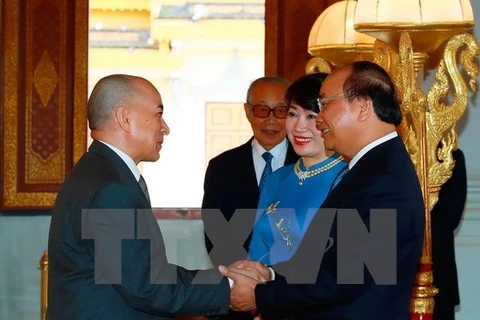
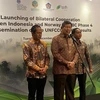
Sok Chenda Sophea, Cambodian Minister attached to the Prime Minister and Secretary General of the Council for Development of Cambodia. (Photo: VNA)
Phnom Penh (VNA) – Vietnam’s economic presence in Cambodia has contributed greatly to the country’s economic development, particularly in investment, trade and tourism.
According to the Council for Development of Cambodia (CDC), Vietnam is the fifth largest investor in Cambodia, operating approximately 200 projects, worth about 3 billion USD. About 70 percent of Vietnamese investment landed in agro-forestry, including rubber cultivation, while 9.4 percent and 7.5 percent were poured into finance and banking, and telecommunication, respectively.
Statistics by the General Department of Vietnam Customs showed two-way trade between Vietnam and Cambodia in the first two months of 2017 hit 624.1 million USD, up 21.2 percent from the same period last year.
[Vietnam, Cambodia strive for 5 billion USD in trade turnover]
In the field of tourism, Vietnam has been the largest source market of Cambodia for eight consecutive years. About one million Vietnamese, among the total of 5 million foreigners, travelled to Cambodia last year.
Sok Chenda Sophea, Cambodian Minister attached to the Prime Minister and CDC Secretary General, said Vietnamese investors have contributed substantially to Cambodia’s economic development, poverty reduction and social security. They created jobs for the locals and involved in many charity works in Cambodia, he added.
Cambodia has four key industries – clothing, footwear, agriculture and real estate, the minister said, noting that these sectors have not received equal attention from Vietnamese enterprises that have focused a majority of their investment in rubber planting and processing.
The Government of Cambodia has provided Vietnamese investors with favourable conditions in recent years, but many firms still worried about doing business in Cambodia due to its unstable policies and unpredictable business environment, said Vietnamese trade counsellor to Cambodia Nguyen Bao.
He suggested the two governments should soon sign bilateral agreements in trade and investment and increase cooperation between their relevant bodies in investment promotion and state management of Vietnamese investors in Cambodia.
The two sides need to provide more updates on investment projects as well as better support to the investors, he added.-VNA
In the field of tourism, Vietnam has been the largest source market of Cambodia for eight consecutive years. About one million Vietnamese, among the total of 5 million foreigners, travelled to Cambodia last year.
Sok Chenda Sophea, Cambodian Minister attached to the Prime Minister and CDC Secretary General, said Vietnamese investors have contributed substantially to Cambodia’s economic development, poverty reduction and social security. They created jobs for the locals and involved in many charity works in Cambodia, he added.
Cambodia has four key industries – clothing, footwear, agriculture and real estate, the minister said, noting that these sectors have not received equal attention from Vietnamese enterprises that have focused a majority of their investment in rubber planting and processing.
The Government of Cambodia has provided Vietnamese investors with favourable conditions in recent years, but many firms still worried about doing business in Cambodia due to its unstable policies and unpredictable business environment, said Vietnamese trade counsellor to Cambodia Nguyen Bao.
He suggested the two governments should soon sign bilateral agreements in trade and investment and increase cooperation between their relevant bodies in investment promotion and state management of Vietnamese investors in Cambodia.
The two sides need to provide more updates on investment projects as well as better support to the investors, he added.-VNA
VNA