A farmer in the nothern province of Hai Duong's Thanh Ha district harvests lychee. (Photo: VNA)
 Hanoi (VNS/VNA) – Vietnam’s economic growth rate this year would reach 3.8 percent if there is no second COVID-19 outbreak in the second half of the year and economic activities gradually resume, the Vietnam Institute for Economic and Policy Research (VERP) has predicted.
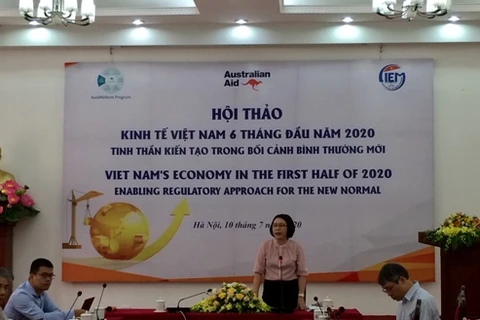
The forecast was released at the launch of an independent assessment of Vietnam’s macroeconomic performance by VERP held in Hanoi on July 21.
“It is likely that the economy will reach 3.8 percent for the whole year 2020. At a lower probability, the economy may grow only 2.2 percent due to adverse developments of the COVID-19 pandemic,” said Pham The Anh, chief economist at VERP, adding that the optimistic scenario of 5 percent is unlikely.
Considering the factors affecting the Vietnamese economy, VERP provided two scenarios for the economy. In the first scenario, the pandemic in many important economic and financial centres around the world is assumed capable of a recurrence, or not confident enough that countries must extend lockdowns to the second half of the third quarter. This would affect demand for importing goods from Vietnam and as well as for tourism and accommodation in the country.
Accordingly, the impact of COVID-19 on agriculture, forestry and fisheries, manufacturing and processing and services would be more serious. In general, growth in industries would be modest, in which the most affected sectors include accommodation, catering, mining and real estate.
In another scenario, the institute forecast the domestic pandemic would be controlled for the rest of the year and economic activities gradually return to normal.
However, if COVID-19 in major economic and financial centres in the world recurs strongly, countries may have to extend lockdown until the fourth quarter of 2020. As a result, Vietnam's import and export activities would be seriously affected and not be able to recover in 2020, leading to weak growth of domestic production.
At the same time, accommodation and catering services have no momentum to recover due to a lack of foreign tourists, while domestic demand for these services is also limited due to the poor economic situation, leading to a GDP growth forecast of 2.2 percent.
Vietnam is one of few countries to have achieved positive economic growth in the second quarter of 2020, reaching 0.36 percent. For the first six months of the year, GDP increased by 1.81 percent.
In the difficult context, agriculture has been a highlight of the economy in the first half of the year, contributing 12 percent to the overall growth, double the same period last year.
In addition, the second contributor was manufacturing and processing, which contributed about 5 percent of overall growth. This was partly due to public investment and construction activities still occurred in the process of social distance.
VEPR experts said that Vietnam's economic prospects in 2020 would depend on the ability to control the disease, not only domestically but also in the world.
They said factors that support the growth in the second half of the year included expectations on economic prospects due to the signing of the European Union-Vietnam Free Trade Agreement (EVFTA), disbursement progress of public investment projects, investment waves into Vietnam and a stable macroeconomy.
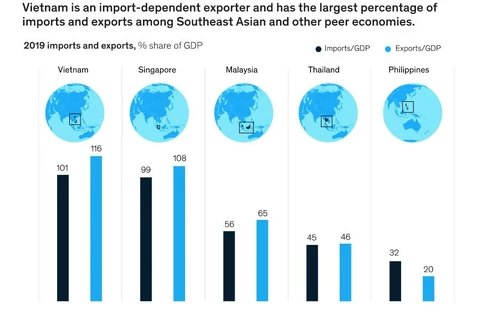
However, Vietnam had been also facing many challenges in the unstable world economic environment and uncertain future. The recurrence of COVID-19 in many countries was accompanied by lockdown measures, making for a lengthier break of the supply chain, while geopolitical conflicts among large countries could make an open economy like Vietnam face unexpected risks.
In addition, the weakness of Vietnam's economy also came from internal risks such as large fiscal imbalance, the speed and level of development investment and infrastructure building slowdown. Although the health of the banking and financial system had been gradually strengthened, it was still vulnerable, according to the experts. The economy was much dependent on growth of the FDI sector and the lack of technological and raw material autonomy.
Can Van Luc, a financial expert, agreed with VEPR's opinion.
“I guarantee inflation will be below 4 percent," he said, giving the main reason that current demand is very weak./.
VNA