WEF ASEAN: Deputy PM attends Asia’s geopolitical outlook panel session

Deputy Prime Minister and Foreign Minister Pham Binh Minh was among speakers at the panel session on “Asia’s Geopolitical Outlook” at the World Economic Forum on ASEAN (WEF ASEAN) 2018 in Hanoi on September 13.
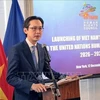
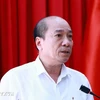
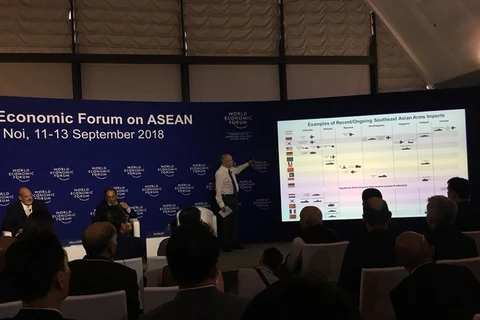
WEF ASEAN: Deputy PM attends Asia’s geopolitical outlook panel session ảnh 1Deputy PM and FM Pham Binh Minh (centre) at the panel session on “Asia’s Geopolitical Outlook” at the World Economic Forum on ASEAN (WEF ASEAN) 2018 in Hanoi on September 13. (Photo: VNA)

Hanoi (VNA) – Deputy Prime Minister andForeign Minister Pham Binh Minh was among speakers at the panel session on“Asia’s Geopolitical Outlook” at the World Economic Forum on ASEAN (WEF ASEAN)2018 in Hanoi on September 13.

Minh said he was concerned about three things when it came to the shiftingregional geopolitical landscape – the disruption of the Fourth IndustrialRevolution (Industry 4.0), the rise of protectionism and security threats.

“It is undeniable that Industry 4.0 will offer tremendousopportunities, but if countries cannot seize these opportunities, they can beleft behind and the development gap would be widen,” he said. “It would lead tothe transformation of the geo-economic as well as geo-political landscapes.”

The rise of the nationalism and protectionism alsoworries him alongside the power politics and strategic competition that canlead nations, whether big or small, to make choices to adapt to the situation.

And his last concern is the traditional andnon-traditional security issues that continue to be a threat, including themaritime disputes, climate change, cyber security and etc.

The Deputy PM also mentioned regional initiatives likethe Belt and Road Initiative or the Free and Open Indo-Pacific Strategy, sayingVietnam welcomes the initiatives as long as they contribute to the maintenanceof peace, stability and prosperity in the region.

“The initiatives must be open, transparent and inclusive;and respect the international law and self-determination of the nation,” Minhadded.

Minh later talked about the challenges of Industry 4.0which he believes can affect the production methods.

For a country’s economy that relies heavily on labourintensity, Industry 4.0 will affect its model of production and the labourforce, he said. Artificial intelligence, automatic advances, robots would takethe jobs of the labour force so education must be the main focus of any countryto provide better skills to the young workers to enable them to adapt to thenew context, he noted.

Joining Minh in the session were Minister of ForeignAffairs of the Republic of Korea Kang Kyung-Wha, Minister of Foreign Affairs ofJapan Taro Kono, Prime Minister of Sri Lanka Ranil Wickremesinghe and AssociateFellow at the International Institute for Strategic Studies (IISS) fromSingapore Lynn Kuok.

The meeting discussed how Asia can secure peace andstability amid a rapid changing geo-economic context, shifting allegiances, andnew security strategies from regional and global powers.

The speakers showed they are quite optimistic aboutAsia’s geopolitical outlook as the situation has seen progress recently withthe Republic of Korea and the Democratic People’s Republic of Korea (DPRK)resuming peace talks, the US-DPRK summit or the new breakthroughs in thedenuclearisation on the Korean Peninsula. They also spoke highly of ASEAN’scentrality in the regional security architecture.

The WEF ASEAN 2018 takes place in Hanoi from September 11– 13. Themed “ASEAN 4.0: Entrepreneurship and the Fourth IndustrialRevolution”, the event has attracted leaders of many ASEAN countries andpartner nations, over 1,000 delegates who are also WEF members, as well asrepresentatives of businesses from around the world.

It serves as a forum for the exchange of new ideas, a place to understandglobal trends, especially in regards to Industry 4.0, and to formulate plansfor Vietnam’s strategic socio-economic development and the growth of Vietnamesebusinesses.

It is also a cultural festival for ASEAN countries with the host country incharge of organising activities to promote ASEAN’s shared values ofmulticulturalism, multi-ethnicity, solidarity, and common goals. –VNA 
VNA
See more

Officers, soldiers and residents in the Truong Sa special zone come to cast their ballots at Polling Station No.1 on March 15. (Photo: VNA)

Voters in Truong Sa special zone join nationwide election day

Voters in Khanh Hoa will elect 12 deputies to the 16th NA from a list of 20 candidates; 67 deputies to the provincial People’s Council for the 2026–2031 term from 108 candidates; and 1,392 deputies to commune- and ward-level People’s Councils from 2,317 candidates.

Party General Secretary To Lam at polling station No. 2 in Ba Dinh ward of Hanoi on March 15 morning (Photo: VNA)

Party General Secretary casts ballot in Hanoi's Ba Dinh ward

Party General Secretary To Lam described the election as a major national event that demonstrates the people’s freedom and right to mastery, enabling them to select capable and reputable representatives to undertake the country’s common tasks and guide national and local development while safeguarding sovereignty and territorial integrity.

Prime Minister Pham Minh Chinh and his spouse cast ballots at Polling Station No. 21 in Tay Ho ward, Hanoi, on March 15 morning. (Photo: VNA)

PM votes in Hanoi as nationwide election underway

Commending Tay Ho ward for its thorough preparations, particularly at Polling Station No. 21, the PM urged the election committee to facilitate early voting and ensure every eligible voter can fully exercise their rights and responsibilities.

A communication team of O Dien commune in Hanoi cycle to support the general election. (Photo: VNA)

General election: OVs show devotion, commitment to homeland

Wherever they may be, the overseas Vietnamese community's devotion and commitment to the homeland remain a strong bond connecting Vietnamese people around the world. All share a common belief that Vietnam will continue moving forward on its development path with the support of its people both at home and overseas.

Voters at Dao San Border Guard Station cast their ballots in the election of deputies to the 16th National Assembly and People’s Councils at all levels for the 2026–2031 term. Photo: VNA

Nationwide voting for 16th National Assembly, People’s Councils for 2026-2031 begins

According to the National Election Council, from 864 candidates, voters will elect 500 deputies to the 16th National Assembly (1.73 candidates per seat). For provincial-level People’s Councils, voters will elect 2,552 deputies from 4,217 candidates (1.65 candidates per seat). For commune-level People’s Councils, voters will elect 72,611 deputies from 120,873 candidates (1.66 candidates per seat).

A border guard comes to cast his ballot in Tan Phu Dong islet commune, Dong Thap province, on March 15 morning. (Photo: VNA)

Early voting begins in Dong Thap province’s islet commune

At 5:00 a.m. on March 15, voters across Tan Phu Dong islet commune in the Mekong Delta province of Dong Thap began casting their ballots to elect deputies to the 16th National Assembly and deputies to the People’s Councils at all levels for the 2026–2031 term.

The head of Polling Team No. 5 in Quy Mong commune, Lao Cai province, introduces the lists of candidates to local residents. (Photo: VNA)

The choice that heralds a new tenure

Choosing "the right representatives"—deputies with integrity, talent, vision, and the courage to act and take responsibility—will enhance the operational quality of the NA and People’s Councils, ensuring the efficiency and effectiveness of the state apparatus over the next five years.

Prime Minister Pham Minh Chinh addresses the meeting meeting between the permanent Government members and leaders of Hanoi to review and provide feedback on the draft Hanoi Capital Master Plan with a 100-year vision on March 14. (Photo: baochinhphu.vn)

Hanoi’s 100-year master plan must put people at centre: PM

According to Prime Minister Pham Minh Chinh, the philosophy of the plan must place people at the centre and as the driving force of development, and Hanoi should aim to become a prosperous, civilised and modern city that preserves its cultural identity.

The National Assembly passes the law amending and supplementing several articles of the Criminal Code. (Photo: VNA_

OVs, scholars in Canada hope for further reform, int’l integration in new NA term

Overseas Vietnamese (OVs) and scholars in Canada have expressed keen interest in the upcoming election of deputies to the 16th National Assembly (NA) and People’s Councils for the 2026–2031 tenure, voicing their hopes that the legislature will further refine institutions, drive economic development, deepen international integration, and strengthen ties with OV communities.

UNDP Resident Representative in Vietnam Ramla Khalidi (Photo published by VNA)

NA, People’s Council election to shape policies sustaining Vietnam’s development momentum: UNDP official

In an interview with the Vietnam News Agency ahead of the election scheduled for March 15, UNDP Resident Representative in Vietnam Ramla Khalidi said the election marks an important milestone in Vietnam’s development trajectory as it takes place at a moment when the country is entering a new phase of policy priorities and institutional reforms that will shape its next stage of development.

Voters on Truong Sa are following information regarding the election of deputies to the 16th National Assembly and People's Councils at all levels for the 2026-2031 term (Photo: VNA)

Party leadership key to ensuring State power belongs to people in election

Ensuring that State power truly belongs to the people, with the leadership of the Communist Party of Vietnam serving as the decisive factor, remains the guiding principle for organising the election of deputies to the 16th National Assembly (NA) and People’s Councils at all levels for the 2026–2031 tenure.

Newly enlisted soldiers at the 2nd Training and Mobile Battalion in Lam Dong province eagerly participate in the early voting session. (Photo: VNA)

Ballots and civic responsibility

All these efforts converge to create the significance of the national election day. Though small, each ballot carries the weight of civic responsibility. By selecting the right representatives and placing trust wisely, voters contribute to building a National Assembly and People’s Councils capable of making important decisions for the country and localities in the new tenure.

PM Pham Minh Chinh welcomes Thai Ambassador to Vietnam Urawadee Sriphiromaya in Hanoi on March 13. (Photo: VNA)

PM Pham Minh Chinh receives Thai Ambassador to Vietnam

PM Pham Minh Chinh proposed that Thailand consider facilitating stable fuel supply for Vietnam’s civil aviation sector, thus contributing to socio-economic stability and development, as well as bilateral trade and tourism.

The special ASEAN foreign ministers’ meeting on the Middle East situation is held online on March 13. (Photo: Vietnamese Ministry of Foreign Affairs)

Vietnamese embassies in Middle East ready to assist ASEAN citizens: FM

Foreign Minister Le Hoai Trung stressed that ASEAN members should prioritise maintaining energy supplies for one another, particularly oil and gas, and make effective use of cooperation agreements with partners, including Gulf Cooperation Council (GCC) countries, to diversify energy sources.