2025 public debt plan, 2025-2027 debt management programme approved

The plans aims to ensure full and timely repayment of public debt without affecting Vietnam’s sovereign credit rating, while continuing to restructure the Government bond portfolio in line with market conditions and development needs.

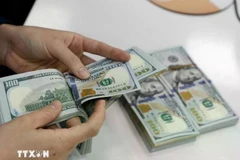
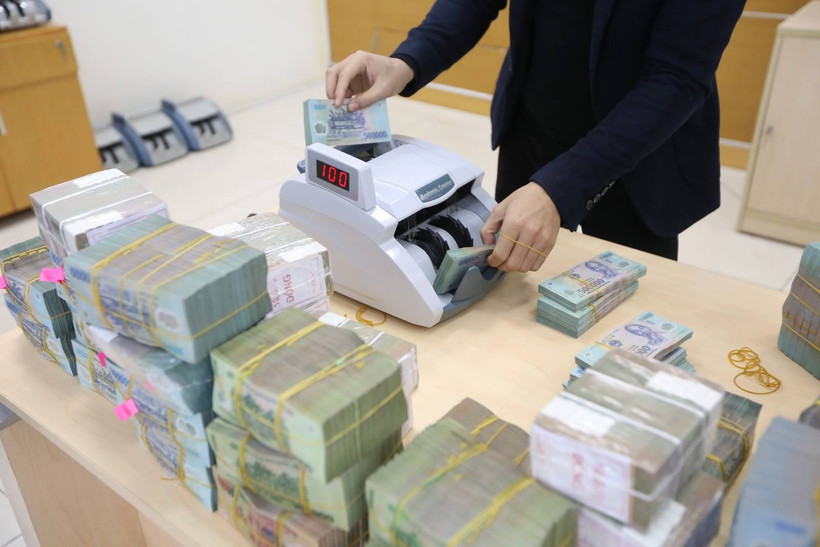
Authorities will exercise strict monitoring to keep debt safety indicators within the approved ceilings, promote the development of the domestic capital market, and maximise ODA and foreign concessional loans. (llustrative photo: VNA)

Hanoi (VNA) – Deputy Prime Minister Ho Duc Phoc has signed a decision to approve the 2025 public borrowing and debt repayment plan and the three-year public debt management programme for 2025–2027.

The plans aims to ensure full and timely repayment of public debt without affecting Vietnam’s sovereign credit rating, while continuing to restructure the Government bond portfolio in line with market conditions and development needs. They also seek to diversify borrowing channels both domestically and internationally to balance the state budget and support socio-economic development, with foreign capital prioritised for large and strategic projects.

Under the plans, authorities will exercise strict monitoring to keep debt safety indicators within the approved ceilings, promote the development of the domestic capital market, and maximise official development assistance (ODA) and foreign concessional loans.

Regarding the 2025 public borrowing and debt repayment plan, government borrowing is capped at 815.238 trillion VND (30.86 billion USD), including up to 443.1 trillion VND to cover the central budget deficit, 361.1 trillion VND for debt repayment, and nearly 11 trillion VND for on-lending. Borrowing will be sourced mainly from Government bonds, ODA and foreign concessional loans, and other lawful financing channels.

Government debt repayments are capped at 506.949 trillion VND, of which direct obligations of the Government account for 468.5 trillion VND, and repayments for on-lent projects total 38.4 trillion VND.

The plan sets no government guarantee for domestically issued bonds of the Vietnam Development Bank in 2025, while allowing the Vietnam Bank for Social Policies to issue up to 10.5 trillion VND in guaranteed domestic bonds.

Local administrations are allowed to borrow up to almost 31.8 trillion VND in 2025, with 3.3 trillion VND allocated for principal repayment and 3.1 trillion VND for interest and fees.

Vietnamese enterprises and credit institutions without government guarantees may take on the maximum of about 5.5 billion USD in medium- and long-term foreign commercial loans, and short-term external debt is expected to rise 18–20% from the end-2024 levels.

Public debt management for 2025–2027

For the 2025–2027 period, total government borrowing is capped at 2.218 quadrillion VND, including 2.18 quadrillion VND for the central budget and 35 trillion VND for on-lending from ODA and foreign concessional loans.

Debt repayments during the three years are capped at 1.346 quadrillion VND, comprising 1.2 quadrillion VND in direct obligations and 120 trillion VND in on-lent debt.

The plan requires full and timely repayment of government obligations to avoid overdue debt and ensure Vietnam’s fulfilment of international commitments.

The ceiling for government guarantees over the period includes up to 14.16 trillion VND for the Vietnam Development Bank. Guarantees for the Vietnam Bank for Social Policies will depend on actual debt recovery of credit packages under the socio-economic recovery and development programme.

The decision also stresses strict control over local government debt, compliance with the State Budget Law, and accelerated disbursement of public investment. Ministries, agencies, and localities are tasked with monitoring, auditing, and reporting on debt management to ensure efficiency, thrift, and transparency./.

VNA

See more

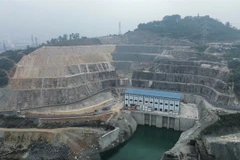
The expanded Hoa Binh Hydropower Plant (Photo baochinhphu.vn)

EVN launches major power projects

Among the flagship projects inaugurated was the expanded Hoa Binh Hydropower Plant with a total installed capacity of 480MW per year and average annual output of about 488 million kWh.

An ultra-intensive shrimp farming model linked with environmental protection in Ca Mau province. (Photo: VNA)

Fisheries take the lead in the Mekong Delta’s green transition

Across the Mekong Delta, leading aquaculture producers, processors and exporters, along with suppliers of inputs, are transitioning to circular, high-tech and clean production models that cut greenhouse gas emissions and comply with international certification standards.

A perspective view of the Red River Landscape Boulevard project in Hanoi (Photo: VNA)

Works starts on Hanoi’s Red River Landscape Boulevard Axis project

The project is among the 234 key works and projects being launched, inaugurated or technically opened simultaneously across 34 cities and provinces nationwide to mark the 14th National Party Congress. Its launch contributes to implementing the country’s strategic development orientations while concretising Hanoi’s development goals in the new period.

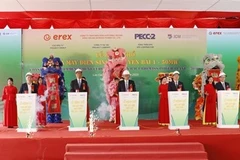
The ground-breaking ceremony of the Yen Bai 1 biomass power plant in Lao Cai province on December 19. (Photo: VNA)

Work starts on 114-million-USD biomass power plant in Lao Cai

The project, developed by Erex Yen Bai Biomass Power Co. Ltd. is located in Dong Cuong commune, Lao Cai province. It is backed by Japan’s Erex Group and falls under the Joint Crediting Mechanism, a bilateral initiative between Vietnam and Japan to reduce greenhouse gas emissions.

At the inauguration ceremony (Photo: VNA)

Vietnam Railways Corporation unveils upgraded coaches, digital tools

These moves reflect the VNR's commitment to fulfilling six priority tasks set by the Prime Minister, including leading in innovation and digital transformation, applying sci-tech in line with the Politburo’s Resolution No. 57-NQ/TW, and spearheading advances in digital, green and circular economy.

Producing MDF panels for export at Hai Duong MDF Construction and Manufacturing Co., Ltd., in Ho Chi Minh City (Photo: VNA)

HCM City targets 15 billion USD in wood exports by 2035

The merger of HCM City with Binh Duong and Ba Ria – Vung Tau is expected to give the local wood industry a strong boost into a phase of high-quality growth driven by linkages, innovation, sustainability, and deeper integration into global value chains.

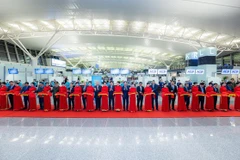
Delegates cut a ribbon to inaugurate the expanded Terminal T2 at Noi Bai International Airport in Hanoi on December 19, 2025. (Photo: VNA)

Expanded Terminal T2 at Noi Bai International Airport makes debut

The project expands the terminal’s floor area to over 200,000 sq.m, increases passenger capacity from 10 million to 15 million, even up to 18 million per year, and boosts operational capacity with boarding gates rising from 17 to 30 and jet bridges from 14 to 27, meeting strong growth in international travel demand.

A section of Can Tho - Ca Mau Expressway (Photo: VNA)

Can Tho – Ca Mau travel time halves from December 19

Stretching more than 110 km with a total investment of over 27.5 trillion VND (1.04 billion USD), the project not only resolves long-standing traffic bottlenecks in the Mekong Delta, but also opens up new development opportunities for the entire region - especially Ca Mau, the last locality in the country to be directly connected to the eastern North–South expressway axis.