Agency banking model develops in rural, remote locations
The State Bank of Việt Nam (SBV) is amending regulations related to the operation of agency banking to improve access to the banking system.
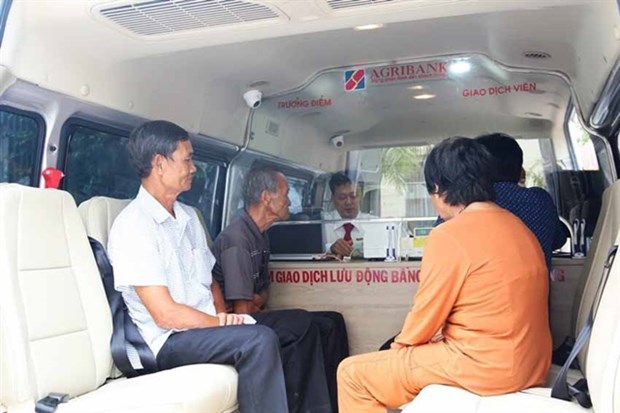 With the most branches in the rural and remote areas in Vietnam, Agribank plans to work with more places to bank the local people (Photo courtesy of Agribank)
Agency banking is a type of branchless banking that allows traditional banks to extend their network of branches and services through authorised agents.
The model arrived in the country in recent years, especially since the Government issued the national comprehensive financial strategy in early 2020.
According to the SBV’s research, Brazil, Kenya, Mexico and India have all seen agency banking become an important tool to expand access to basic financial services and promote financial inclusion. Five years since Brazil launched the agents, the network has served 12.4 million new bank accounts.
The state bank said in Southeast Asia, Malaysia's agency banking model uses the nationwide telecommunications network to expand the network of traditional banking services to customers in rural and remote areas at a low cost. The model also helps Malaysian banks save more than 80 percent of costs for setting up service points and 60 percent of transaction costs compared to the traditional bank branch network.
Banks intrigued
According to the latest Comprehensive Financial Report of World Bank released in 2018, 69 percent of adults in Vietnam were unbanked and relied on cash while the rate in the world was 31.5 percent at the same time.
Meanwhile, the national strategy of financial services sets the goal to have at least 50 percent of communes accessing financial service points and 80 percent of adults having transaction accounts at banks or other institutions by 2025.
Experts reckon the low rate of bank accessing in Vietnam is a big chance to develop banking agents across the country.
By the end of 2017, the SBV piloted agency banking in rural areas with three models.
MB Bank work with Viettel services, PGBank with Petrolimex sales points and Vietcombank with M_service Company, reaching 32,185 sales points.
More than 11 million transactions with a value of more than 81 trillion VND (3.49 billion USD) were recorded among some 6 million customers.
Outside of the SBV pilot, LienVietPostBank took advantage of post office locations to develop savings services, while Jens Lottner, CEO of Techcombank, shared the bank’s plan to work with Masan Group to take advantage of convenience stores to bring the bank’s financial products and services to a wider population.
Between 2020 and 2025, Agribank plans to set up a network of banking agencies and work with postal organisations, public administrations and microfinance projects to deploy low-cost, convenient, safe products for individual payment transactions.
Seeing the potential of the model, a SBV representative said there must be a legal corridor.
The SBV said completing the legal framework on agents was proposed in the national comprehensive financial strategy) to improve the level of access to financial services for people.
The central bank said it was amending other regulations related to the operation of the model, especially those on anti-money laundering/terrorist financing, regulations on electronic money and know-your-customer (KYC) processes.
CEO of TPBank Nguyen Hung said such regulations would need to go into detail to guide the establishment of agencies to provide banking services, such as regulations on approved and prohibited services, criteria to become authorised agencies and the form of operation.
Hung mentioned two main forms of authorisation used in Brazil known as full authorisation and credit authorisation, adding a fully authorised agent will provide a full range of services from receiving and forwarding application documents for opening a payment account, savings account, deposit/withdrawal transaction, transfer, payment as well as loan applications and opening credit cards. Meanwhile, a credit agency will only provide services on payment, borrowing and credit.
Taking another example of Bangladesh, Hung said authorised dealers can provide cash withdrawal/deposit services, support for small loan disbursement and debt collection/instalment, bill payment assistance, fund transfer assistance, balance queries, collect and forward applications for opening accounts, opening savings, loans and credit cards. However, they are not allowed to approve the decision to open card/loan accounts, conduct financial appraisals and conduct foreign currency transactions.
According to another financial expert, it is necessary to clarify the quality and capacity of organisations authorised to act as banking agents.
The agents must ensure that they meet all the standards of financial capacity, reputation, ability to meet commitments under adverse conditions, ability to provide financial services based on technology and capacity of internal control, security assurance and anti-money laundering./.




You should also see
Energy industry needs nearly 5 trillion VND of investment in 2021-2030
The total investment capital demand for the whole energy sector in the 2021-2030 period is between 4.13-4.8 trillion VND (163.01-189.46 million USD), according to a plan to implement the National Power Planning in the 2021-2030 period with a vision to 2050.


See more
 Business
Cam Lam - Vinh Hao Expressway to help drive south-central region's economy
The 78.5km Cam Lam - Vinh Hao Expressway, one of the three sub-projects of the North - South Expressway project’s eastern wing, officially opened to traffic on April 26.
 Business
Vietnam needs drastic reforms to create firm ground for economic growth: experts
Drastic institutional reforms are needed to create firm ground for economic growth in the context that persistent challenges, both external and internal, still cloud the growth prospect, experts have said.
 Business
Dak Lak firm pioneers in following EUDR in coffee production
The Dak Lak September 2 Import-Export Company Limited (Simexco) has pioneered in building coffee growing areas following the EU Deforestation Regulation (EUDR), it announced on April 25.
 Business
Dong Nai calls for Korean investment into green growth
The southern province Dong Nai introduced its investment projects and incentives to the Republic of Korea (RoK)’s firms at a workshop in Seoul on April 25.
 Business
Vietnam ranks fifth among aquatic product suppliers for Singapore
Vietnam jumped one place to become the fifth largest exporter of aquatic products to Singapore for the first time in the first quarter of this year, according to its Trade Office in the city state.
