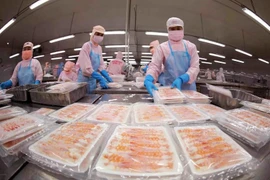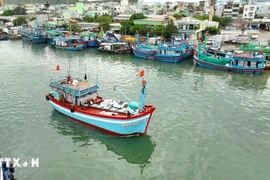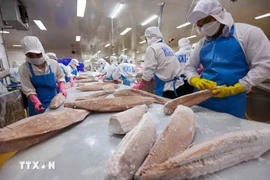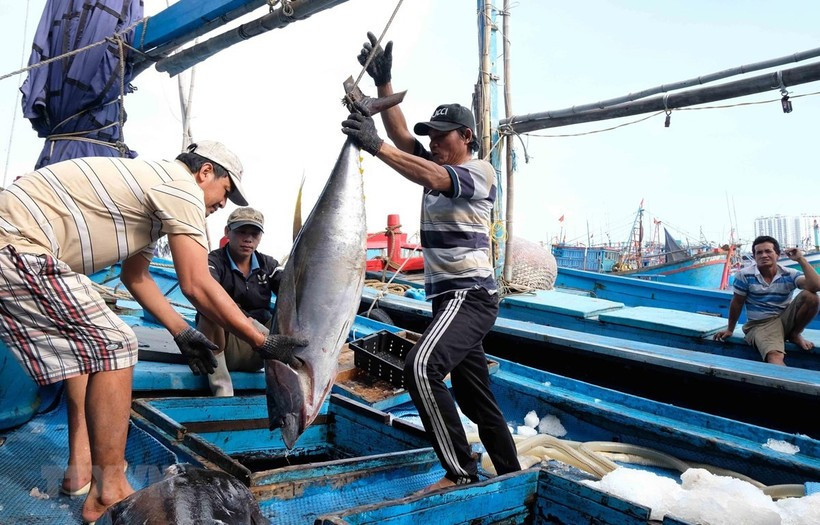
Hanoi (VNA) – Despite volatility in global trade, aquatic exports have maintained solid growth, laying the foundation for the sector to reach 11 billion USD this year and expand its presence in demanding markets, according to Deputy Minister of Agriculture and Environment Phung Duc Tien.
The official reported that fisheries production has so far reached around 9.05 million tonnes, with an expected total of 9.7–9.8 million tonnes for 2025, potentially surpassing the results in 2024.
Fisheries export value up 13.2%
Deputy Minister Tien noted that despite natural disasters since early 2025 causing an estimated economic loss of 97 trillion VND (3.68 billion USD) and severely affecting agriculture, including fisheries, the sector maintained impressive growth.
Fishery production has currently reached around 9.05 million tonnes, with full-year output expected at 9.7–9.8 million tonnes, potentially surpassing 2024’s results.
This growth has been supported by the Ministry of Agriculture and Environment’s efforts to boost trade promotion, and diversify export markets and products. The ministry’s efforts also support market access, address technical barriers, and ensure traceability and food safety. In the long run, it will also serve to have the European Commission (EC) “yellow card” warnings against Vietnamese seafood exports for illegal, unreported and unregulated (IUU) fishing lifted.
At the same time, the Ministry of Agriculture and Environment has paid heed to enhancing the efficiency and effectiveness of state management in disaster prevention, forest protection and development, and biodiversity conservation. The ministry promotes administrative reform and decentralisation, strengthened inspection and supervision, management based on real-time data and information, and increased dialogue and support for citizens and businesses.
Vietnam earned 10.38 billion USD from aquatic exports in the first 11 months of 2025, up over 13.2% year-on-year, driven by market diversification. China, the US, and Japan remain Vietnam’s three largest fishery importers, accounting for 20.2%, 17.6%, and 15% of the market share, respectively.
The Vietnam Association of Seafood Exporters and Producers (VASEP) attributed the results to persistent efforts of the agriculture and environment sector amid volatile markets, particularly the policy shocks from the US market.
Notably, although signs of slowdown appeared in the third quarter of 2025 due to reciprocal tariffs and severe natural disasters, Vietnam’s key fishery products have maintained strong momentum, laying the foundation for total fishery exports in 2025 to potentially reach 11 billion.
Promoting responsible fisheries development
Although the fisheries sector has recorded impressive growth over the first 11 months, Nhu Van Can, Deputy Director of the Department of Fisheries and Surveillance under the Ministry of Agriculture and Environment, noted that the three storms, along with floods in October and November, caused serious damage to aquaculture and fisheries operations in the South Central and Central Highlands provinces.
Can said the damage is likely to affect fisheries production in 2026. Therefore, the department has proactively proposed measures to maintain production, including immediate urgent solutions and long-term strategies to reorganise and restore operations.
Accordingly, the Department of Fisheries and Surveillance has advised local authorities to promptly complete procedures for damage verification to provide timely support under Decree 09/2025/ND-CP, which regulates agricultural production assistance for natural disaster-hit areas. The agency also provides guidance on environmental management, determining safe stocking times.
In the long term, local authorities are required to review, reorganize cage aquaculture activities to minimise risks, prioritise infrastructure development in key farming areas, and strengthen regular environmental monitoring and early warning systems. Further, they are to promote the application of digital technology for disaster and environmental alerts in aquaculture zones, and develop specialised credit and risk insurance mechanisms for marine farming.
Tien stressed that responsible and environmentally friendly fisheries development is not only a global trend but also a prerequisite for Vietnam’s fisheries sector to integrate deeply and meet international standards.
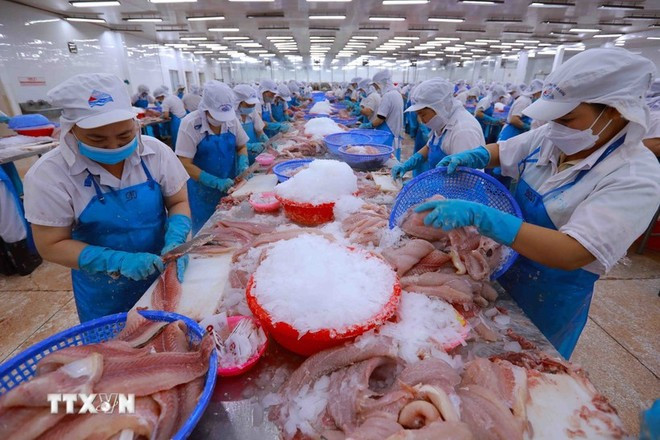
In this context, fishery enterprises must proactively restructure markets, increase value-added products, invest in processing technology to meet sustainability standards, laying the foundation for long-term growth, he added./.