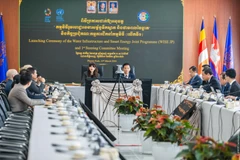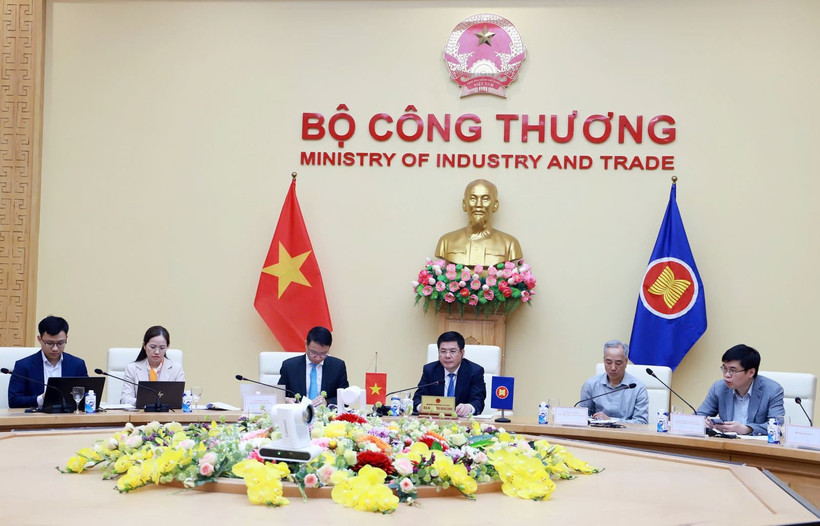
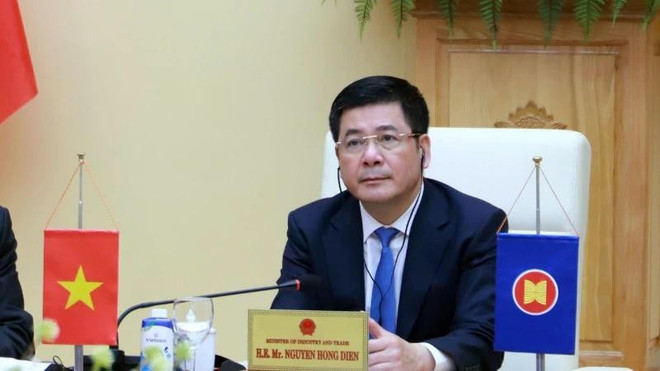
Hanoi (VNA) – The Association of Southeast Asian Nations (ASEAN) needs to remain united, calm, and resilient in cooperation with the US, Vietnamese Minister of Industry and Trade Nguyen Hong Dien recommended at the Special ASEAN Economic Ministers’ Meeting on the US’s new tariff policy held online on April 10.
Sharing Vietnam’s stance on this reciprocal tariff policy, Dien said that the country has taken the initiative in exchanging views and holding dialogues and negotiations with the US.
Vietnam supports ASEAN’s comprehensive, flexible, and practical approach to enhancing economic resilience and promoting supply chain diversification through the effective utilisation of free trade agreements (FTAs), he affirmed.
The Vietnamese minister suggested the bloc give priority to promoting cooperation with external partners in general, and the US in particular, in areas of mutual interest to implement its long-term development goals and enhance its position in the new global context.
At the same time, he acknowledged and expressed support for the contents of the Joint Statement issued by Vietnam and other ASEAN member states, emphasising that it reflects ASEAN’s unity and proactive role amidst a complicated and unpredictable global trade environment.
In the Joint Statement, the ASEAN Economic Ministers reaffirmed the strong and enduring partnership between ASEAN and the US. As a Comprehensive Strategic Partner of ASEAN, for more than four decades the US has played a significant role in fostering ASEAN-centered regional architecture that promotes peace, stability, economic growth, investment, and trade in the region which has benefited the two sides. In 2024, ASEAN was the US’s fifth largest trading partner, while the US was the bloc’s largest FDI source and second largest trading partner.
They called on the US to engage in frank and constructive dialogues to address trade-related concerns, affirming that open communication and collaboration will be crucial to ensuring a balanced and sustainable relationship. In that spirit, ASEAN committed to not impose any retaliatory measures in response to the US's tariffs.
ASEAN member states remain committed to safeguarding ASEAN’s economic interests as well as maintaining strong and mutually beneficial trade relations with the US, they said, reaffirming their readiness to work together with the country under the ASEAN-US Trade and Investment Framework Agreement (TIFA) and Expanded Economic Engagement (E3) Workplan, to explore mutually acceptable solutions on issues of common interest. These include facilitating two-way trade and investment, deepening strategic trade partnerships, and enhancing supply chain connectivity and resilience through digital technology and innovation, that can promote stronger regional cooperation.
The minister also reaffirmed their support for a predictable, transparent, free, fair, inclusive, sustainable, and rules-based multilateral trading system with the World Trade Organisation (WTO).
At the meeting, participants also reached consensus on several key points, including the establishment of an ASEAN geo-economics task force to assess the impact of US duty policies and provide timely recommendations to support the grouping’s efforts in addressing mutual concerns, and exploring cooperation opportunities in emerging areas of shared interest./.