Bac Giang creates breakthrough in service sector development

In its efforts to strengthen the local economy, the northern province of Bac Giang is focusing on transforming the service sector into a core driver of growth.

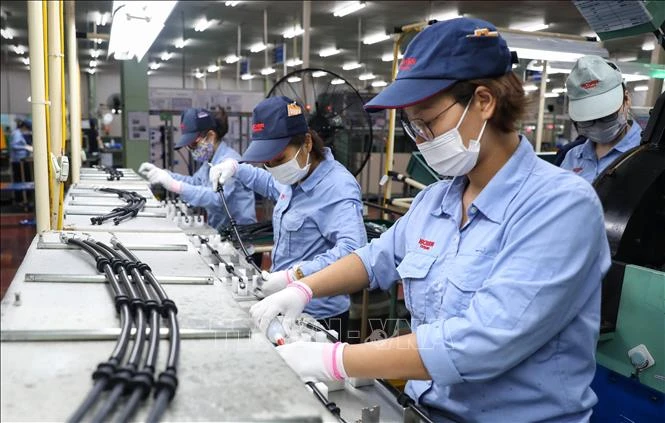
Bac Giang aims to achieve an average annual growth rate of 7.5 - 8.5% for the service sector between 2024 and 2030. (Photo: VNA)

Bac Giang (VNA) - In its efforts to strengthen the local economy, the northern province of Bac Giang is focusing on transforming the service sector into a core driver of growth.

Vice Chairman of the provincial People’s Committee Phan The Tuan highlighted the province’s commitment to attracting investments to and fostering high-quality and competitive service development.

The province has identified several service industries with potential for growth, including commercial services in urban areas and industrial parks, transportation and logistics, banking and finance, tourism, nighttime economy, sports and culture, healthcare, and high-quality education and vocational training.

vna_potal_bac_giang_thu_hut_von_fdi_tang_gap_5_lan_so_voi_cung_ky_nam_2022_stand (1).jpeg
By 2030, the service sector's contribution to Bac Giang’s gross regional domestic products (GRDP) is expected to reach 21 - 22%. (Photo: VNA)

Bac Giang aims to achieve an average annual growth rate of 7.5 - 8.5% for the service sector between 2024 and 2030. By 2030, the sector's contribution to the province’s gross regional domestic products (GRDP) is expected to reach 21 - 22%, with retail and consumer service revenues targeted at an annual growth pace of 15% during 2024 - 2030.

To realise these goals, the province is prioritising the establishment of modern commercial centers, particularly in urban areas and industrial zones. The plan includes developing at least one large-scaled commercial hub equivalent to a tier-one shopping mall and ensuring all new industrial parks feature dedicated service areas.

Developing tourism at the same time with entertainment and accommodation services is also a focus. Efforts will be made to attract investments to two or three 4-star or higher hotel projects and at least one large-scaled entertainment complex.

By 2030, Bac Giang aims to establish at least two nighttime economy zones in Bac Giang city and Viet Yen township to cater to tourists, residents, and professionals working in the province.

Healthcare and education are other priorities, with plans to attract investments to at least three high-quality hospitals and one or two international schools in Bac Giang city, Viet Yen township, and areas with developed industrial parks.

The province is working on high-quality residential areas tailored to foreigners and mixed-use zones combining residential, commercial, and recreational facilities near large urban areas and industrial hubs. These areas will include a range of housing options, from low-rise and high-rise units to serviced apartments and condotels, designed to meet the living and leisure needs of local residents and foreign professionals.
Van Trung Industrial Park.jpg
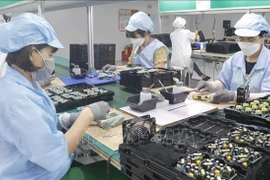
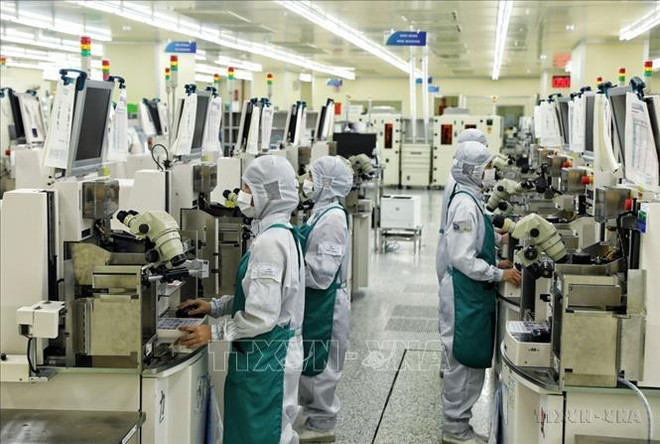
The modern production line of Hana Micron Vina Co., Ltd., a Korean-invested company, located in the Van Trung Industrial Park of Bac Giang province. (Photo: VNA)

Key projects include the Bac Giang mixed-use urban area and international market, the Nham Bien Mountain golf urban area, and the Ho Cao Lake eco-tourism and resort complex. These projects aim to create significant economic momentum while enhancing Bac Giang’s appeal as a tourist and investment destination.

Despite its robust GRDP growth, the province’s service sector development has not yet matched the pace of its broader economic expansion.

In 2023, retail and consumer service revenues reached 56.5 trillion VND (2.2 billion USD), a 13% increase from the previous year, with an average annual growth rate of 13.8% between 2021 and 2023.

However, Bac Giang faces challenges such as a lack of large-scaled entertainment facilities and comprehensive nighttime attractions.

While some progress has been made, like the planned establishment of an Aeon Mall in Bac Giang city, there is still a notable absence of high-profile projects in commercial services, leisure, and tourism. Existing recreational facilities are limited to urban parks and small-scaled venues like Hoang Hoa Tham Park and the Wedding Land Entertainment Park.

To address these challenges, the province is set to focus on improving infrastructure, enhancing urban planning, and allocating land for commercial and service development. It is also accelerating administrative reforms and investment promotion activities to attract large-scaled projects.

The local administration is encouraging the private sector and the community's participation in service development. Efforts are also underway to expand the supply of skilled labour for the service industry, alongside reforms to improve the business and investment climate.

By 2030, Bac Giang envisions a thriving service sector anchored by modern urban centres, vibrant tourism, and competitive industries. With strategic investments in infrastructure and key sectors, it aims to establish itself as a dynamic economic hub that meets the needs of residents, professionals, and tourists alike./.


VNA

See more

PM Pham Minh Chinh speaks at the event (Photo: VNA)

PM spotlights solidarity, cooperation, dialogue at annual business forum

Vietnam will maintain political stability and social order, push three strategic breakthroughs in institutional reform, hard and soft infrastructure, and quality human resources, while restructuring the economy and reforming the growth model, sustaining macroeconomic stability, and bolstering connectivity between domestic and FDI enterprises, said PM Pham Minh Chinh.

Officers of the Vam Lang border guard station in Dong Thap disseminate information on the prevention of illegal, unreported and unregulated (IUU) fishing and present a national flag to members of a local ship. (Photo: VNA)

Dong Thap province’s fishing cooperation models prove effective

According to Tran Thi Be Bay, Deputy Director of the provincial Department of Agriculture and Environment, the cooperative groups and cooperatives have members engaging in logistics services, such as purchasing seafood at sea and supplying fuel to fishing vessels, thereby helping fishermen stay longer at sea and increase productivity.

Vietnam’s pepper exports maintain strong growth momentum of over 25%, earning nearly 1.4 billion USD in the first ten months of 2025. (Photo: VNA)

Pepper exports maintains over 25% growth

According to the Vietnam Pepper and Spice Association (VPSA), the country exported 19,430 tonnes of pepper in October, including 16,464 tonnes of black and 2,966 tonnes of white pepper, with a total value of 129.5 million USD.

Vietnam's dragonfruits for export (Photo: VNA)

Tay Ninh expands middle East–Africa markets for farm produce

Leveraging its position as a gateway linking the Southeast and Mekong Delta regions, Tay Ninh province is asserting its role as a strategic hub in expanding agricultural supply chains to Muslim markets, especially the Middle East and Africa, which have emerged as promising destinations for Vietnamese agricultural exports, particularly Halal-certified products.

Vietnam’s Trade Counselor in India Bui Trung Thuong and Nguyen Phi Van, Chairwoman of Go Global Holdings, cut the ribbon at the opening ceremony of a Three O’Clock coffee shop at AIPL Joy Central. (Photo: tuoitre.vn)

Three O’Clock brings Vietnamese coffee to India’s billion-people market

This milestone on November 8 came 11 months after the signing of an international franchise agreement between Three O’Clock (a brand under the Teatime limited company) and its exclusive master franchise partner for the Indian subcontinent FranGlobal. Under the deal, FranGlobal will develop the brand in India, Nepal, Sri Lanka, and Bangladesh, committing to a minimum of 100 outlets within a decade.

A Vietjet flight attendant offers gifts to international passengers during a flight. (Photo: courtesy of Vietjet)

Vietjet reports strong growth in Q3, announces 20% stock dividend

In Q3, Vietjet's air transport revenue reached 16.728 trillion VND, with a pre-tax profit of 393 billion VND. Cumulatively, for the first nine months of the year, the company reported air transport revenue of 52.329 trillion VND and a pre-tax profit of 1.987 trillion VND, which increased by 28% year-on-year.

Nguyen Duc Thien, General Director of Vietnam Electricity (EVN)’s Northern Power Corporation (centre), chairs the working session with credit rating organisation Fitch Ratings (Photo: npc.com.vn)

Fitch Ratings affirms Northern Power Corporation at ‘BB+’ with stable outlook

The rating reflects EVNNPC’s standalone credit profile of ‘BB+’, which is on par with both parent company EVN and Vietnam’s sovereign rating of ‘BB+/Stable’. Fitch said the alignment of EVNNPC’s rating with EVN’s reflects the state-owned parent’s full ownership and the high likelihood of government support, consistent with Fitch’s Parent and Subsidiary Linkage Rating Criteria.

Vietnamese Ambassador to Brazil Bui Van Nghi (right) meets with President of the Brazilian Association of Soybean Producers (Aprosoja) Mauricio Buffon in Brasilia. (Photo: VNA)

Vietnam, Brazil boost agri-trade cooperation

The Vietnamese ambassador expressed the country’s desire to increase the export of aquatic products, cashews, wood items, processed farm produce, apparel, mobile phones, computers, and electronic components to Brazil.

A dancing performance at the opening ceremony of the 2025 K–Vietnam Pop-up Festa in Dalat on November 8 (Photo: VNA)

K-Market Vietnam 2025 held in Lam Dong

The event features a series of cultural and trade exchange activities between Vietnam and the Republic of Korea (RoK), with more than 100 Lam Dong and Korean enterprises showcasing typical products from both sides.

Workers handle the preliminary processing of sea grapes before production. (Photo: VNA)

Company brings Vietnamese sea grapes to the world

The Tri Tin Seaweed Company, founded by Le Ben, has pioneered a new path for the province’s aquaculture sector by establishing a fully integrated production chain, applying high-tech processes, and adhering strictly to international standards.