Belgian media introduces Vietnam’s Quang Phu Cau incense-making village

The Belgian Radio-Television of the French Community (RTBF) on March 1 broadcast a report on Quang Phu Cau incense-making village near the Vietnamese capital city of Hanoi, which is a favourite destination of Vietnamese people.
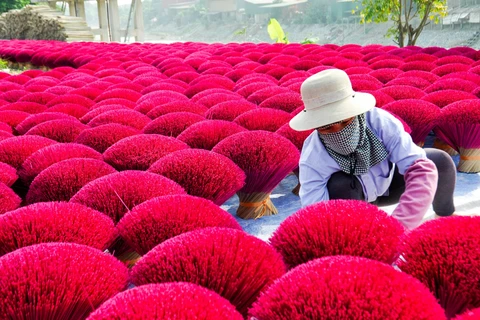
Belgian media introduces Vietnam’s Quang Phu Cau incense-making village ảnh 1Quang Phu Cau village is famous for its incense business.(Photo: VNA)

Brussels (VNA) – The Belgian Radio-Television of the French Community (RTBF) on March 1 broadcast a report on Quang Phu Cau incense-making village near the Vietnamese capital city of Hanoi, which is a favourite destination of Vietnamese people.

The report features mesmerising images of the village, which is famous for its incense business and nearly 3,000 local households living on this traditional craft. 

It said the village came into spotlight with a photo of colourful incense sticks being dried outdoors by a Vietnamese artist. The photo motivated the owner of Long Hoa company, which has been producing incense for more than 100 years, to come up with the idea of opening a photo tour for guests at a price of 4 EUR (4.26 USD) per person. On peak days, the village welcomes about 100 tourists and photographers.

Belgian media introduces Vietnam’s Quang Phu Cau incense-making village ảnh 2Colourful incense sticks are dried outdoors. (Photo: VNA)

During the tour, visitors and incense makers interact with each other, the TV report said, adding that the demand for incense in Vietnam and for exports is huge.

The incense-making process is also described in the report. Bamboo trees are cut into pieces and split into thin sticks. Then, they are dyed red or pink which are colours that Vietnamese people think bring good luck.

The report concluded that in Vietnam, incense is a part of spiritual life and a way to communicate with the afterlife as well as to pay respect to ancestors or to pray for simpler things like passing an exam./.

VNA

See more

Ha Long Bay in Quang Ninh province. (Photo: VNA)

Quang Ninh - magnet for affluent Indian travellers

Alongside wedding tourism, Quang Ninh is also seeing robust growth in arrivals of Indian MICE travellers. Delegations of hundreds, and sometimes thousands, of visitors have been coming to the province for conferences, seminars and incentive travel programmes combined with leisure stays.

Visitors at Van Mieu - Quoc Tu Giam (The Temple of Literature) in central Hanoi. (Photo: hanoi.gov.vn)

Hanoi gears up for tourism boom during national holidays

For Hanoi tourism sector, the national holidays to commemorate Hung Kings (April 25-27), along with the national reunification celebration (April 30) and the Labour Day (May 1) are not only a peak time for welcoming visitors but also a test of its operational capacity, service organisation, and destination quality in the context of a volatile market.

The sea area off the southern coast of Phu Quoc Island. (Photo: VNA)

UK newspaper praises Phu Quoc’s unspoilt charm amid tourism boom

Phu Quoc is positioned as a compelling alternative – even a potential rival to Phuket – for travellers seeking authenticity in Southeast Asia. Its appeal lies not only in scenic beauty and fresh seafood, but also in the harmonious coexistence of modern tourism and enduring local culture.

Cua Viet beach is a magnet for both locals and visitors during holidays. (Photo: VNA)

Quang Tri seeks to unlock potential of marine tourism’s “golden triangle”

Cua Tung, Cua Viet and Con Co special zone are identified as three key destinations of marine tourism, and to transform this “tourism triangle” into premium and peaceful resorts, a new strategy is needed to enhance attractiveness to high-end travellers seeking private spaces as the strength of these places lies in their pristine and tranquil beauty.

Korean tourists on Ho Chi Minh City's book street (Photo: VNA)

Vietnamese destinations attracting Korean visitors amid “micro-trip” trend

Last year, Vietnam welcomed more than 4.3 million Korean visitors out of a total of nearly 29.6 million Koreans traveling abroad. This volume significantly outpaces Korean arrivals to neighbouring competitors like Thailand, Singapore, and the Philippines, cementing Vietnam’s status as a premier regional hub for East Asian tourism.