Big push for Vietnam to escape middle-income trap: Int'l institutions

The World Bank said that to maintain rapid growth and achieve its ambitious development goal, Vietnam must deepen the sweeping institutional reforms that are underway, strengthen the legal and regulatory environment, and improve both the scale and quality of public investment.

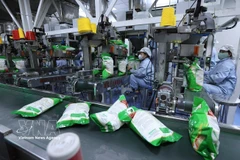
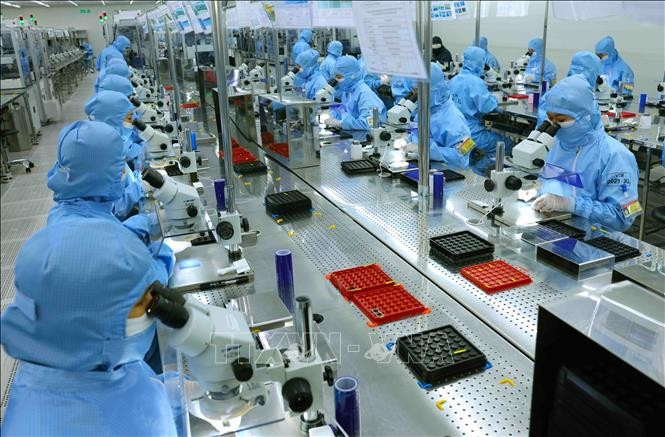
A production line of camera modules and electronic components for export at the factory of MCNEX VINA Co., Ltd of the Republic of Korea in Phuc Son Industrial Park, Ninh Binh province. (Photo: VNA)

Hanoi (VNA) - The World Bank (WB) has urged Vietnam to take urgent action to adapt to climate change, in addition to its policy recommendations to improve public investment efficiency, strengthen accountability, and enhance the legal framework.

Institutional reforms: big push for breakthroughs

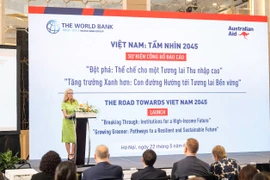
In its latest report “Vietnam 2045 – Breaking Through Institutions for a High-Income Future,” the WB emphasises the central role of institutional reforms in ensuring sustainable growth. The bank said that to maintain rapid growth and achieve its ambitious development goal, Vietnam must deepen the sweeping institutional reforms that are underway, strengthen the legal and regulatory environment, and improve both the scale and quality of public investment.

International experience shows that countries that have escaped the middle-income trap and reached high-income status have done so by continuously improving the quality of their institutions.

Mariam J. Sherman, World Bank Director for Vietnam, Cambodia, and Laos said that “Vietnam’s ambition to become a high-income country by 2045 has brought renewed focus on institutions as enablers of sustained growth”. She added that recent efforts show commitment, but achieving this goal will require even bolder reforms - an ‘institutional big push’ - to unlock the private sector’s potential to drive growth and create quality jobs for its people.

In addition, administrative reforms, greater accountability, more autonomy, and better coordination across localities are the key to improving the business environment and strengthening subnational governance. The WB also highlights the need for Vietnam to build an efficient and accountable civil service - one that is right-sized, better paid, and backed by stronger institutions for due process, transparency, and external oversight.

The second report, "Vietnam 2045 - Growing Greener: Pathways to a Resilient and Sustainable Future," highlights how investments in adaptation can help limit the impact of climate shocks on Vietnamese farms, businesses, and factories.

A 2024 WB survey found that about three-quarters (75%) of manufacturers in apparel and electronics - two of Vietnam’s leading export sectors – garments and electronics, which are operating in areas facing significant heat stress, putting more than 1.3 million workers at risk.

In the absence of adaptive actions, climate impacts could reduce Vietnam’s Gross Domestic Product (GDP) by as much as 12.5% by 2050 compared with baseline projections, potentially undermining the country’s ambition to reach high-income status by 2045, the report said.

It estimates that such investments could significantly mitigate the damage, reducing the projected climate-induced GDP loss from 12.5% to 6.7% by 2050.

The WB recommends Vietnam to integrate climate risk management across all economic sectors and develop policies that encourage businesses and people to actively adapt.

The report also identifies opportunities for Vietnam to reduce the carbon intensity of its economy and move toward the Government’s goal of achieving net-zero emissions by 2050, which not only help protect the environment but also strengthen the country’s position in global supply chains.

Staying optimistic amid uncertainties

At the micro level, the HSBC Global Trade Pulse 2025 survey released recently reveals that Vietnamese companies are facing steeper cost increases than the global average due to tariffs and trade uncertainties.

The survey found that 80% of Vietnamese firms reported rising costs stemming from changes in tariffs and trade uncertainties. Short-term cost pressures are expected to persist, with 82% of Vietnamese enterprises anticipating further increases, and over the long term, 75% still anticipate elevated cost levels.

Rising costs are impacting not only profit margins but also directly affecting revenues. Businesses anticipate an average revenue decline of 18% due to supply chain delays.

In response to these uncertainties, Vietnamese businesses are actively adjusting their operational strategies. According to the survey, 42% have reshored production to Vietnam, 41% are shifting focus to the domestic market, and another 41% are enhancing data analytics efforts. Additionally, 54% acknowledge the need for external support in crisis response planning and strengthening business resilience.

Despite challenges, 81% remain optimistic about future international growth, while 76% say trade volatility has spurred them to seek new business opportunities, enhance innovation, upgrade, and restructure their operating models.

According to Surajit Rakshit, Country Head of Global Trade Solutions at HSBC Vietnam, the current landscape of tariffs and trade uncertainties presents significant challenges for global businesses, but they are showing great resilience and adaptability in the way they operate./.

VNA
See more

In 2025, Hyundai sales reached 53,229 vehicles across the Vietnamese market. (Illustrative photo: Yonhap/VNA)

Hyundai sales in Vietnam rise almost 23% in December

In 2025, sales reached 53,229 vehicles across the market, a result considered a testament to the efforts by TC Group, Hyundai Thanh Cong, and the entire Hyundai dealership network nationwide amidst a volatile market.

Hydroponic vegetable cultivation model at the High-Tech Agricultural Park (Photo daibieunhandan.vn)

HCM City accelerates shift toward ecological urban agriculture

​The city’s agricultural sector is undergoing a strong transformation, restructuring toward higher value-added and sustainable development. In recent years, the sector has maintained steady growth, with agricultural, forestry and fisheries output rising by an estimated 2.5% annually.

Illustrative photo (Photo: VNA)

Dong Nai to launch major projects ahead of 14th National Party Congress

The launch of work on these projects represents an important political event for the province as they demonstrate the strong commitment of the entire political system to developing a comprehensive and modern infrastructure network, enhancing inter-regional connectivity, and addressing social welfare needs.

Illustrative image (Photo: VNA)

Lam Dong ready for nationwide economic census 2026

The entire process needs to reassure respondents that statistical activities operate independently, information is protected under the Statistics Law, and all data collection is completely separate from tax management.

Officials cut the ribbon to inaugurate the IFC Da Nang. (Photo: VNA)

Vietnam launches International Financial Centre in Da Nang

The Government has clearly defined the development orientation of the International Financial Centre in Da Nang as a modern international financial hub closely linked with the innovation ecosystem, digital technology, and sustainable finance.

Officers of the Thanh Hai Border Guard Station (Phu Thuy ward, Lam Dong province) patrol and monitor fishing vessels entering and leaving the port. (Photo: VNA)

Lam Dong steps up oversight to curb IUU fishing

As of early January 2026, the province had 8,210 registered fishing vessels, with more than 90% holding valid fishing licences, according to the department. A total of 8,115 vessels, or 98.76%, have been updated in the National Population Database, while 1,773 out of 1,941 vessels measuring 15 metres or longer have been granted food safety certificates, accounting for 91.34%.

Prime Minister Pham Minh Chinh speaks at the national conference on accelerating public investment for 2025 and 2026 (Photo: VNA)

People’s legitimate rights, interests must never be overlooked in public investment: PM

The Prime Minister underlined that public investment has consistently been identified as a key political task, with public investment disbursement results serving as one of the criteria for evaluating officials under Party regulations. Through state spending, public investment directly boosts aggregate demand and serves as an effective tool for regulating and stabilising the macroeconomy while safeguarding major economic balances.

Hoi An ancient town attracts large numbers of tourists. (Photo: VNA)

Da Nang aims to welcome nearly 93,000 MICE visitors in 2026

The Da Nang MICE Tourism Promotion Programme 2026, themed “Da Nang - Elevating your MICE experience”, will be implemented from January 1 through the end of the year. Under the programme, the city targets welcoming and supporting nearly 93,000 MICE visitors, representing an increase of about 12% compared to 2025.

(Source: Sun Group)

Sun PhuQuoc Airways records highest on-time performance in December

Despite entering the market only in November last year, Sun PhuQuoc Airways immediately ranked among the top two airlines in Vietnam for on-time performance in that month. This early consistency underscores the airline’s core commitment to reliability and respect for passengers’ time, sustained from its inaugural flights onward.

Imports and exports at Lach Huyen container port in Hai Phong city (Photo: VNA)

Vietnam targets 23 billion USD trade surplus in 2026

To meet these goals, the agency will continue refining the legal framework governing import-export activities and gather feedback from local authorities and relevant agencies to propose amendments, supplements or replacements for outdated circulars.