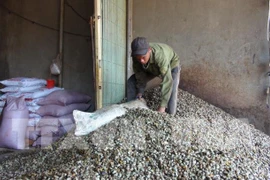
Harvesting the 2020 spring rice crop in Hoa Binh commune of Vu Thu district, Thai Binh province (Illustrative photo: VNA)
 Can Tho (VNA) - An international workshop was recently held in the Mekong Delta city of Can Tho to seek ways to raise income for Vietnamese farmers.
It offered a platform for scientists, researchers and policymakers to share ideas and new achievements; identify emerging challenges and forge academic cooperation in various fields related to business, economy and finance.
Organised by the Can Tho University, the event saw the participation of scientists and experts of Vietnam, Japan, New Zealand, the US, and Indonesia.
Prof. Scott Hipsher of Webster University of the US pointed out that the COVID-19 pandemic is taking its toll on vulnerable groups, including farmers.
He urged farmers to utilise time and human resources to increase farm production and quality during border closures and trade restrictions. Once the pandemic is brought under control and trade resumed, they are believed to gain an upper hand in supply and increase revenues.
Prof. Tsunoda Manabu from the Japan International Cooperation Agency laid a stress on the role of sustainable agro-economy development models.
He also touched on the application of modern technology in agriculture, saying it will be the most effective and sustainable agricultural development orientation.
A number of solutions were introduced during the event to bolster income for farmers, including the diversification of varieties, arrangement of short-term refresher courses and regular updates on market information.
In addition, farmers’ fear over risks should be minimised through the diversification of production, the Government’s support for insurance for varieties and thorough land planning, among others./.
It offered a platform for scientists, researchers and policymakers to share ideas and new achievements; identify emerging challenges and forge academic cooperation in various fields related to business, economy and finance.
Organised by the Can Tho University, the event saw the participation of scientists and experts of Vietnam, Japan, New Zealand, the US, and Indonesia.
Prof. Scott Hipsher of Webster University of the US pointed out that the COVID-19 pandemic is taking its toll on vulnerable groups, including farmers.
He urged farmers to utilise time and human resources to increase farm production and quality during border closures and trade restrictions. Once the pandemic is brought under control and trade resumed, they are believed to gain an upper hand in supply and increase revenues.
Prof. Tsunoda Manabu from the Japan International Cooperation Agency laid a stress on the role of sustainable agro-economy development models.
He also touched on the application of modern technology in agriculture, saying it will be the most effective and sustainable agricultural development orientation.
A number of solutions were introduced during the event to bolster income for farmers, including the diversification of varieties, arrangement of short-term refresher courses and regular updates on market information.
In addition, farmers’ fear over risks should be minimised through the diversification of production, the Government’s support for insurance for varieties and thorough land planning, among others./.
VNA