Cashew industry faces risk of trade deficit

Cashew nuts are one of the exports which have created a large market for Vietnam, however, the industry faces the risk of trade deficit due to higher raw material prices.

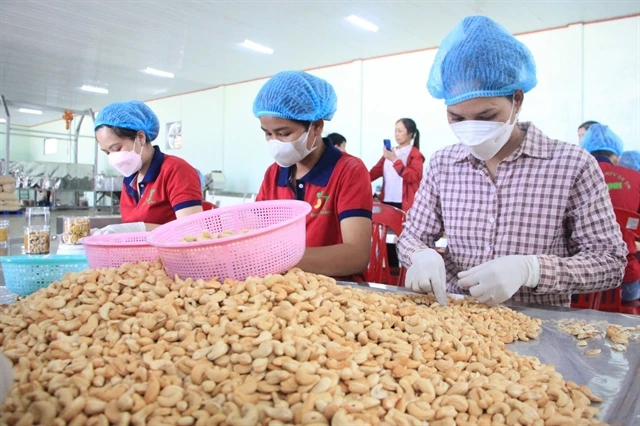
Processing cashews for export at a factory in Bình Phước Province. Việt Nam's cashew nut exports in the first eight months of 2024 reached 486,470 tonnes (Photo: VNA)

Hanoi (VNS/VNA) - Cashew nuts are one of the exports which have created a large market for Vietnam, however, the industry faces the risk of trade deficit due to higher raw material prices.

Exports of cashew nuts were up 22.9% in volume and 21.8% in turnover year-on-year, according to the General Department of Customs, with an average price of 5,706 USD per tonne.

Notably, the export turnover of cashew nuts still maintained growth, but the gap between the export value and the import turnover of raw materials has gradually narrowed.

In 2023, the export turnover of cashew nuts reached 3.64 billion USD, while the import of raw materials stood at 3.1 billion USD. The industry achieved a trade surplus of 500 million USD.

In the first eight months of this year, the cashew industry spent about 2.7 billion USD to import raw materials for processing, approaching the import value of last year.

"This figure accurately reflects the current situation of the cashew industry," said Vu Thai Son, Chairman of the Binh Phuoc Cashew Association and General Director of Long Son Company.

Vietnam is the world's leading country in processing cashew nuts. It has a large number of factories, but the domestic raw material area is reducing, only meeting about 10 - 12% of the demand for raw cashew nuts for those factories. Most of the raw materials have to be imported from Africa and Cambodia, according to Son.

A few years ago, the raw cashew nut supply was quite large, however this year supplies have fallen sharply due to drought.

In addition, African countries' export of raw cashew nuts has also tightened, so the selling price of raw cashew nuts has increased by 40-50%.

The growth rate of the export price of cashew nuts is not significant, so many enterprises have suffered heavy losses.

According to the Vietnam Cashew Association (VINACAS), Vietnam's cashew tree growing area is gradually decreasing year on year, from 440,000ha in 2007 to 302,500ha in the 2019-2020 crop year, with an output of about 339,800 tonnes.

In 2024, the total cashew area nationwide will remain at 305,000ha, with estimated output of raw cashew nuts at 370,000 tonnes. With low incomes and greater competition from imported raw cashew nuts, the domestic growers in some areas have switched to other crops with higher value.

At the beginning of this year, the price of cashew nuts skyrocketed - suppliers demanded price increases or cancelled contracts, causing a lack of raw material for domestic cashew factories.

Bach Khanh Nhut, VINACAS Permanent Vice Chairman, said every year Vietnam imports more than 2.5 million tonnes of raw cashews, of which about 1.7 million tonnes are sourced from Africa, mainly west Africa.

This year, El Nino impacted cashew production across Africa, including the Ivory Coast, leading to low output and high prices.

Raw material exporters from Africa had increased the price of the contracts that had previously been signed with Vietnamese enterprises, by 40-50% to 1,500-1,700 USD per tonne.

For many years, Vietnam had led the global cashew supply chain, but that position was shaky and would certainly be lost if it did not change in time.

Small and medium sized factories must compete with large export processing enterprises, mainly foreign direct investment (FDI) factories, in purchasing raw cashew nuts. SMEs could face bankruptcy if things do not change, leading large firms to eventually dominate the world cashew nut market, he warned.

"The cashew industry's profits have always been very low and now there is no profit, some even face losses," Son told Thanh Nien Newspaper.

Small enterprises who sell cashew nuts on the domestic market or export to China without signing a contract in advance, are the only ones who can make money./.


VNA

See more

The codification of Resolution 42 into the law, effective from mid this month, is an important step, marking a key milestone in completing Vietnam’s NPL resolution process. (Photo: thoibaonganhang.vn)

Bad debt settlement fully benefits from new policy from H2 2026

Resolution 42, enacted in 2017 to pilot bad debt settlement for credit institutions, was introduced in response to a sharp rise in non-performing loans (NPLs). It empowered credit institutions to seize and liquidate collateral assets, expediting debt recovery. After more than six years of implementation, the resolution delivered certain results but expired last year.

The total retail sales of goods and consumer service revenue were estimated at 5.7 quadrillion VND for the first 10 months of the year. (Photo: VNA)

Retail sales growth remains stable over 10 months

With the current recovery momentum, the trade and services sector is expected to continue being a bright spot in Q4, driving GDP growth and ensuring a balance between domestic consumption and exports amid ongoing global economic fluctuations.

Delegates at the event (Photo: Ministry of Finance)

ASEAN meeting to drive regional cooperation, growth by removing barriers

Running from November 5–11, CCS 111 focuses on advancing service liberalisation and facilitation in ASEAN by removing barriers, enhancing transparency, reducing policy risks, and simplifying administrative procedures to enable businesses and service providers to operate more efficiently.

Goods at Hai Phong Port in northern port city of Hai Phong. (Photo: VNA)

Vietnam determined to build transparent global trade system

The Government of Vietnam on November 6 updated the World Trade Organisation (WTO)’s Committee on Rules of Origin (CRO) on adjustments to the agencies and organisations authorised to issue certificates of origin (C/O), as well as on the application of QR codes in the C/O issuance process.

SemiExpo Vietnam 2025, themed “Powering Vietnam’s Semiconductor Ambition,” brings together around 5,000 delegates and feature 200 booths from major global technology corporations (Photo: VNA)

Vietnam opens largest int’l semiconductor exhibition

SemiExpo Vietnam 2025, themed “Powering Vietnam’s Semiconductor Ambition,” brings together around 5,000 delegates and feature 200 booths from major global technology corporations such as Lam Research, Coherent, Qorvo, Amkor, GlobalFoundries, Micron, Tokyo Electron, KLA, STMicroelectronics, Soitec, and Siemens.

Consumers learn about Hanoi's OCOP products. (Photo: VNA)

Hanoi launches digital booths to promote e-commerce

Hanoi will open an online store showcasing Hanoi's products on the e-commerce platform Shopee. It will introduce digital tools such as electronic signatures, e-contracts, e-invoices, and product traceability systems for local producers and businesses participating in the booth.

Loading rice for export at a port in Vietnam (Photo: VNA)

Exports hit new records following strong momentum

Vietnamese enterprises have set records across multiple areas, demonstrating strong export momentum that not only expands trade but also reinforces Vietnam’s position in global supply chains.

Products are promoted at the event. (Photo: VNA)

Vietnam connects resources to boost innovation, sustainable development

The Vietnam Innovation Summit, an annual international forum organised by InnoLab Asia, not only discusses policy and trends but also serves as a global bridge, bringing knowledge, resources, and cooperation opportunities from advanced innovation ecosystems worldwide to Vietnam.