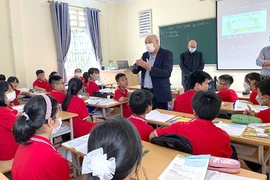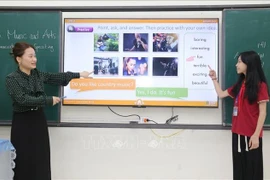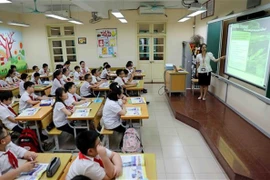
Hanoi (VNA) – The Government's Decree No. 222/2025/ND-CP on teaching and learning in foreign languages at educational institutions, which took effect on September 25, 2025, is expected to improve students’ language proficiency and lay the groundwork for Vietnam’s deeper integration into global education.
In recent years, a number of schools, vocational institutions, and universities in Vietnam have piloted foreign-language teaching. However, legal provisions remained fragmented and inconsistent, resulting in uneven quality and scope across localities. The new decree provides a uniform legal framework, ensuring consistency and higher quality nationwide.
The decree aims to help learners access global knowledge through modern materials and teaching methods, standardize training quality so that degrees and skills are more widely recognised, and prepare students for working in international environments. Teaching in foreign languages must be based on social demand, learners’ consent, and quality assurance, contributing to promoting Vietnam’s education and cultural values abroad.
Teachers must meet strict foreign language proficiency requirements: at least Level 4 (equivalent to B2) under Vietnam’s six-level foreign language proficiency framework for primary and lower-secondary education, and at least Level 5 (equivalent to C1) for upper-secondary, vocational, and higher education. Those who studied full-time abroad or hold language-related degrees in Vietnam are exempt from these requirements.
The decree prioritises teaching subjects such as mathematics, natural sciences, technology, and informatics in foreign languages at the general education level. Nguyen Thi Minh Thuy, Principal of Nguyen Sieu Secondary and High School in Hanoi, said teaching these subjects in foreign languages is vital in the digital era, giving students direct access to global knowledge and the latest technologies. However, she also noted challenges, particularly in training teachers who must combine pedagogical expertise with international-standard language skills.
Teachers play a pivotal role
Dr. Nguyen Thi Mai Huu, Head of the National Foreign Language Project under the Ministry of Education and Training, stressed that making English a second language in schools is a major challenge. She highlighted the need for investment in teaching facilities, especially in remote areas. Thai Van Tai, Director of the ministry’s Department of General Education, said Vietnam will need about 12,000 more preschool English teachers, nearly 10,000 for primary schools, and at least 200,000 trained to teach other subjects in English by 2030.
Several schools have already piloted bilingual programmes. Nguyen Sieu School currently offers over 15 subjects in foreign languages, ranging from math and sciences to psychology, economics, and tourism. Meanwhile, the University of Languages and International Studies under Vietnam National University, Hanoi (VNU Hanoi), has begun introducing English as a second language across its affiliated secondary and high schools.
Tran Anh Phuong, a history teacher at the Foreign Language Secondary School under VNU, Hanoi, said she has integrated English naturally into her lessons by using it for universal terms and encouraging students to first master knowledge in Vietnamese before presenting it in English. This approach, she said, helps avoid rote translation and promotes genuine understanding.
Phan My Hanh, Deputy Director of the Department of Education and Training of Lang Son province, emphasised that not only English teachers but also subject teachers and administrators must improve their language capacity to support students in bilingual learning environments./.