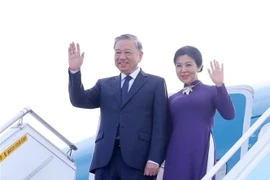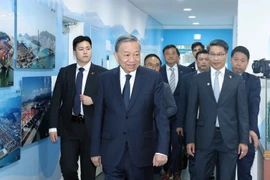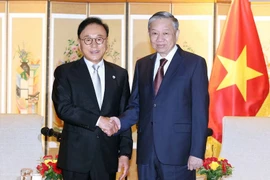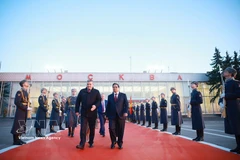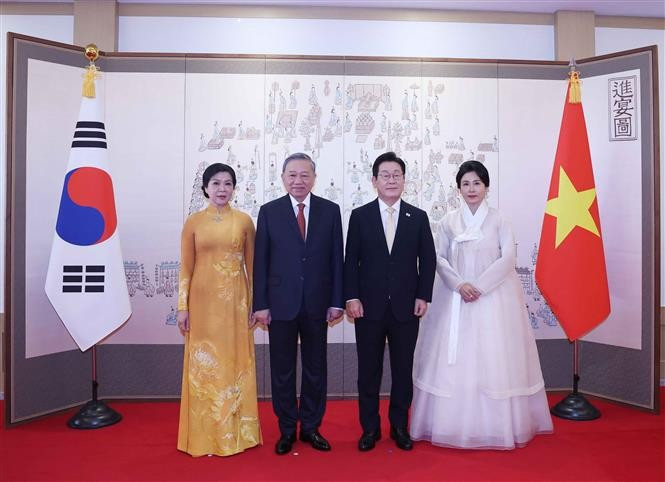
Hanoi (VNA) – The outcomes of the state visit to the Republic of Korea (RoK) by Party General Secretary To Lam and his spouse from August 10-13 are reflected in five major aspects, ranging from political trust and multifaceted cooperation to social foundations and multilateral engagement, according to Deputy Prime Minister and Minister of Foreign Affairs Bui Thanh Son.
Speaking to the press following the trip, Son said the first aspect is the deepening of political trust and the consolidation of good personal relations between the two countries’ top leaders. The visit resulted in important shared understanding on comprehensively advancing and further deepening the Vietnam – RoK Comprehensive Strategic Partnership.
Throughout talks and meetings, senior Korean leaders consistently viewed Vietnam as a top priority partner in implementing the RoK’s foreign policy in the region, expressing their readiness to accompany and support Vietnam in achieving its goal of becoming a developed, high-income country by 2045.
General Secretary Lam affirmed that Vietnam consistently treasures its relations with the RoK and wishes to make bilateral cooperation more practical, effective, close, and sustainable, commensurate with the Comprehensive Strategic Partnership framework. Both sides agreed to increase visits and exchanges between high-ranking leaders, expand cooperation through Party, State, Government, and parliament channels, and strengthen collaboration in all spheres under the Comprehensive Strategic Partnership framework.
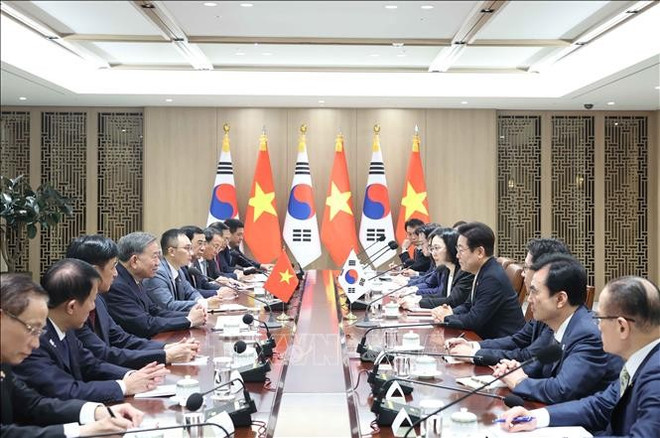
Second, the visit yielded significant results in terms of economy, trade, investment, science-technology, innovation, and human resources training. Amid global political and economic uncertainties, the Party chief proposed the RoK help shape a new strategic vision for the bilateral ties, shifting from economic cooperation to economic linkage, including joint development of production chains, mutual market access, and enabling Vietnamese enterprises to join RoK-led global supply chains. The two sides aim to raise bilateral trade to 150 billion USD by 2030 in a balanced and sustainable manner.
General Secretary Lam also called on Korean businesses to continue seeing Vietnam as a global production hub and strategic destination for establishing R&D centres, while expanding investment in key sectors and building integrated industrial complexes along value chains in Vietnam.
Third, the visit opened new cooperation opportunities in priority areas such as science-technology, strategic infrastructure development, high-tech agriculture, sustainable development, and climate change response. The two sides agreed to make science-technology, innovation, digital transformation, and human resources training new pillars of the bilateral ties, and to develop strategic industries and enhance collaboration in digital transformation, artificial intelligence, and digital innovation policies.
Fourth, the leaders of both nations underscored the importance of social foundations and people-to-people exchanges as a strong glue for friendship and mutual understanding. They committed to boosting cooperation in culture, education, human resources training, and people-to-people exchanges, supporting Vietnamese–Korean multicultural families, and stepping up locality-to-locality cooperation. The two sides agreed to extend their memorandum of understanding on sending and receiving workers under the RoK’s Employment Permit System (EPS), to promote culture-sport-tourism exchanges, and to simplify travel procedures for their citizens.
On this occasion, General Secretary Lam highly appreciated the contributions by over 350,000 Vietnamese people living in the RoK, and called on the host country to create the most favourable conditions for them to live and work stably, and to contribute more to the bilateral ties in the new period.
Fifth, in the multilateral arena, both sides agreed to work closely together and enhance mutual support at international and regional forums such as the Association of Southeast Asian Nations (ASEAN), the United Nations, the Asia-Pacific Economic Cooperation (APEC), and the Mekong sub-region, while actively joining international efforts to address traditional and non-traditional security issues as well as global challenges. They also exchanged views on regional and international matters of mutual concern, and pledged to support each other in successfully hosting the APEC Economic Leaders' Meetings in the RoK this year and in Vietnam in 2027.
Son added that during the visit, the two sides signed 50 cooperation documents between ministries, agencies, organisations, enterprises, and localities covering a wide range of areas such as energy, industry, digital infrastructure, digital transformation, finance, banking, services, culture, tourism, high-quality human resources training, and locality-to-locality cooperation. Regarding specific orientations Vietnam will take to implement the agreements reached between General Secretary Lam and the Korean leaders during the visit, Son stated that, in line with the spirit of the joint statement and the outcomes of this visit, Vietnam and the RoK will continue to increase exchanges and meetings between senior leaders to deepen political trust and friendship between the leaders and people of both countries via cooperation channels of the Party, Government, parliament, ministries, localities, and people-to-people exchanges. After his talks with President Lee Jae Myung, General Secretary Lam instructed Vietnamese ministries and localities to review the effectiveness of existing cooperation mechanisms, propose new dialogue frameworks where needed, and promptly address any issues that may arise in cooperation.
Under the joint statement on deepening the Vietnam - RoK Comprehensive Strategic Partnership, the two sides will work closely to turn high-level consensus and signed agreements into concrete actions. Science and technology cooperation will be elevated as a new pillar of the relationship. In economy, trade, and investment, the two countries aim to achieve 150 billion USD in bilateral trade by 2030 in a balanced and sustainable way, while continuing to create favourable conditions and resolve difficulties for Korean investors in Vietnam and support Vietnamese businesses investing in the RoK.
For culture, sport, tourism, and people-to-people exchanges, the RoK will share its experience with Vietnam in developing the entertainment industry and support Vietnam in building and implementing its cultural industry development strategy. The RoK will also support Vietnam in establishing a Vietnam Culture Centre in the RoK. On labour, education, and exchanges, the two sides will explore expanding job categories and increasing the number of Vietnamese workers in the RoK, and promote cooperation between Vietnamese educational institutes and leading Korean universities and enterprises to develop high-quality human resources in line with the development orientations of both sides.
General Secretary Lam urged friendship unions and organisations to enhance their role as effective bridges, connecting the unions, localities, and people of both countries more vibrantly and substantially, which aligns with the framework of the Comprehensive Strategic Partnership.
The two sides will continue to coordinate and support each other at regional and international forums such as ASEAN, the United Nations, Asia-Pacific Economic Cooperation (APEC), and the Mekong sub-region. They will work together to ensure the success of the Mekong–RoK Summit at the end of 2025, and the APEC Economic Leaders' Meetings in the RoK in 2025 and in Vietnam in 2027./.