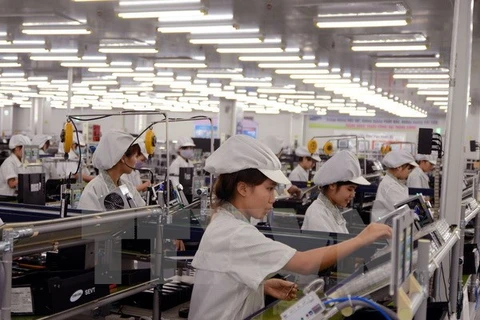
A motorcycle component factory in the Song Cong Indsutrial Park in Thai Nguyen province (Photo: VNA)
 Hanoi (VNA) – Improving human resources and revamping the labour structure are strategic solutions to improving the competitiveness of the economy in the context of deeper and wider international integration.
The decision to shift to the market economy in 1986 has been proved to be a sound move by the Party and State to mobilise all resources and potential to develop the economy. Notably, the country’s membership of the World Trade Organisation (WTO) in 2007 served as an important premise for economic growth.
During the past 30 years, a series of market-oriented reforms have been carried out, especially in the agricultural sector, the private economic sector, export and international economic integration. Vietnam’s economy has undergone a transition from self-sufficiency with low income to a multi-sectoral one.
As a result, the domestic labour market has been formed and developed on the right track. The State no longer played the role of directly creating jobs, instead it now creates the necessary environment for job generation while ensuring labourers’ rights through improving the legal system.
Acknowledging the market economy’s risks and ensuring the unemployed find jobs soon, the policy on unemployment insurance has been enforced.
The country has also focused on the labour export market, with several key markets seeing positive growth including Chinese Taiwan and Japan. The quality of Vietnamese workers abroad and the operations of labour export companies have improved.
Policies related to salaries, social and unemployment insurances, labour safety and hygiene, and management of foreign workers in Vietnam have been implemented well. The regional minimum wage in 2015 increased 2.3-fold compared with 2011, while the average monthly income in 2015 also rose 1.8 million VND (79.2 USD) per capita from 2011.
During that time, labour relations have also improved. As of October 2015, the number of strikes had fallen by 25 percent compared to the same period in 2011.
Thanks to new policies and mechanisms on employment and developing the labour market, more than 7.8 million jobs were created throughout the country from 2011-2015, helping reduce the unemployment rate to below 4 percent in urban areas.
Last year, over 1.6 million people found new jobs, of which approximately 115,000 people went abroad to work.
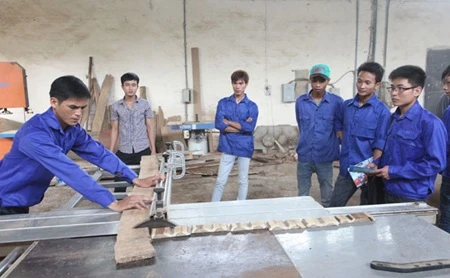
Vocational training has been linked to the demands of the market and businesses, and international integration requirements. The forms of vocational training have been diversified, with priority given to people in rural areas, ethnic minorities and people with disabilities.
In 2015, vocational training was provided for more than 2.1 million people. As of late 2015, the rate of trained workers reached 51.6 percent, up 11.6 percent from 2010.
However, several targets have yet to meet expectations. The proportion of labourers working in the agricultural sector and the non-official sector remains high, accounting for nearly 65 percent of the total.
The number of workers who have taken out social insurance accounts for only 20 percent of the total, posing a challenge for fulfilling the target of 50 percent by 2020.
Integration into ASEAN is also posing challenges for Vietnam as the newly-formed ASEAN Community will allow the free flow of labour among the bloc’s countries.
The Ministry of Labour, Invalids and Social Affairs forecasts that Vietnam will have 59.13 million labourers by 2020 and around 68 million labourers in 2030. In 2020, the rate of trained workers is expected to reach 70 percent.
To improve labour quality and utilise human resources effectively, the ministry will continue to update the legal system and align the domestic labour market with international integration requirements in order to ensure a modern, effective, competitive and equal labour market, thus contributing to fulfilling development targets in the 2011-2020 Socio-Economic Development Strategy.
It will also expand the labour export market, while intensifying management to protect the interests of Vietnamese workers abroad.
Attention will be paid to vocational training for rural workers, and building a vocational education network that matches the country’s socio-economic development strategy and human resources development plans.-VNA