Divestment plans at State-owned enterprises attract little attention

Many State-owned enterprises have announced their auction schedule for capital divestment plans, but not all of them are attracting customers.
Divestment plans at State-owned enterprises attract little attention ảnh 1A branch of Lien Viet Post Commercial Joint Stock Bank in the northern province of Bac Ninh. (Photo: bacgiang.gov.vn)
Hanoi (VNS/VNA) - Many State-owned enterprises have announced their auction schedulefor capital divestment plans, but not all of them are attracting customers.

Among the 122million shares of Lien Viet Post Commercial Joint Stock Bank (LienVietPostBankor LPB) brought to auction by the Vietnam Post on HNX recently, only 800 shareswere registered for purchase by a few individual investors.

With astarting price of up to 28,930 VND per share (1.27 USD), which is nearly 15 percenthigher than LPB's market price, the auction attracted few buyers. LPB sharesreceived attention for a few sessions after the information about the auctionwas officially announced, but quickly stagnated due to weak cash flow.

The recentauction of 35 million shares of Binh Duong Trade And Development JSC (TDC) witha starting price of 27,900 VND per share was also regarded as a failure as only50,000 shares were sold to four individual investors.

On auctionday, TDC's market price was 10 percent lower than the starting price of theauction, not to mention the time for the shares to be sent to the account tookup to a month or even a few months, making investors displeased.

The auction ofthe capital portion of the State Capital Investment Corporation (SCIC) at Chau DucUrban Development and Construction Joint Stock Company was also recentlycancelled due to no investors participating.

NTP stock ofTien Phong Plastic JSC has reached a price of approximately 70,000 VND pershare at the end of January 2021 after SCIC announced a plan to divest capitalin February, but the divestment has not yet been confirmed and NTP shares havedropped 10 percent from its market price.

Similarly, BMIshares of Bao Minh Corporation also touched 45,800 VND per share, but now aretrading around 38,000 VND per share.

At the end oflast week, some investors registered to buy shares of HUD1 Investment andConstruction JSC (HUD1) without carefully considering the health of thisbusiness. Interested investors must register to buy the whole lot with astarting price of 75 billion VND, equivalent to the market price of HUD1 beingtraded on the floor.

Bad debts,member enterprises that have ceased operations, and suspended projects are thethree most obvious disadvantages in this enterprise. In the 2017-2020 period,the debt/total assets and debt/equity ratios of HUD1 continuously increased,reaching nearly 96 percent and 582 percent in 2020.

The investmentin HUD 1.02 Investment and Construction Joint Stock Company (12.75 trillion VND)and the investment in CIC DECOR Architecture and Construction Joint StockCompany (1 billion VND) have not brought about profits, causing HUD1 to make aprovision for risks of 4.43 billion VND.

Currently,both of these units are temporarily suspending production and businessactivities, so the ability to recover capital at these enterprises has not beendetermined.

The long-termcapital contribution investment with Dai Thien Loc Company of 13 billion VND toimplement the Lien Bao-Bac Ninh project which has lasted since 2011 also facespotential risks in terms of investment./.
VNA
See more

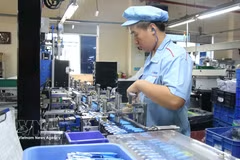
A ballpoint pen production line at Thien Long Group in Ho Chi Minh City. (Photo: VNA)

Ho Chi Minh City steps up efforts to unlock growth drivers

The municipal People's Committee has identified the year-end period as crucial to mobilising more than 1.2 quadrillion VND (46.7 billion USD) for development investment, boosting traditional and new growth drivers, and removing bottlenecks related to land, planning, site clearance, construction materials and investment procedures.

At the business networking programme between Vietnamese and Polish enterprises in Ho Chi Minh City on November 10. (Photo: sggp.org.vn)

Poland promotes trade, culinary culture in Ho Chi Minh City

The “Taste Europe!” programme is part of a series of promotional activities aimed at demonstrating that European food products represent not only high quality but also a commitment to environmental responsibility, Polish Ambassador to Vietnam Joanna Skoczek said.

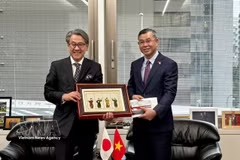
Vietnamese Minister of Finance Ngo Van Tuan (R) presents a souvenir to Chairman of the Board of Directors of the Japan Bank for International Cooperation (JBIC) Maeda Tadashi in Tokyo on November 10. (Photo: VNA)

Vietnam strengthens cooperation with Japan Bank for International Cooperation

Tuan expected JBIC to help promote investment flows from Japan into Vietnam, with priority given to large-scale projects in green energy, smart infrastructure, semiconductors and high-tech electronics, as well as projects with spillover effects that enable Vietnamese businesses to participate more deeply in global supply and value chains.

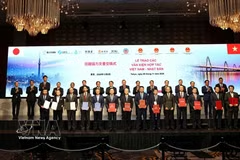
General Secretary of the Communist Party of Vietnam Central Committee and President To Lam and officials witness the exchange of cooperation documents at the Vietnam-Japan Public-Private Forum on Economic, Science and Technology Cooperation in Tokyo on November 9, 2026. (Photo: VNA)

Petrolimex steps up strategic cooperation with Japan’s ENEOS

Under the MoU, the two sides will focus on ensuring and diversifying fuel supplies to improve their responsiveness to supply chain fluctuations. They will also explore cooperation opportunities in high-quality petroleum products, petrochemicals and new energy solutions.

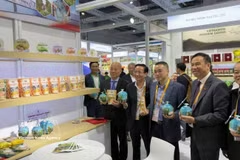
Vietnamese Consul General in Shanghai Tran Huy Hung (centre) and Vu Ba Phu (first, left), General Director of the Vietnam Trade Promotion Agency under the Ministry of Industry and Trade, visit Vietnam's trade pavilion at the 2026 China International Import Expo (CIIE). (Photo: VNA)

Vietnamese goods make strong impression at CIIE 2026

A wide range of products is on display, particularly processed fruits and vegetables, dairy products, bird's nest, coffee, tea and canned foods. Participating businesses focus on deep processing, modern packaging and strict compliance with China's food safety and hygiene standards.